Educational illustration · Read the evidence and limitations below.
Medical · What is Retatrutide?
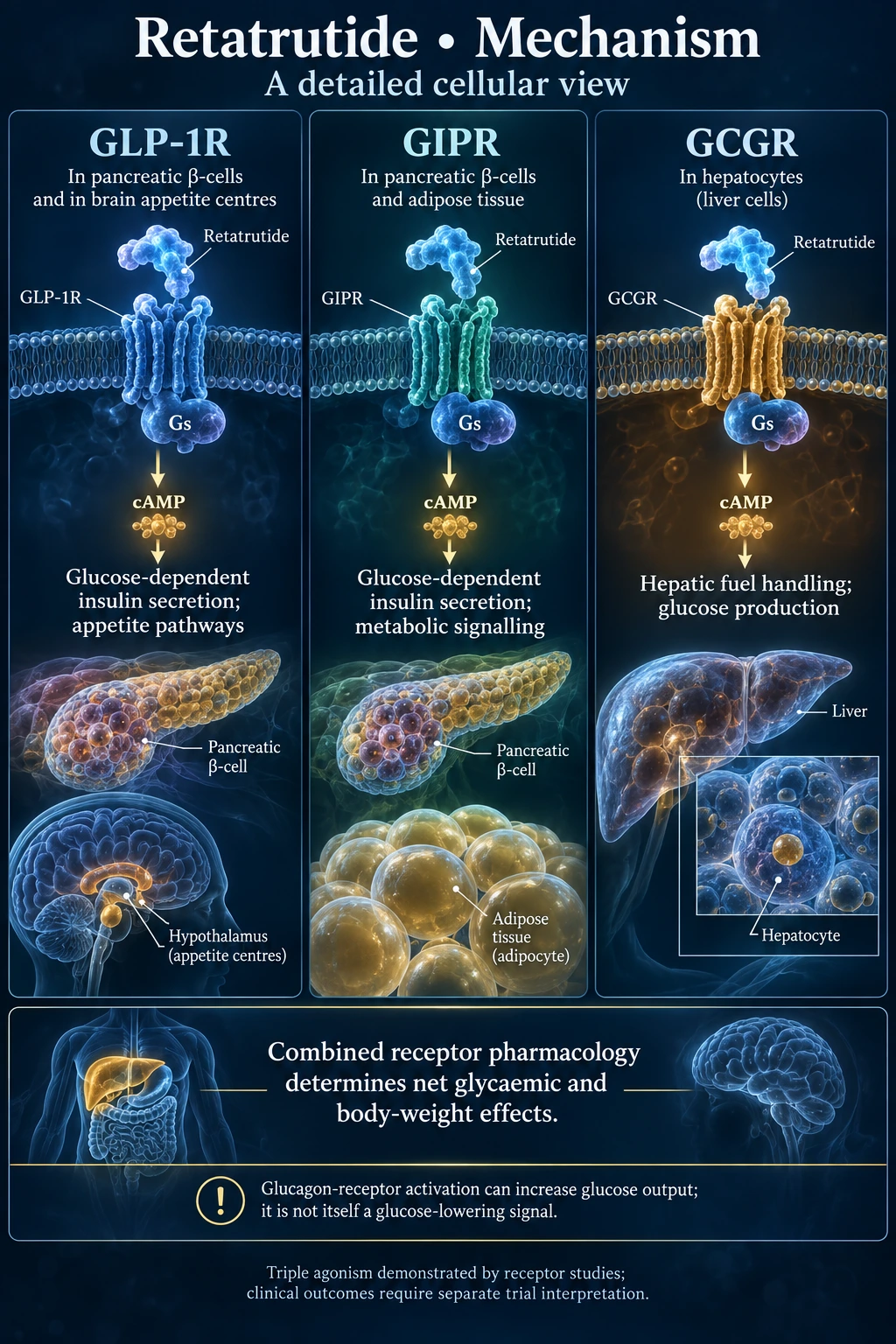
Retatrutide is an investigational peptide designed to act on three hormone receptors: GIP, GLP-1 and glucagon. It is discussed mainly for weight management and metabolic health. The nickname “triple agonist” refers to those three targets; it does not mean that it is three separate peptides mixed in a vial.
The attraction is a combination of appetite effects and changes in how the body manages energy. Early clinical trials reported substantial weight loss, which brought retatrutide into mainstream peptide discussions. A research-labelled vial, however, is not the same product as the material supplied under a clinical-trial protocol.
Understanding retatrutide starts with understanding what someone wants to change: hunger, body weight, glucose control or physical function. These outcomes overlap, but they are not identical, and they should not all be reduced to the number on a scale.
Medical · Benefits and common reasons for interest
Weight management
A phase 2 trial in 338 adults reported average weight loss of 24.2% at 48 weeks in its 12 mg group, compared with 2.1% with placebo. Lower-dose groups also lost weight. These results explain the interest, but the 12 mg figure was a study target reached through a protocol, not a starting dose for a new user.
Metabolic health
Separate research in type 2 diabetes reported improvements in blood glucose. This matters because a treatment can affect glucose independently of visible weight loss. People already using insulin or other diabetes medicines cannot judge safety only by appetite.
Energy expenditure
The glucagon component is intended to contribute to energy regulation beyond appetite. That does not make retatrutide a workout replacement or guarantee preserved muscle. A fall in weight can include both fat and lean tissue.
Medical · How does it work?
GIP and GLP-1 help coordinate the body's response to food. Glucagon helps mobilise stored energy, including glucose from the liver. Retatrutide combines activity at all three receptor systems in one molecule, aiming for a useful balance rather than simply pushing every signal as high as possible.
This is why descriptions such as “three times stronger” are misleading. Receptor activity, dose, tolerability and the person's health all matter. A different receptor balance may create different benefits and side effects rather than a fixed multiplier of another peptide.
Changes in appetite can happen before the eventual weight result. Using the first few days' sensations to predict months of benefit is unreliable, particularly with a long-acting compound.
Medical · Retatrutide, Tirzepatide and combinations
Tirzepatide targets GIP and GLP-1; retatrutide also targets glucagon receptors. Semaglutide targets GLP-1. They are not equivalent milligram for milligram, and switching between them is not a concentration calculation.
Combining retatrutide with another appetite peptide can make nausea, poor intake and other effects harder to interpret. A claim of “synergy” needs evidence for the actual combination. It is not a reason to put different compounds in one syringe or transfer a titration schedule from another molecule.
Medical · Dosing and concentration
The phase 2 obesity study tested weekly subcutaneous target doses of 1, 4, 8 and 12 mg. Some groups started at 2 mg and others at 4 mg before reaching their assigned target. Gastrointestinal effects were generally less troublesome with the lower starting strategy. These are details of that trial, not a universal retatrutide dosing ladder.
Online schedules often omit eligibility criteria, dose-hold rules, monitoring and the exact formulation. Those missing parts matter as much as the target milligrams. Retatrutide dosing for an individual belongs in a supervised research or clinical plan, with clear instructions for adverse effects and interruptions.
For concentration arithmetic, amount equals concentration multiplied by volume. A hypothetical 5 mg/mL solution contains 1 mg in 0.2 mL. This demonstrates measurement only. A U-100 syringe would mark that volume as 20 units, but those markings are not retatrutide potency units. Changing vial strength requires recalculating the volume.
Medical · Preparation and reconstitution
A lyophilised vial contains freeze-dried peptide. Reconstitution is the process of dissolving it using a specified liquid and final volume. The necessary details include the exact compound, diluent compatibility, concentration, container and preparation limit.
Bacteriostatic water is frequently mentioned in peptide discussions. Its preservative does not establish retatrutide stability, remove impurities or sterilise the contents of a research vial. An internet instruction to add a convenient amount of water is not a substitute for formulation documentation.
Research participants should use the supplied study preparation and instructions. Do not add water to a ready-made solution, mix it with another peptide or infer suitability for injection from a clear appearance. Keep the batch, concentration, preparation date and assigned discard date in the record.
Medical · Administration
The weight-management trials cited here used subcutaneous administration. This places a formulation beneath the skin, rather than into a vein or muscle. Research participants receive instructions for their supplied device, site rotation and handling.
An abdominal injection does not target abdominal fat. Site choice is about suitable tissue and reliable delivery, not spot reduction. Avoid damaged or inflamed skin, use new sterile equipment and dispose of sharps immediately. A clinician should demonstrate the actual device; needle length, insertion technique and delivery checks differ between pens and syringes.
If delivery is uncertain, do not automatically repeat the amount. Record the event and contact the study or treating team. Long-acting exposure makes accidental repeat dosing particularly important.
Medical · Oral versus subcutaneous delivery
Subcutaneous delivery avoids digestive breakdown. An ordinary swallowed retatrutide preparation would face stomach acid, enzymes and the intestinal absorption barrier. A capsule's stated milligrams therefore cannot be treated as the same amount delivered into the circulation.
Some peptides are investigated for a local effect in the gut despite low bloodstream absorption. That is not the established purpose of retatrutide. Its clinical programme concerns systemic receptor activity, and an oral product would need its own delivery and clinical evidence.
Medical · Half-life
Retatrutide is long acting, with a reported half-life of roughly six days in early clinical development. Weekly doses overlap. A change in appetite over a few hours does not mean the previous dose has cleared, and a half-life is not a reason to add an extra dose.
Medical · Storage
Use the temperature and discard instructions for the exact study or documented preparation. Retatrutide's name alone does not specify how long a reconstituted vial remains stable. Refrigeration, protection from light and avoidance of freezing may be part of instructions, but none supplies a missing shelf life.
Record opening or preparation dates and any prolonged heat exposure. Do not reuse another GLP-1 medicine's room-temperature allowance for retatrutide. Keep the container labelled and away from children, and avoid moving the solution into an unlabelled syringe for long-term storage.
Medical · Contraindications and side effects
Gastrointestinal symptoms were common in the phase 2 study, and increases in heart rate were observed. A racing heart, dizziness, persistent vomiting or inability to eat adequately should not be dismissed as evidence that the peptide is working.
Pregnancy, breastfeeding, significant gastrointestinal disease, previous pancreatitis, gallbladder problems and glucose-lowering treatment require individual review. Research exclusion criteria are not a complete prescribing label, and the absence of a listed interaction is not proof that combinations are safe.
Seek prompt assessment for severe abdominal pain, fainting, dehydration or a serious allergic reaction. Tell healthcare teams about retatrutide before sedation, surgery or new treatment, including the exact preparation and date of the last administration.
Medical · Nutrition and supplement support
Protect food intake as appetite changes
When food becomes less appealing, set up small meals that still provide protein, energy and variety. A yoghurt with fruit, eggs with toast, tofu with rice or fish with potatoes may be more manageable than one large meal. The goal is adequate nourishment, not the longest possible period without hunger.
Strength matters alongside weight
Resistance exercise and sufficient protein help support muscle during weight reduction. Record functional changes such as walking tolerance or usual training performance. If these deteriorate while weight falls quickly, review food intake and treatment rather than celebrating the scale alone.
Supplements with a specific purpose
A protein supplement can fill a practical food gap. Vitamin D, B12, iron or calcium should be considered according to diet, risk factors and testing. There is no demonstrated retatrutide-specific vitamin stack. Iron may aggravate constipation, and large magnesium doses can worsen diarrhoea.
Hydration and stimulants
Vomiting and diarrhoea can cause fluid loss. Ongoing symptoms need assessment, especially with kidney disease. Avoid using high-caffeine “fat burners” to compensate for fatigue; they can complicate heart-rate symptoms and conceal under-eating. Electrolytes are not a substitute for medical attention when fluids cannot be retained.
Medical · Tracking progress and common questions
Record the study or clinical plan, actual amount, preparation, appetite, bowel symptoms and resting pulse when appropriate. Keep weight measurements consistent and note changes in strength and daily energy.
“Is faster weight loss always better?” No: tolerability, muscle, nutrition and health outcomes matter. “Does triple agonist mean I need three peptides?” No: retatrutide is one molecule. “Can a published target dose be used as a starting dose?” No: a target is only one part of the study protocol and does not define an individual's treatment.
Medical · Medical
The cited studies concern defined trial formulations and participants. Their doses and results should be read as trial findings, not instructions for research-labelled material.