Educational illustration · Read the evidence and limitations below.
What is Retatrutide?
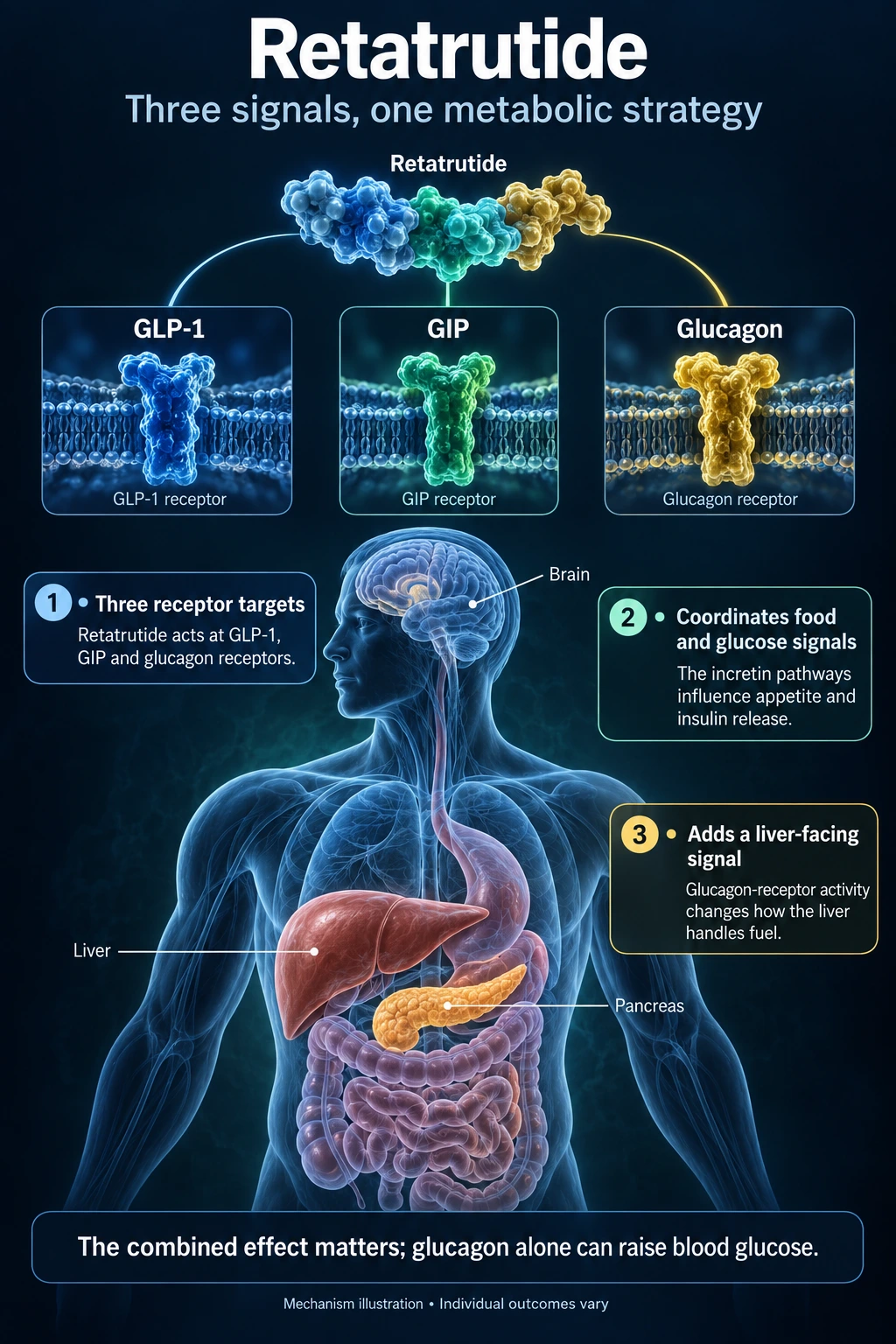
Retatrutide is a peptide designed to activate three hormone receptors: GIP, GLP-1 and glucagon. Its development focuses on weight reduction and metabolic disease. The addition of glucagon-receptor activity makes it different from both semaglutide and tirzepatide.
“Triple agonist” means one molecule activates three receiving systems. It is not a three-peptide blend. Its experimental use for weight loss is based on this coordinated action, but results from a defined clinical formulation do not establish the performance or quality of an unrelated research-labelled vial.
Appetite and energy use are separate parts of the idea
The GLP-1 and GIP pathways contribute to appetite and glucose-related responses. Glucagon has a different role in fuel handling, particularly in the liver, and its contribution to energy expenditure is part of the development rationale. This creates a broader metabolic approach than describing the peptide only as an appetite suppressant.
That does not mean retatrutide automatically makes someone feel more energetic. Energy expenditure is how much energy the body uses; subjective energy is how alert or capable someone feels. A treatment can influence metabolism without producing a stimulant-like sensation.
Why glucagon is not simply a contradiction
Glucagon can raise blood glucose by signalling the liver to release stored fuel. Adding its receptor activity to a metabolic treatment may therefore sound counterintuitive. The key is that the whole molecule acts across several pathways at once. Its overall effect cannot be predicted by considering glucagon alone.
This is also why a receptor count is not a dosing formula. The strength and balance of activity at each receptor matter, as do duration and the person's health. Three targets do not mean three times the benefit or an automatic reason to prefer the peptide.
What it is used for
Weight reduction and body composition
The principal development goal is substantial weight reduction. Reduced appetite can lower energy intake, while the glucagon-related component adds interest in fuel use. The resulting weight change still includes more than one tissue compartment; preserving muscle and useful function remains important.
A smaller waist and a lower body weight measure different things. Fluid balance and bowel contents can move the scale quickly, while body-fat change is assessed over a longer period. Rapid loss is not automatically preferable if food intake, hydration or strength deteriorate.
Liver fat and metabolic health
Retatrutide is also being investigated for conditions involving excess liver fat and abnormal metabolism. Liver fat is stored within the liver, whereas visceral fat surrounds organs inside the abdomen. They can coexist, but they are not the same measurement.
A reduced waist does not by itself establish that liver inflammation or scarring improved. Those are separate aspects of liver health. This distinction allows the profile to discuss a promising area of use without turning a change in body shape into a claim about organ recovery.
Glucose regulation
Its combined receptor activity has also been investigated in type 2 diabetes. Changes in glucose regulation can accompany the direct hormonal effects and changes in body weight. They should not be interpreted independently of existing glucose-lowering treatment.
An appetite-reducing effect may change how much someone eats before the rest of their medicines have been adjusted. That makes medication context important. The peptide's multiple targets do not remove the need to understand interactions and the risk of low glucose with other treatments.
Fitness and longevity claims
Improved mobility may follow weight reduction, but retatrutide is not a direct endurance or muscle-building treatment. Likewise, interest in metabolic health does not establish that it extends life or reverses ageing. Those are different outcomes from losing weight or reducing liver fat.
The useful goal is specific: weight management, a metabolic condition or another assessed problem. A broad promise of “optimisation” gives a reader less information than explaining which body process is intended to change.
How it works
Coordinated receptor activity
The GLP-1 receptor participates in appetite, stomach-emptying and pancreatic responses. The GIP receptor contributes to nutrient-related signalling. The glucagon receptor influences hepatic fuel handling and is relevant to the molecule's intended energy-expenditure effects.
These actions interact. They cannot be recreated by assuming that separately adding three substances would produce the same result. Nor can an amount of retatrutide be converted directly into an equivalent amount of tirzepatide or semaglutide by comparing milligrams.
Extended activity and changing response
Retatrutide is designed for prolonged activity. This means the experience after one administration can overlap with the timing of subsequent administrations. A change in hunger from one day to the next is not a precise measure of circulating concentration.
Gradual changes in exposure during development programmes are intended partly to manage tolerability. They are not evidence that every user should advance on the same schedule or pursue the highest amount. Preparation, response and adverse effects all matter.
Gastrointestinal and cardiovascular observations
Nausea, vomiting and other digestive effects are important tolerability considerations. Heart-rate increases have also been observed during development. A faster pulse should not be described as proof that more fat is being burned or interpreted as a desirable performance effect.
Persistent symptoms, inadequate intake or marked changes in how someone feels require attention in their own right. Recording them alongside the intended outcome keeps the assessment focused on the whole experience rather than weight change alone.
What distinguishes this peptide
Retatrutide's defining feature is the combination of three receptor activities in one molecule. It offers a distinct approach to appetite and metabolism, but its identity, formulation and clinical context still determine what can reasonably be expected. The Medical tab provides the development evidence separately from this plain-language explanation.