Educational illustration · Read the evidence and limitations below.
Medical · What is Tirzepatide?
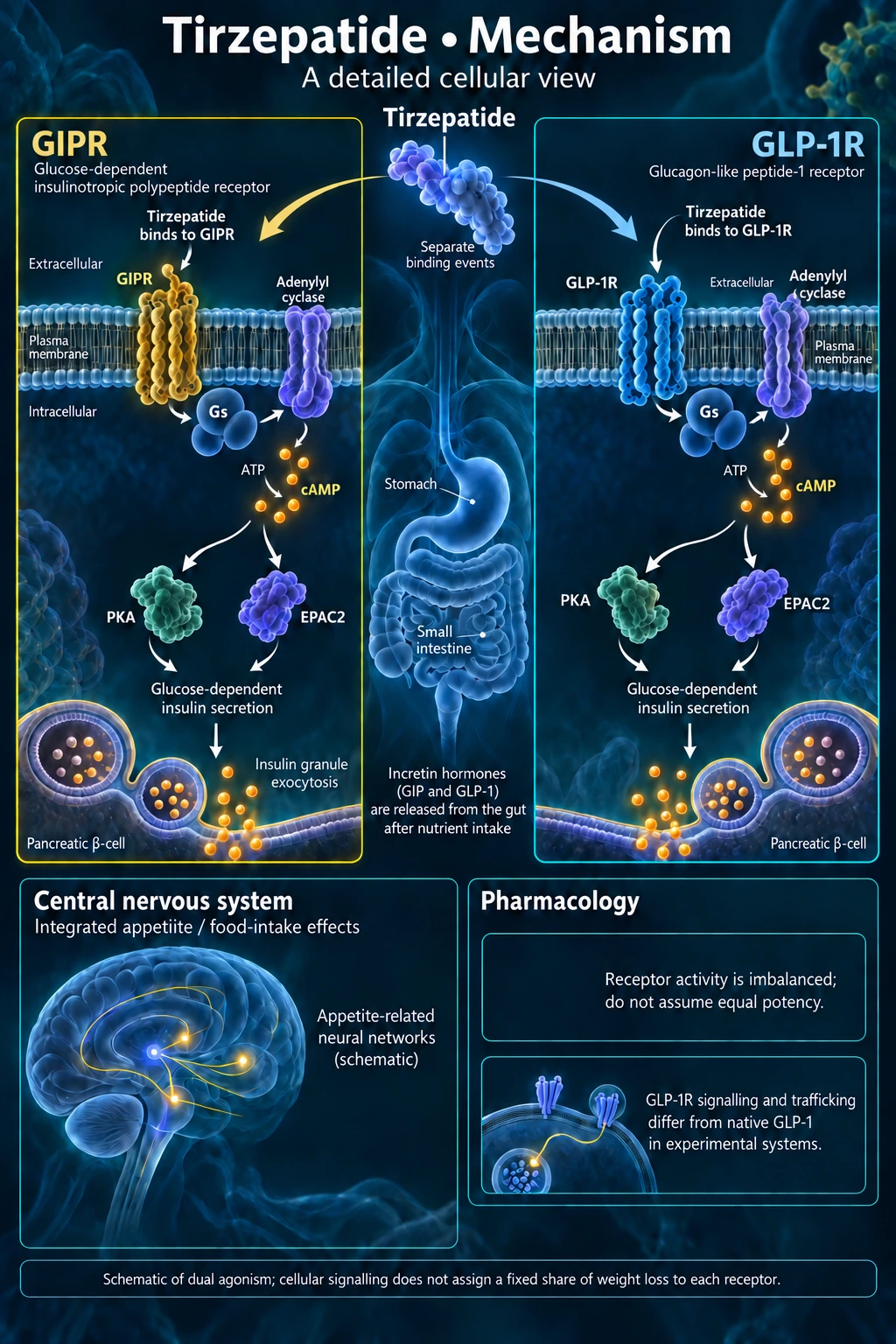
Tirzepatide is a peptide that acts on two hormone systems involved in appetite and blood sugar: GIP and GLP-1. People usually know it for making hunger easier to manage, reducing persistent food cravings and helping with weight loss or type 2 diabetes. It is commonly described as a dual agonist, meaning that one molecule activates two different receptors.
Its effects are broader than simply keeping food in the stomach longer. It changes meal-related signals between the gut, brain and pancreas. For many users, the practical change is being able to eat a smaller meal and feel satisfied rather than spending the day fighting appetite.
Tirzepatide appears in prescription pens and vials as well as research-labelled preparations. Understanding the peptide does not remove the need to identify the exact solution, strength and device. Two vials can contain the same total milligrams but deliver very different amounts per syringe marking.
Medical · Benefits and common reasons for interest
Weight management
In SURMOUNT-1, adults with obesity or overweight plus a weight-related condition, without diabetes, received weekly tirzepatide or placebo alongside lifestyle support. Mean weight reductions at 72 weeks ranged from about 15% to 20.9% across the active doses, versus 3.1% with placebo. These are trial averages, not targets every person should chase.
Glucose and metabolic health
Tirzepatide helps regulate blood glucose in type 2 diabetes. Weight change, glucose control and how someone feels may improve at different rates. Those already taking glucose-lowering medicines need an agreed monitoring plan because their requirements can change.
Less food preoccupation
Some people describe reduced “food noise”: repeated urges or thoughts about eating. This can make meal planning easier, but it should not become a goal of suppressing all hunger. Eating enough to maintain strength, hydration and daily function still matters.
Medical · How does it work?
GIP and GLP-1 are hormones released in response to food. Tirzepatide activates receptors for both, influencing insulin release and appetite regulation. Insulin helps move glucose from blood into tissues where it can be used or stored.
Its effect on stomach emptying can also change how quickly a meal or an oral medicine moves through the digestive system. This helps explain why gastrointestinal symptoms and interactions involving oral medicines are relevant. More nausea does not necessarily mean a better metabolic response.
Calling tirzepatide a “fat burner” misses the main point. The useful change is in appetite and metabolic regulation over time, not selective removal of fat from an injection site or a dramatic increase in energy immediately after a dose.
Medical · Tirzepatide and other appetite peptides
Semaglutide acts at GLP-1 receptors; tirzepatide acts at GIP and GLP-1 receptors; retatrutide also targets the glucagon receptor. Cagrilintide belongs to a different, amylin-related pathway. These are different molecules, not successive concentrations of one medicine.
A milligram of one is not equivalent to a milligram of another. Combining appetite peptides can also compound side effects. A weight plateau alone is not a reason to add another compound, and published combination research should not be turned into a home mixing recipe.
Medical · Dosing and concentration
The cited adult tirzepatide injection instructions start at 2.5 mg once weekly for four weeks, then 5 mg weekly. Subsequent increases are in 2.5 mg steps after at least four weeks at the current dose, if needed and tolerated; the labelled maximum is 15 mg weekly. The starting amount is for initiation, not an instruction to remain indefinitely or advance automatically.
The same milligram dose can come in different volumes. Current presentations include single-dose and multi-dose products, so a remembered “half a millilitre” rule is unreliable. Read milligrams per dose and milligrams per millilitre separately.
For arithmetic only, a 10 mg/mL solution contains 2.5 mg in 0.25 mL. A U-100 syringe marks that volume as 25 units; tirzepatide itself is prescribed in milligrams, not insulin units. Have the actual concentration and measuring device checked before using a vial. Do not use pen clicks as a substitute for documented dose instructions.
Medical · Preparation and reconstitution
Ready-made tirzepatide solutions are already formulated. A vial is not necessarily lyophilised, and a multi-dose vial is not the same as a single-dose vial. Do not add bacteriostatic water to a ready-to-use medicine.
Lyophilised means freeze-dried. To prepare such material correctly, the instructions must specify a compatible diluent, exact liquid volume and final concentration. Bacteriostatic water usually contains benzyl alcohol, which slows growth of some bacteria; it does not make contaminated material sterile or demonstrate that a research preparation is fit for injection.
Keep the compound name, total amount, concentration, route, opening date and discard date together. “Add two mL” without the vial strength is incomplete information. If two people use different vial strengths, identical syringe markings can deliver different doses.
Medical · Administration
Subcutaneous injection places medicine in the fatty layer beneath the skin, commonly at the abdomen, thigh or upper arm according to the presentation's instructions. Rotate sites. Avoid inflamed, bruised or damaged skin, and never inject into a lump simply because it feels less sensitive.
Use clean hands, a clean work area and new sterile equipment. The device determines whether a separate needle is required and how long it should remain in place. Never share pens or syringes. Dispose of used needles in a sharps container rather than placing loose sharps in household rubbish.
Timing relative to meals is not a substitute for consistent weekly records. If medicine leaks or delivery is uncertain, do not immediately repeat the whole dose. Record what happened and obtain product-specific advice.
Medical · Oral versus subcutaneous delivery
Subcutaneous tirzepatide bypasses the stomach and intestinal enzymes that break down many peptides. Ordinary oral capsules or drops do not reproduce the exposure of a studied injection. An oral absorption percentage needs evidence for that particular formulation, not a comparison based only on its label strength.
A peptide can sometimes be delivered orally to act locally on gut tissue, but tirzepatide's established clinical use relies on systemic hormone-receptor effects. Reduced oral absorption is not evidence that an unstudied oral preparation will provide a useful local intestinal treatment.
Medical · Half-life
Tirzepatide's half-life is approximately five days. Weekly doses overlap, so levels build over several weeks. Side effects may take time to settle after a change; the previous dose is not gone the next morning.
Medical · Storage
Refrigeration and room-temperature allowances differ between presentations. The cited single-dose product permits storage at up to 30°C for a total of 21 days. Multi-dose presentations have different opening and discard rules. None of these allowances can be transferred to an unidentified reconstituted vial.
Protect the actual product as directed, avoid freezing and keep a dated record of any temperature excursion. Do not place it directly against an ice pack. A travel pouch can prevent light exposure but cannot prove that its contents remained within temperature limits.
Medical · Contraindications and side effects
The cited label contraindicates use with personal or family medullary thyroid carcinoma, MEN2 or serious hypersensitivity. Nausea, diarrhoea, vomiting and constipation are common concerns. Persistent severe abdominal pain, dehydration or a serious allergic reaction requires medical assessment.
Tell the clinician about severe stomach-emptying problems, pancreatitis, gallbladder disease and glucose-lowering medicines. Pregnancy and planned pregnancy require review. Oral hormonal contraceptives need particular attention: the label advises a non-oral method or added barrier protection for four weeks after initiation and after each dose escalation.
Inform an anaesthesia team before surgery or deep sedation. Delayed stomach emptying can matter even when usual fasting instructions were followed. Never stop essential oral medicines on your own; discuss whether absorption or timing needs review.
Medical · Nutrition and supplement support
Protein without oversized meals
Try placing a manageable protein source in each meal rather than saving most food for one large dinner. Yoghurt, eggs, tofu, fish, beans and poultry provide options with different textures. If appetite is low, a modest protein drink may be more tolerable than a very large meal. It supplements food; it does not replace all the fibre and micronutrients of a varied diet.
Digestive comfort
Eat slowly and pause at comfortable fullness. Smaller portions and less fatty food may help when nausea or reflux is troublesome. Fibre supports bowel regularity, but large sudden increases can worsen bloating. Persistent constipation, severe distension or vomiting needs assessment rather than repeated experiments with laxative supplements.
Nutrient gaps
A sustained drop in food intake can reduce iron, B12, calcium or other nutrient intake, depending on the diet. Choose supplements for a demonstrated gap. Vitamin D does not directly increase tirzepatide's activity, and B12 is not a mandatory companion. Iron may worsen constipation, while magnesium-containing products may worsen diarrhoea.
Muscle and hydration
Resistance exercise and adequate food support muscle during weight loss. Creatine can be discussed for exercise goals, but it is not a tirzepatide enhancer and may change scale weight through water retention. If vomiting or diarrhoea causes fluid loss, seek advice on rehydration. People with kidney or heart disease need individual guidance before increasing electrolyte supplements.
Medical · Tracking progress and common questions
Log weekly amount, formulation, dose changes, appetite, bowel symptoms and hydration. Compare weight under similar conditions rather than reacting to every daily fluctuation. Note strength and energy as well as body measurements.
“Does stronger appetite suppression mean I should eat as little as possible?” No: under-eating can produce weakness and nutrient gaps. “Can I change to another peptide at the same milligrams?” No. “Should I take extra because hunger returns before the next dose?” Hunger alone is not a dosing instruction. Review the overall pattern and the current plan with the clinician.
Medical · Medical
Tirzepatide outcome studies use defined products and populations. The cited label contains separate device and storage instructions; read the section matching the actual presentation.