Educational illustration · Read the evidence and limitations below.
What is Tirzepatide?
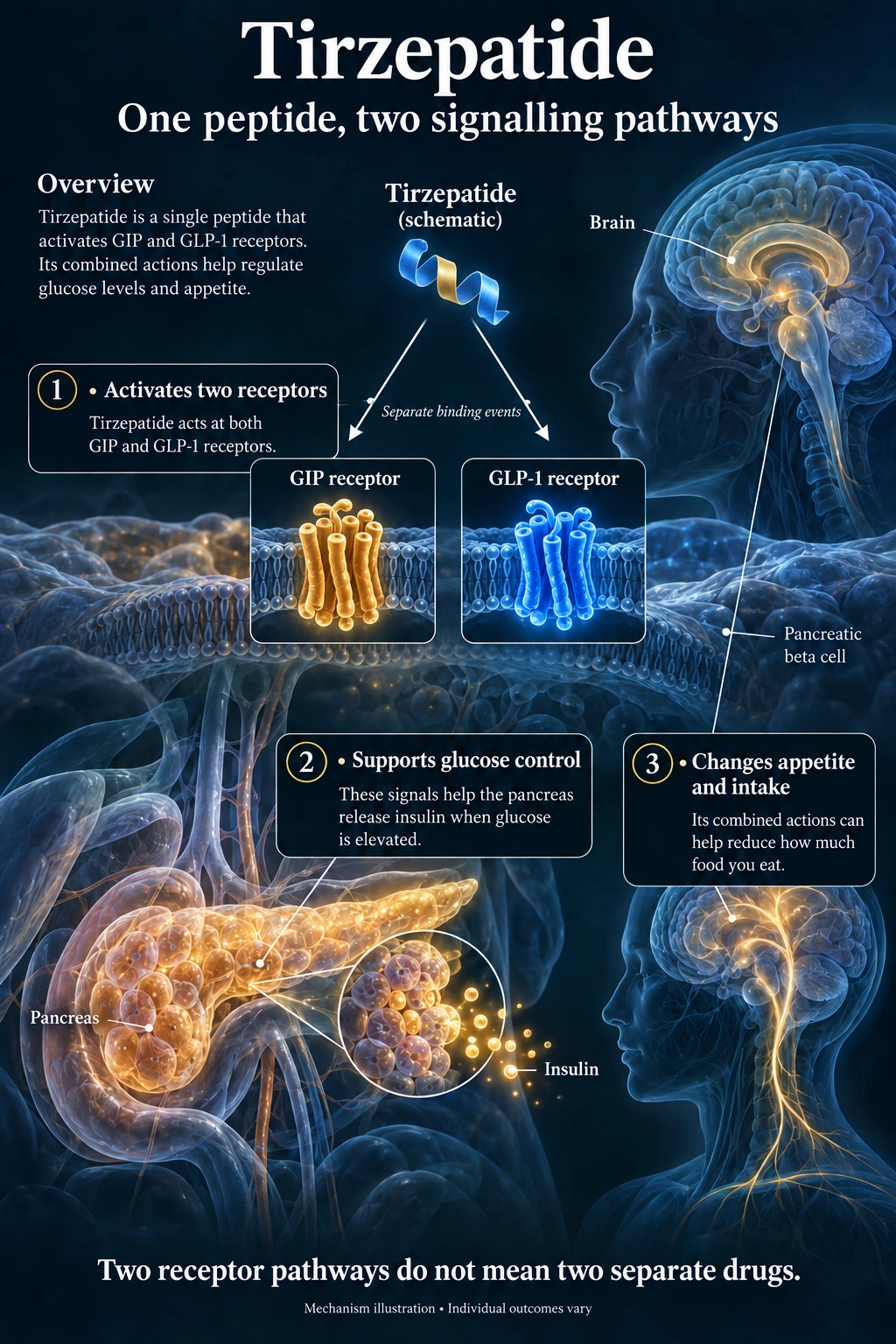
Tirzepatide is a peptide that activates two hormone receptors: GIP and GLP-1. Both belong to signalling systems involved in the body's response to food. Tirzepatide uses these pathways to influence appetite and blood glucose, and it is used for substantial weight reduction as well as diabetes care.
Its practical appeal in weight management is reduced hunger and an earlier sense that a meal is enough. It does not need to cause nausea to be effective. A comfortable reduction in appetite is different from being unable to eat because of unpleasant digestive symptoms.
What a dual agonist means
A receptor is a receiving point on a cell. An agonist activates it. “Dual agonist” means tirzepatide activates two receptor types; it does not mean there are two separate peptides mixed together in the vial. The two activities are built into one molecule.
This distinguishes it from semaglutide, which primarily activates the GLP-1 receptor, and retatrutide, which adds glucagon-receptor activity. The number of receptors is a description of mechanism, not a universal ranking of suitability or tolerability.
The molecule and the preparation
Tirzepatide is the active peptide used in pharmaceutical products with different approved applications. The molecule's appetite and metabolic actions can be discussed directly without centring the brand. The actual preparation still determines how much is delivered and how it should be handled.
A vial's milligram content, the concentration after preparation and the volume drawn into a syringe are separate values. A research label does not establish equivalence to a finished pharmaceutical presentation. The Practical section retains those distinctions rather than treating all products bearing the name as interchangeable.
What it is used for
Weight reduction
Tirzepatide can make it easier to reduce food intake by changing appetite and meal satisfaction. That can produce weight loss over time. It is not a local fat-dissolving injection, and the site used for subcutaneous administration does not select which fat depot is lost.
As weight decreases, energy needs change. A slower rate of loss later in treatment does not automatically imply that receptor activity has stopped. Changes in food intake, activity, bowel habits and fluid balance can also influence the trend. A single week is a limited view of a process that unfolds over months.
Preserving useful function during weight loss
Weight includes fat, muscle, water and other tissue. Losing weight does not guarantee that all the loss came from fat. Strength and the ability to perform everyday activities therefore matter alongside body weight and waist measurements.
With a smaller appetite, meals need to carry useful nutrition in a tolerable volume. Protein-containing foods, appropriate fluid intake and attention to constipation can become practical priorities. These are reasons for thoughtful meal planning, not a requirement for a large supplement stack.
Glucose control and insulin resistance
Tirzepatide affects insulin release in relation to glucose and can improve glucose control. Insulin helps coordinate nutrient use and storage. Insulin resistance means that tissues respond less effectively to that signal, not that insulin itself is inherently harmful.
Someone taking insulin or another medicine that can lower glucose needs the combined treatment considered. Eating less can change glucose requirements as well as the direct effects of tirzepatide. Symptoms and readings should not be interpreted as if the peptide were the only influence.
Maintenance after weight reduction
The appetite effect remains relevant after a desired weight is reached. Stopping treatment can allow hunger and weight-regain pressures to return. Maintenance is therefore a separate phase of care rather than simply continuing to pursue faster loss.
A useful maintenance goal includes stable nutrition, physical function and tolerability. It should not require complete absence of hunger. Hunger remains a normal signal, even when treatment has made it easier to manage.
How it works
Two meal-related pathways
GLP-1 signalling contributes to appetite regulation and glucose-dependent insulin release. GIP also participates in the response to nutrients and insulin secretion. Tirzepatide engages both systems through the same molecule; the resulting effect cannot be understood by treating one receptor as the “fat-loss part” and the other as the “muscle part.”
The biology is more interconnected. Appetite, pancreatic responses and changes accompanying weight reduction all contribute to the overall outcome. A mechanism explains why a treatment can work, but it does not predict an individual's exact amount of weight loss.
Gastric emptying and oral medicines
Tirzepatide can slow gastric emptying, the movement of food out of the stomach. This can affect fullness and the timing of absorption of some oral medicines. It is not the entire explanation for weight loss, because central appetite pathways are also involved.
Oral contraception deserves specific attention: additional or alternative contraception may be needed around initiation and dose increases under product-specific guidance. That precaution follows from medication absorption, not from a claim that tirzepatide is a contraceptive or directly controls fertility. The detailed instructions belong in Practical and Medical.
Duration is different from immediate sensation
Tirzepatide is designed for prolonged activity. The strength of hunger on one particular day is not a direct measurement of the amount remaining in the body. Repeating an administration early because appetite briefly increases can create overlapping exposure.
Likewise, a larger amount is not automatically the appropriate response to a plateau. Timing, the current treatment plan, side effects and the broader weight trend need to be considered together.
Tolerability is part of the result
Nausea, vomiting, diarrhoea and constipation are relevant adverse effects. Severe or persistent symptoms, dehydration or substantial abdominal pain deserve assessment rather than being accepted as evidence of potency. Good results include being able to eat and drink adequately while the intended metabolic and weight-related benefits develop.