Educational illustration · Read the evidence and limitations below.
Medical · What is Thymosin Alpha-1?
Thymosin Alpha-1, often written Tα1, is a 28-amino-acid peptide associated with immune regulation. A synthetic medicinal version is also known as thymalfasin. Its research concerns how immune cells recognise threats, coordinate responses and recover from some forms of immune dysfunction.
People usually encounter it while looking into infection recovery, resilience, chronic illness or immune support. It has a more substantial clinical research history than many peptides discussed in wellness communities, including trials in viral hepatitis, severe infection and cancer-related care.
That history needs to be explained carefully. The immune system is not a single dial that should always be turned up. Sometimes the problem is an inadequate response; sometimes it is harmful inflammation or an immune attack on the body's own tissue. A useful treatment has to fit the problem.
Thymosin Alpha-1 is also different from thymosin beta-4 and TB-500. Their similar names do not mean they have the same purpose, preparation or safety considerations.
Medical · Benefits and common reasons for interest
Immune function
Research has explored effects on cells involved in recognising pathogens and coordinating immune responses. This provides a biological basis for study in selected illnesses, but it does not establish that every healthy person benefits from a course before travel or during a stressful month.
An “immune boost” is not a well-defined outcome. Fewer infections, less severe illness, a change in an immune-cell count and improved survival are different questions that require different studies.
Viral hepatitis and other infections
Thymosin Alpha-1 has been studied in viral hepatitis, including as part of treatment combinations. Those studies concern diagnosed infections and specific outcomes. They do not make the peptide a substitute for contemporary antiviral care or vaccination.
A person with persistent symptoms after an infection may need assessment of the cause rather than assuming ongoing immune weakness. Fatigue, inflammation and infection are not interchangeable diagnoses.
Severe infection
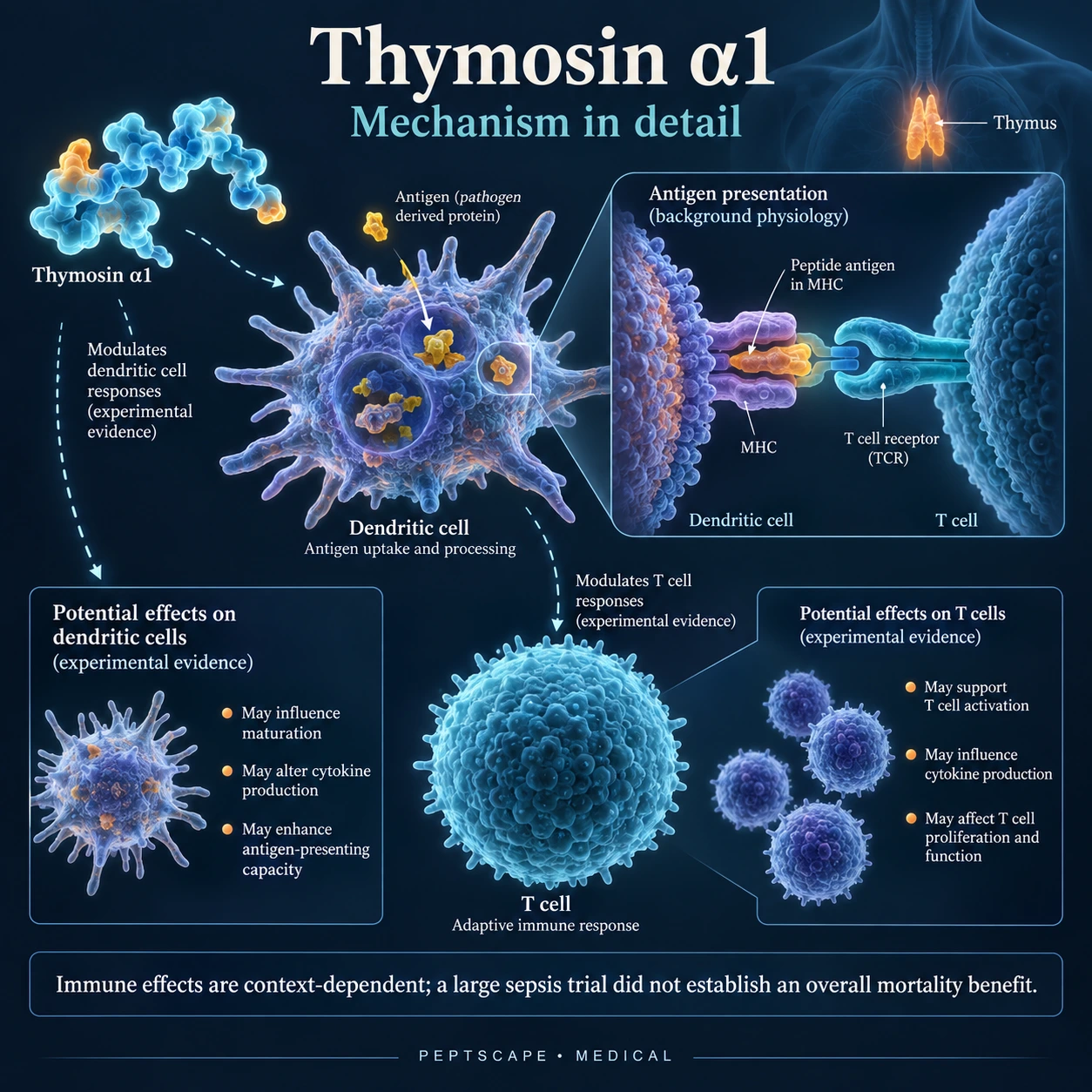
Clinical studies have examined thymosin Alpha-1 in sepsis, a life-threatening response to infection. A large 2025 trial did not show a clear reduction in 28-day mortality in the overall study population. This is important context alongside earlier, more encouraging smaller studies.
Sepsis is an emergency requiring hospital treatment. Its research cannot be converted into a home prevention or recovery schedule.
Cancer-related care
Some studies investigate use alongside cancer treatment. Adjunctive use means an addition to a defined treatment programme, not a replacement for it. Decisions belong with the oncology team because immune effects can interact with the disease and its treatment.
Medical · How does it work?
The immune system includes cells that recognise possible threats and cells that carry out or regulate the response. Dendritic cells help present information about a threat, while T cells participate in targeted immune activity.
Thymosin Alpha-1 research has explored how these systems are influenced, including signalling through receptors involved in recognising microbial patterns. The aim is better coordination in a particular clinical setting, not indiscriminate stimulation.
A laboratory change in a cytokine or immune-cell measurement is a clue about biology. It does not automatically mean fewer infections or a better clinical outcome. The latter needs to be measured directly.
This distinction also explains why a peptide described as immunomodulatory can require caution in autoimmune disease or transplantation. The desired direction of immune change depends on the person's circumstances.
Medical · Thymalfasin, thymosin mixtures and related peptides
Thymalfasin refers to synthetic thymosin Alpha-1. Thymalin and other thymus-derived mixtures are not the same single molecule. Thymosin beta-4 and TB-500 belong to a different discussion focused on cell movement and tissue repair.
Keep the exact name, formulation and amount in a record. “Thymosin” alone is not enough to identify what was used. A blend's total milligrams also cannot establish the amount of thymosin Alpha-1 within it.
Country-specific medicinal authorisations may differ in indication and product instructions. An approval or clinical use in one setting does not make all research-labelled preparations equivalent.
Medical · Dosing and concentration
A commonly studied clinical schedule is 1.6 mg subcutaneously twice weekly in selected disease settings. Other studies use different schedules, especially in acute illness. The amount is tied to the condition and protocol, not a universal immune-support routine.
The twice-weekly figure should not be converted into a general recommendation for healthy users, and intensive hospital regimens should not be copied for ordinary infection recovery. Frequency does not follow directly from the plasma half-life because immune responses can continue after the peptide is cleared.
Record the actual prescribed amount, purpose, route and planned duration. A treatment course should have a review point based on the clinical goal, not simply continue because vials remain.
For concentration literacy, 1.6 mg in a documented final volume of 1 mL equals 1.6 mg/mL. That calculation does not establish that every 1.6 mg vial uses 1 mL of the same diluent or should be administered in full. The actual product instructions determine preparation.
Medical · Preparation and reconstitution
Thymosin Alpha-1 may be supplied as lyophilised, or freeze-dried, material. Medicinal presentations can specify their own supplied diluent and prompt use after mixing. Those details matter more than a generic peptide recipe.
Bacteriostatic water contains a preservative. It should not replace sterile water or a supplied diluent simply to create a multidose vial. Adding preservative does not establish compatibility or a longer usable period.
For a prescribed preparation, check the exact identity, amount, diluent, mixing volume, final concentration and post-reconstitution instructions. Use clean handling and sterile single-use equipment. Follow the stated mixing method and do not add another compound to the same vial without compatibility information.
Label and record the preparation immediately. A single-use presentation remains single use unless its own approved directions say otherwise; retaining a remainder for later is not justified by the peptide's name.
Medical · Administration
Subcutaneous administration delivers a medicine into the fatty tissue beneath the skin. Have the correct device, suitable sites and technique demonstrated for the prescribed preparation. It should not be injected into a lymph node or near an infected area to try to direct an immune response.
Rotate appropriate sites and avoid damaged or infected skin. Use new sterile equipment for each administration and keep used needles and syringes out of both medicine and diluent containers.
Record the actual time and any local reaction. Fever or worsening illness should be evaluated in context, not automatically described as evidence that the immune system is “switching on.” Do not delay standard treatment while waiting for a peptide response.
Medical · Routes and bioavailability
Subcutaneous delivery bypasses the initial digestive breakdown faced by swallowed peptides. Clinical pharmacokinetic findings apply to the preparations and route studied, not to every oral or nasal product using the same name.
An oral peptide can sometimes act locally on the gut lining. That principle does not establish an oral thymosin Alpha-1 treatment for systemic immune support. A low bloodstream level is not proof of useful local immune activity.
Differences in formulation can affect absorption even within the same route. This is one reason a precise percentage or oral-to-injection conversion should not be supplied without product-specific evidence.
Medical · Half-life
Human subcutaneous research reports an elimination half-life of less than three hours, with formulation-related differences. The immune effects being investigated are not limited to the period the peptide remains measurable in blood.
That short half-life does not imply frequent redosing. Clinical schedules are based on the condition and study protocol, not simply on counting half-lives.
Medical · Storage
Use the particular product's labelled storage and reconstitution instructions. Keep the lyophilised expiry separate from the mixed preparation's discard time. Some medicinal presentations are intended for prompt use after preparation rather than storage as a multidose solution.
Refrigeration and bacteriostatic water do not create a universal 30-day usable period. Protect the container as directed, avoid inappropriate freezing and record a significant temperature excursion.
Do not pool leftovers from different vials or keep an unlabelled prepared syringe for later. Appearance cannot establish sterility, and a damaged seal or uncertain handling history needs assessment.
Medical · Contraindications and side effects
A prior allergic reaction to the peptide or formulation is a major concern. Local reactions and other symptoms should be documented, and severe allergic symptoms need urgent treatment.
People with an organ transplant, autoimmune disease or treatment intended to suppress immune activity need specialist review before adding an immune-active peptide. This is not a claim that all such patients will be harmed; it reflects the importance of the intended immune effect in their care.
Cancer treatment, pregnancy, breastfeeding and paediatric use require a specific clinical decision. Do not stop immunosuppressants, antivirals or other prescribed treatment to substitute a peptide.
New confusion, severe breathlessness, fainting, rapidly worsening illness or signs of a serious infection needs urgent medical assessment. An immune-support label should never delay that response.
Medical · Nutrition and supplement support
Adequate intake during illness
Poor appetite and restrictive diets can reduce protein and energy intake during recovery. Small, regular meals and suitable protein sources may be more useful than a long list of “immune boosters.” If illness makes eating difficult, the nutritional plan should address that practical problem.
Hydration and food tolerance matter, but severe illness may require individual fluid or dietary restrictions. General wellness advice should not override instructions for heart, kidney or liver disease.
Vitamin D, zinc and vitamin C
These nutrients contribute to normal immune function. Correcting a deficiency is different from taking large doses to amplify an immune-active peptide. More immune activity is not always desirable, and a nutrient's biological role does not prove a beneficial combination.
Excess zinc can cause copper deficiency. Large vitamin C doses can cause gastrointestinal effects and may be unsuitable for some people with kidney-stone risk or other conditions. Vitamin D should also be used with attention to total intake and clinical need.
Selenium and iron
Selenium is needed in small amounts; excessive supplementation can cause harm, including hair and nail changes. It should not be added automatically because the word “immune” appears in a plan.
Iron is appropriate when a deficiency or another clear indication exists. Fatigue during illness does not justify routine iron supplementation without understanding the cause.
Probiotics and live products
Probiotics are not universally suitable, particularly for severely ill or significantly immunocompromised people. A general gut-health claim is not enough to establish safety in someone receiving complex immune treatment. Discuss them with the treating team.
Herbal immune products
Echinacea, medicinal mushroom products and multi-ingredient immune blends can have their own effects and interactions. Combining them with thymosin Alpha-1 has not been established as a superior strategy. In transplant, autoimmune and oncology care, the complete supplement list is particularly important.
Medical · Tracking progress and everyday questions
Track the actual clinical goal: symptoms, diagnosed infections, treatment tolerance or clinician-selected laboratory outcomes. A nonspecific feeling of warmth or a changed blood-cell count should not be labelled “stronger immunity” without interpretation.
Does thymosin Alpha-1 prevent every infection? No. Is it an antibiotic or antiviral replacement? No. Is it the same as TB-500? No. Does a history of clinical use make every online vial equivalent? No; preparation and indication remain important.
The review should ask whether the intended outcome improved and whether treatment remains appropriate for the person's changing health.
Medical · Medical
The evidence spans different diseases and treatment combinations. In the large TESTS sepsis trial, 28-day mortality was similar between treatment and placebo groups; the study did not establish an overall mortality benefit. A published correction should be read alongside the report.
Human pharmacokinetic research compared different subcutaneous formulations and found that formulation could influence exposure. Hepatitis studies and trial protocols support discussion of disease-specific schedules, not a universal wellness regimen. Thymosin Alpha-1 does not have a U.S. FDA-approved medicinal indication.