Educational illustration · Read the evidence and limitations below.
What is Thymosin Alpha-1?
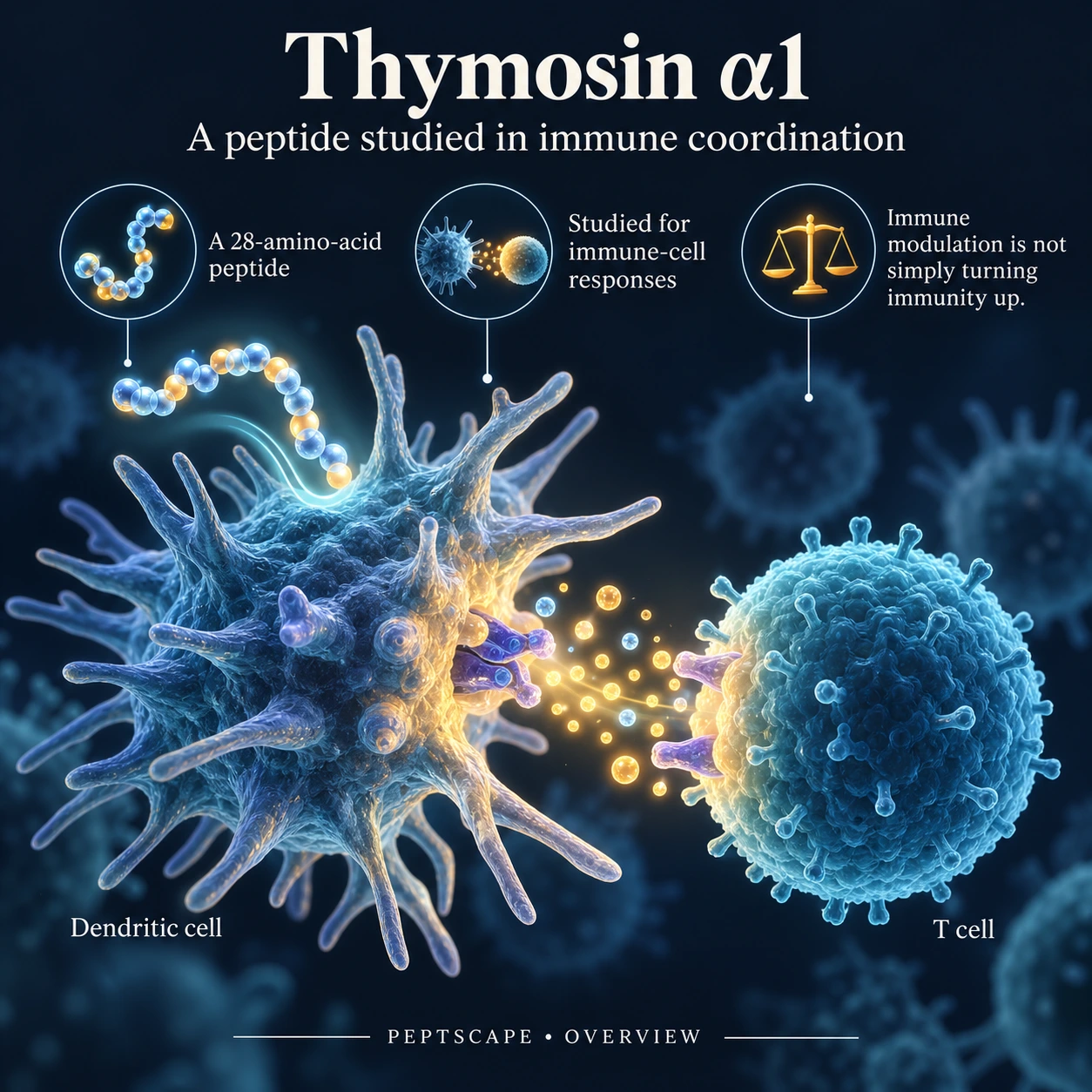
Thymosin Alpha-1 is a 28-amino-acid peptide involved in immune signalling. It is associated with the thymus, an organ that helps develop T cells, a group of immune cells important for recognising and responding to threats. A manufactured version is also known as thymalfasin.
Its central area of use is immune function. More specifically, interest centres on how immune cells mature, communicate and respond. This is a different purpose from increasing growth hormone, suppressing appetite or directly repairing a tendon. Despite the shared word “thymosin,” Thymosin Alpha-1 is not Thymosin Beta-4 or TB-500.
Immune function is not a single strength setting
The immune system has to recognise threats, coordinate a response and then limit that response when it is no longer needed. Too little activity can be a problem, but excessive or misdirected activity can also damage tissue. “Boosting immunity” is therefore an incomplete description of what a useful treatment should do.
Thymosin Alpha-1 is better understood as an immune-modulating peptide. Modulation means influencing the response, not guaranteeing that it moves in a beneficial direction in every condition. Its usefulness depends on the illness, the immune state and the treatment context. It is not established as a routine preventive injection for healthy adults.
Two connected parts of defence
Innate immunity provides rapid responses to potential threats. Adaptive immunity develops more specific responses, including those involving T cells and antibodies. These systems communicate with one another rather than operating independently.
This matters because an effect on one immune signal does not prove better resistance to every infection. A change in a cell count, an inflammatory marker and fewer days of illness are different findings. The most meaningful result depends on the condition being addressed.
What it is used for
Adjunctive immune treatment
Thymosin Alpha-1 has been used or investigated alongside treatment for certain infections and other illnesses involving immune dysfunction. “Adjunctive” means added to an existing treatment, rather than replacing the medicine or procedure directed at the underlying disease.
That distinction is important for viral infections. An immune-modulating peptide is not automatically an antiviral that blocks viral replication directly. It also is not a substitute for a vaccine, which is designed to develop recognition of a particular threat.
Recovery after illness
Experimental use includes attempts to support recovery after illness or periods of perceived immune vulnerability. However, fatigue after an illness does not by itself identify a weak immune system. Sleep disruption, reduced activity, inflammation and organ-specific problems can all contribute to recovery difficulties.
The relevant goal should therefore be concrete: recovery from a defined condition, a particular immune abnormality or another clinically assessed problem. Simply feeling run down does not establish a reason to stimulate immune pathways, and an immediate feeling of energy would not measure immune competence.
Thymosin Alpha-1 has also been investigated in serious illnesses such as sepsis and in some cancer-related settings. These applications do not establish a general ability to prevent severe disease or improve cancer outcomes. Different illnesses involve different forms of immune disturbance, and results from one setting cannot be assigned to another.
The Medical tab keeps those condition-specific findings separate. This allows the Overview to explain what the peptide is intended to influence without turning every historical use into a promised benefit.
Autoimmunity and transplantation are different situations
With autoimmune disease, the immune system is acting against the body's own tissues. After transplantation, medicines may intentionally suppress parts of the response to protect the transplanted organ. In either case, changing immune activity is not a simple wellness intervention.
An immune-related diagnosis or the use of immunosuppressive medicines therefore needs explicit review before considering this peptide. The label “modulator” does not guarantee that it will safely balance whatever problem is present.
How it works
Helping coordinate immune-cell responses
Proposed and investigated actions involve T-cell function and cells that help recognise and present potential threats to the immune system. Presenting a threat means displaying identifying pieces so other immune cells can respond more specifically. Communication between these cells helps determine what type of response develops.
The peptide has also been investigated in signalling pathways involved in recognising infection and regulating inflammatory messages. These messages are often called cytokines. A cytokine is a communication molecule, not automatically a harmful substance that should always be lowered.
More activity does not always mean better protection
An immune response needs appropriate timing and location. A stronger signal measured in isolation may not translate into a better outcome for the whole person. This is why laboratory activity and useful clinical benefit must remain separate ideas.
Similarly, absence of a noticeable sensation does not mean immune signalling was unchanged. Immune function is not directly felt in the way that hunger or sedation can be. An injection-site reaction is a tolerance observation, not proof of stronger defence against infection.
Support the whole recovery process
Adequate nutrition, sleep and treatment of the underlying condition remain relevant because immune cells are part of the wider body. Extra supplements do not automatically improve a peptide's action, and a high dose of a nutrient is not necessarily better than correcting an actual deficiency.
The nutrition section addresses those distinctions separately. The essential point about Thymosin Alpha-1 is its immune-signalling role: it is neither a universal infection shield nor a generic energy treatment, and the purpose needs to be tied to the person's actual clinical situation.