Educational illustration · Read the evidence and limitations below.
Evidence in perspective
This resolves the peptide’s name and sequence. It does not validate hormone-restoration claims: the measured endpoints were laboratory fluorescence and binding.
Selected full-text methods/results assessed. Fluorescent labelling and multi-peptide assays limit transfer to unmodified KEDG in people. Clinical sign-off remains pending.
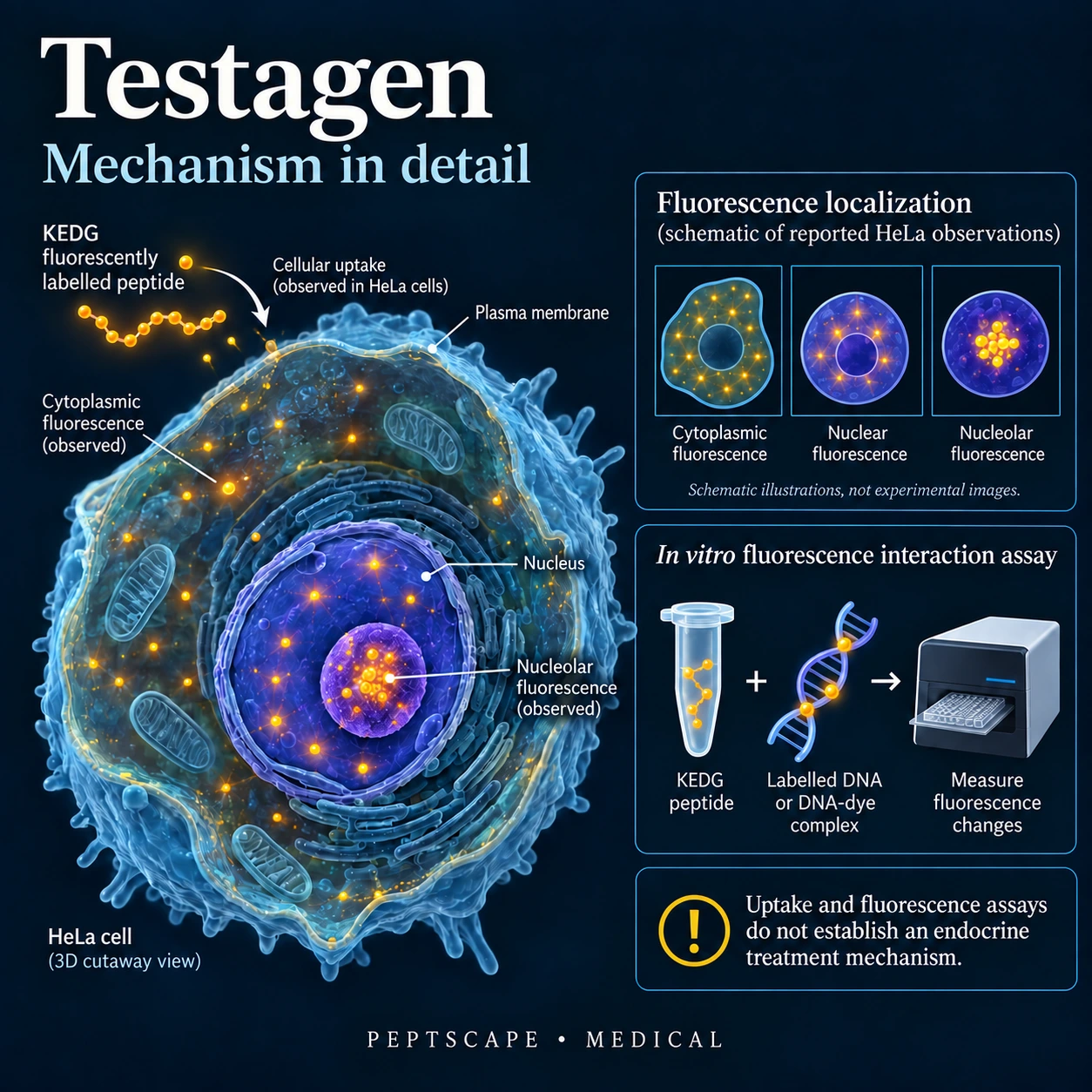
Fluorescently labelled peptides in HeLa cells and cell-free oligonucleotide/DNA assays.
What the sources found
The study reports nuclear fluorescence and sequence-dependent interactions in a panel including Testagen; it does not measure testosterone, fertility or patient outcomes.
Fluorescently labelled peptides in HeLa cells and cell-free oligonucleotide/DNA assays.
Identity documentation and publication do not confer marketing authorization. No new jurisdiction-specific approval claim is made.
What remains unknown
Selected full-text methods/results assessed. Fluorescent labelling and multi-peptide assays limit transfer to unmodified KEDG in people. Clinical sign-off remains pending.
How it works
Identity and evidence must be read separately.
This resolves the peptide’s name and sequence. It does not validate hormone-restoration claims: the measured endpoints were laboratory fluorescence and binding.
Preclinical research
The catalog primarily cites laboratory or animal research. Human benefit, a safe dose and long-term risks cannot be inferred from those findings.
The study reports nuclear fluorescence and sequence-dependent interactions in a panel including Testagen; it does not measure testosterone, fertility or patient outcomes.
Fluorescently labelled peptides in HeLa cells and cell-free oligonucleotide/DNA assays.