Educational illustration · Read the evidence and limitations below.
What is Testagen?
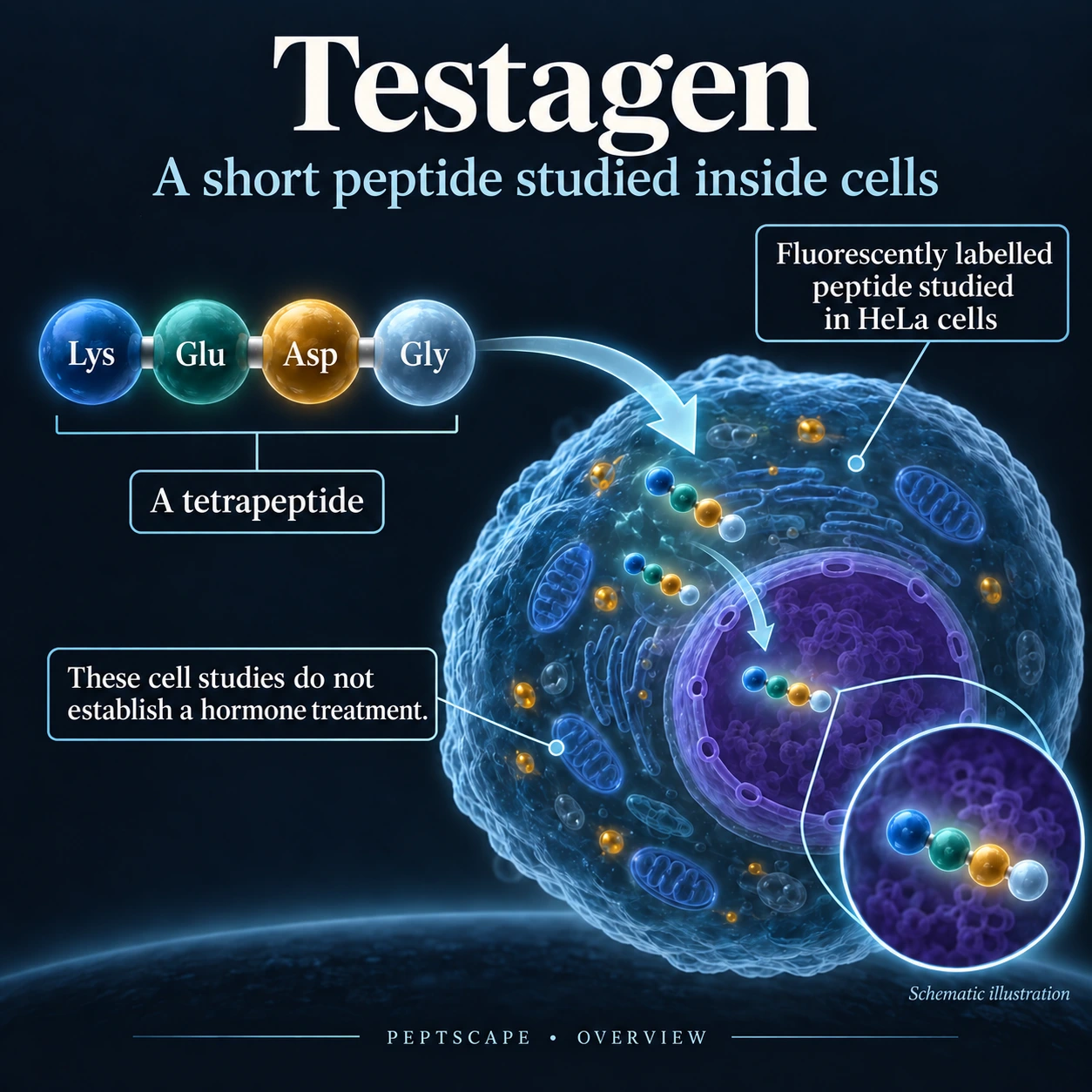
Testagen is the short peptide lysine–glutamate–aspartate–glycine, abbreviated KEDG in the cited literature. It is not testosterone, a testosterone ester or a gonadotropin. Its name should not be used to infer that it replaces a deficient sex hormone.
The wider picture
Peptides are short chains of amino acids, but their effects depend on the order of those amino acids and any chemical modifications. Two compounds with similar names may have different targets. An added chemical group, a reversed sequence or a different terminal form can change how a molecule interacts with cells. The name of a parent peptide does not fully describe a derivative.
A chemical identity can include more than the sequence. Some peptides have altered amino acids, capped ends, salts or attached groups. These details can affect breakdown and interactions with tissue. A complete name or analytical identity is therefore more informative than the broad category research peptide.
What it is used for
Its promoted interest includes endocrine and age-related function, but the name does not establish a reliable testosterone-raising treatment. Low testosterone has specific causes and requires correctly timed testing and clinical assessment. A peptide associated with gene-regulation experiments cannot be assumed to correct those causes.
Understanding the intended benefit
An experimental use describes the goal of development, not an assurance of a particular result. It helps to ask a concrete question: is the aim to change pain, tissue repair, metabolism or a laboratory marker? Those outcomes should not be substituted for one another. An effect on cells does not explain by itself how a person would feel or function.
A useful explanation separates the intended target from the hoped-for outcome. A target may be a receptor, an enzyme or a protein interaction. The hoped-for outcome might be less pain, improved function or a change in disease activity. Understanding the connection between the two helps avoid treating a promising mechanism as a completed treatment claim.
How it works
The research concept concerns interactions between a short peptide and cellular regulatory processes. A change in gene-related activity is different from a demonstrated rise in an active hormone or an improvement in fertility. The sequence defines the peptide; it does not supply the direct receptor action of HCG, GnRH or testosterone.
The biology in plain language
The relevant mechanism begins with the exact molecule. Receptor activity, entry into tissue and the time a molecule remains intact all influence its behaviour. A research-labelled product needs a clear identity before results for another preparation can be applied to it. Practical decisions about preparation and administration require a defined formulation; they cannot be supplied by extending a mechanism diagram into a personal schedule.
The amount present in a vial, the amount delivered and the amount reaching a target are different. Absorption and distribution lie between them. Changing the route or attaching another chemical group can change those steps, but does not provide a simple conversion factor. This is why practical instructions need to match an identified preparation rather than a generic name alone.