Educational illustration · Read the evidence and limitations below.
Medical · What is tesamorelin?
Tesamorelin is a peptide best known for reducing visceral fat—the fat stored deep inside the abdomen, around organs such as the liver and intestines. It works by encouraging the body to release growth hormone, which helps regulate how the body uses and stores energy.
If you have been reading about peptides for body composition, you have probably seen tesamorelin described as a “belly-fat peptide.” That description needs one clarification: the soft fat you can pinch at your waist is mostly a different kind of fat. Tesamorelin’s strongest research concerns the deeper fat you cannot pinch.
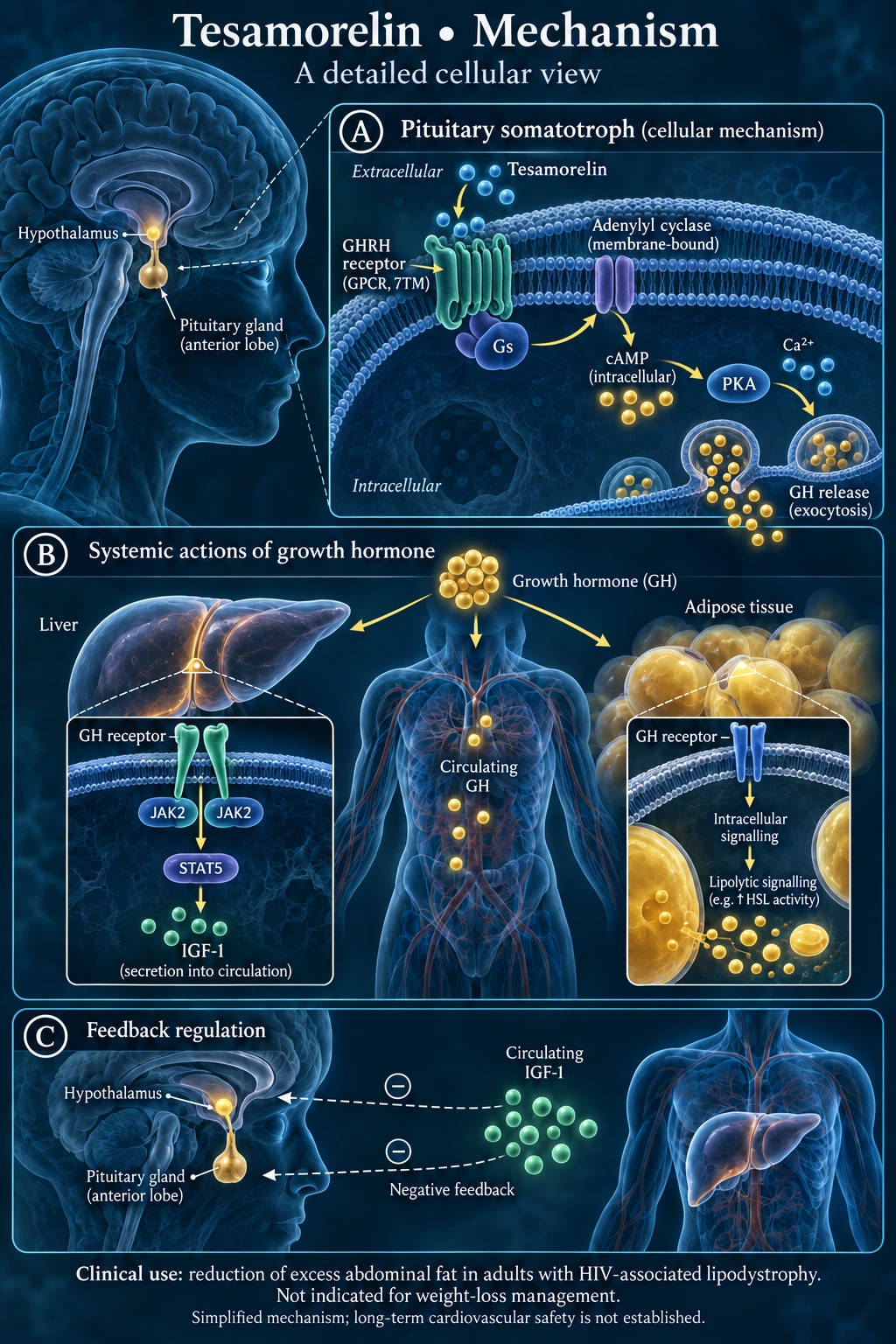
Tesamorelin is made to resemble growth hormone–releasing hormone, or GHRH, a signal the body already produces. It is not growth hormone itself. Instead, it acts on the pituitary—a small gland beneath the brain—to encourage growth-hormone release.
People explore it for a smaller waist, changes in body composition and concerns about abdominal fat. The most substantial human research involves adults with HIV-associated lipodystrophy, a condition that can change where the body stores fat. There is also research in selected people with obesity and reduced growth-hormone secretion. These findings are useful, but they do not mean every person with belly fat will respond in the same way.
Tesamorelin is the peptide name. EGRIFTA is a prescription product containing it. Research-labelled vials also appear online, but a matching ingredient name does not make their preparation, absorption or quality equivalent.
Medical · Visceral fat versus the fat under your skin
Visceral fat: the deeper compartment
Visceral fat lies inside the abdominal cavity, surrounding internal organs. It is the compartment measured in the main tesamorelin trials.
Subcutaneous fat: the pinchable layer
Subcutaneous fat sits beneath the skin. It contributes to the softness around the waist and the appearance of abdominal definition. Someone can reduce deeper abdominal fat without losing much of this outer layer.
Why this changes expectations
A smaller amount of visceral fat does not necessarily produce a dramatic change on the bathroom scale or visible abdominal muscles. “Less deep abdominal fat,” “weight loss” and “a leaner appearance” describe different outcomes.
A waist measurement can help track overall change, but cannot tell you exactly how much visceral fat you have lost. Research studies use imaging to distinguish the fat compartments. A home scale’s “visceral fat” score is an estimate, not the same measurement.
Medical · Benefits and uses
Reducing deep abdominal fat
This is tesamorelin’s best-supported use. Randomized trials in adults with HIV-associated abdominal fat accumulation found reductions in visceral fat over months of treatment.
The practical expectation is gradual change in a particular fat compartment, rather than immediate appetite suppression or rapid weight loss. It is not a local fat-dissolving injection.
Body composition outside the main treatment population
A separate randomized trial studied people with obesity and relatively low growth-hormone secretion. It found a reduction in visceral fat. That broadens the research beyond HIV, but the participants were selected for a particular hormone pattern; they were not a general sample of healthy people seeking cosmetic fat loss.
Liver fat
A six-month study in adults with HIV and abdominal fat accumulation found reductions in liver fat as well as visceral fat. Liver fat is fat within the liver, not simply the tissue around it.
This is a reason for medical interest, not a reason to assume tesamorelin treats every cause of fatty liver. The study also observed an early rise in fasting glucose, illustrating why different metabolic measurements can move in different directions.
Muscle, recovery, sleep and energy
These benefits are often mentioned in online discussions because tesamorelin affects growth-hormone signaling. They should not be presented as equally established outcomes.
A person’s training, sleep, diet and health conditions also influence these experiences. A visceral-fat study does not by itself establish faster injury healing, better athletic performance or reliable improvements in sleep. If these are the main goals, they deserve their own assessment rather than being assumed benefits of treatment.
Medical · How does it work?
The body normally releases growth hormone in pulses. Tesamorelin acts on GHRH receptors in the pituitary and stimulates this release. A study in healthy men measured changes in both pulsatile and basal growth-hormone secretion.
Growth hormone then affects other tissues. One downstream signal is IGF-1, short for insulin-like growth factor 1. You may encounter this name on a blood-test report because it helps clinicians monitor the hormonal response.
Think of tesamorelin as a signal to a hormone-producing gland. It does not supply dietary protein, directly dissolve fat where it is injected or work primarily by reducing appetite.
“Stimulates your own growth hormone” also does not mean the response is automatically ideal. IGF-1 can become too high, and glucose regulation can change. More hormonal activity is not always a better result.
Medical · Dosing and treatment duration
Why 2 mg appears so often
Older clinical trials used 2 mg by subcutaneous injection once daily. This explains why that figure appears repeatedly in online descriptions. It describes the regimen and preparation studied; it is not a universal instruction for every vial sold as tesamorelin.
Current prescription formulations
The labelled daily doses are 1.4 mg for EGRIFTA SV and 1.28 mg for EGRIFTA WR, both subcutaneous. These formulations are not substitutable. Their different numbers are not interchangeable options to choose according to a fat-loss goal.
For any prescribed preparation, keep the formulation, amount, concentration and volume together. A mass such as 1.4 mg is different from the liquid volume used to deliver it.
How long before judging a result?
The main trials assessed changes over months, including 26-week treatment periods. A few days of scale readings cannot tell you whether visceral fat is changing.
In extension research, visceral fat reaccumulated after treatment stopped. Tesamorelin therefore should not be described as a short course that permanently removes deep abdominal fat.
A treatment review should consider benefit, symptoms and monitoring results together. A plateau alone is not a reason to increase an amount or extend treatment indefinitely.
Timing and missed doses
The current prescription schedules are once daily. Their labels do not require a universal bedtime or fasting schedule. Online rules about mandatory fasting should not be presented as established requirements for all tesamorelin preparations.
For a missed dose, follow the prescribed instructions; do not double the next dose to compensate.
Medical · Oral versus SubQ
Why swallowing it is different
The digestive system is designed to break down proteins and peptides. Enzymes can cut them into smaller fragments, while the intestinal lining limits how much intact peptide reaches the blood.
Tesamorelin needs to reach the circulation to act on the pituitary. Simply swallowing the same number of milligrams does not reproduce an injected amount.
Could oral tesamorelin work directly on the gut?
That is not the reason tesamorelin is used. Its intended target is the hormone-signaling system, not the surface of the intestinal lining. The local-gut explanation sometimes discussed for other peptides does not explain tesamorelin’s body-composition effects.
An oral or nasal preparation would need evidence showing how much is absorbed and what it does in people. A different route cannot be assigned an equivalent dose from the peptide name alone.
What SubQ means
Subcutaneous, or SubQ, means delivery into fatty tissue beneath the skin. This bypasses digestive processing, although absorption still occurs from the injection site. It should not be described as automatically delivering 100% of the amount to the bloodstream.
Medical · Preparation and reconstitution
Reconstitution means adding the specified water to a lyophilised (freeze-dried) peptide to prepare a solution. Bacteriostatic water contains a preservative and is used for some formulations, including tesamorelin WR. Tesamorelin SV requires its supplied sterile water instead. The type of water and the volume must match the formulation’s preparation instructions.
Before opening the supplies
Check the peptide name, vial strength, expiry and preparation instructions. Confirm that the diluent belongs with that formulation. Have a clean preparation area, the instructed sterile supplies and a sharps container ready.
The two documented examples below show why a universal tesamorelin mixing recipe would be misleading. They are instructions for the named prescription formulations, not a way to prepare a different research-labelled vial for human use.
SV formulation
For EGRIFTA SV, add 0.5 mL of the supplied sterile water to its 2 mg vial. Roll gently for 30 seconds; do not shake. The concentration is 4 mg/mL. Its labelled 1.4 mg dose occupies 0.35 mL. Use immediately and discard the remainder.
WR formulation
For EGRIFTA WR, add 1.3 mL of its supplied bacteriostatic water to the 11.6 mg vial. Swirl; do not shake. The labelled concentration is 8 mg/mL and the 1.28 mg dose occupies 0.16 mL. Do not recalculate concentration by simply dividing the printed vial mass by the added liquid.
What the different waters mean
Sterile water has no antimicrobial preservative. Bacteriostatic water contains a preservative. They are not automatically interchangeable, and a preservative does not sterilize contaminated powder.
A research-use-only vial does not become a documented injectable medicine when water is added. Its label alone cannot establish a suitable human preparation method.
Inspect and record
Follow the preparation’s inspection instructions. Do not use a solution that is cloudy, discolored or contains particles when it is supposed to be clear. Record the mixing date, final concentration and instructed discard date. Appearance alone cannot establish sterility.
Medical · Administration
Tesamorelin’s prescription instructions specify subcutaneous injection into the abdomen, rotating sites and avoiding the navel, bruises and scar tissue. The needle goes into tissue beneath the skin—not deep into the abdomen or into visceral fat.
Use the supplied or prescribed injection equipment and the technique demonstrated by the treating team. Do not choose a longer needle to “reach belly fat.” Needle length, angle and technique should suit the person and equipment.
Use a new needle and syringe each time, never share supplies, and place used sharps in the appropriate container. Avoid inflamed or infected skin. Repeated local reactions deserve review of the preparation and technique.
Syringe markings are volume
On a U-100 insulin syringe, 100 marked units equal 1 mL. Those markings are not milligrams of tesamorelin or units of growth-hormone activity. A saved instruction such as “use 20 units” becomes ambiguous if the concentration changes. Record the mass and concentration as well as volume.
Medical · Half-life
Approximately 8 minutes for SV and 11 minutes for WR, measured after their respective single subcutaneous doses in healthy subjects.
This is how quickly tesamorelin is cleared from blood—not how long the hormonal response or body-composition changes last. It does not imply that doses should be repeated every few minutes.
Medical · Storage
Storage belongs to the formulation, not just the peptide name.
SV powder is stored at 20–25°C with light protection. After mixing, use it immediately; do not refrigerate or freeze the mixed solution for later use.
WR mixed solution is stored at 20–25°C and discarded seven days after mixing; do not freeze it. A vial providing a week’s supply does not mean the medicine is injected once weekly.
For a different preparation, obtain its own documented storage and discard instructions. Do not transfer either example to it. Refrigerating every mixed peptide is not a universal rule.
When travelling, record any significant temperature excursion and seek advice on the affected preparation. Re-cooling a vial does not reset its expiry or prove it remained stable.
Medical · Contraindications and precautions
When tesamorelin should not be used
Clinical contraindications include active cancer, pregnancy, serious allergy to tesamorelin or its ingredients, and disruption of the hypothalamic-pituitary system, such as certain pituitary disease, surgery, irradiation or injury.
Conditions needing additional review
A history of treated cancer, diabetes or elevated glucose, and breastfeeding require individual assessment. Safety and effectiveness in children have not been established.
Tell the treating clinician about other hormone-active treatments and steroid replacement for adrenal insufficiency. A combination can change monitoring or medication requirements; it is not simply a stronger version of tesamorelin alone.
“Not an absolute contraindication” does not mean “nothing to check.” The practical question is whether the expected benefit justifies the risks for that person.
Medical · Side effects and monitoring
Possible effects include joint or muscle discomfort, swelling, tingling or carpal-tunnel-type symptoms, and injection-site reactions. Changes in glucose or IGF-1 may occur without an obvious symptom.
Agree a monitoring plan with the treating clinician, including glucose assessment and IGF-1. Do not interpret rising IGF-1 as a score to maximize. New swelling also should not automatically be logged as muscle gain.
Seek emergency care for trouble breathing, facial or throat swelling, or fainting after an injection. Report persistent or worsening local reactions promptly.
Medical · Nutritional and supplement support
Protein: support the muscle you want to keep
A body-composition goal usually includes maintaining useful muscle, not simply making the scale lower. Include protein foods throughout the day: fish, eggs, dairy, poultry, tofu, beans or lentils are examples.
A protein powder can fill a practical gap when food intake is insufficient. It is not required to activate tesamorelin. A highly restrictive diet that makes adequate protein and overall nutrition difficult can work against a sustainable plan.
Creatine: a separate training tool
Creatine monohydrate can support repeated high-intensity exercise and resistance-training performance. That evidence does not establish it as a tesamorelin enhancer.
It can increase body weight through water retention, which is useful to remember when reviewing a weight chart. Record when it was started so a change is not automatically attributed to the peptide. Consider it in relation to training goals and medical history rather than adding it to every plan.
Magnesium: meet a nutritional need
Magnesium supports normal muscle and nerve function. Nuts, seeds, legumes and whole grains are useful sources.
Supplements can cause diarrhea, interact with some medicines, and pose greater risk when kidney function is impaired. The adult upper limit of 350 mg daily applies to magnesium from supplements and medicines, not food. It is a limit, not a recommended tesamorelin-support dose. Check the elemental magnesium amount on the label.
Vitamin D: bone and muscle health
Vitamin D helps the body absorb calcium and supports bone health. Fatty fish and fortified foods contribute to intake. A supplement may be appropriate for an intake gap or a clinically assessed deficiency.
For adults aged 19–70, the reference intake is 600 IU daily; above 70 it is 800 IU. The general adult upper limit is 4,000 IU daily unless a clinician directs otherwise. These figures describe nutritional intake, not a fat-loss or peptide protocol. Excess intake can raise calcium to harmful levels.
Food quality and consistency
Build meals you can repeat: a protein source, vegetables or fruit, and suitable sources of carbohydrate and fat. Record major dietary changes alongside the peptide plan so the progress record tells a coherent story.
A “glucose support” supplement is not a substitute for checking glucose during hormone-active treatment. Adding several products at once makes it harder to identify which change caused a benefit or an unwanted effect.
No supplement combination has been established as necessary to make tesamorelin work. The useful reasons to add a supplement are to address a dietary gap, correct a deficiency or support a separate, defined training goal.
Medical · Tracking progress in Peptscape
A useful record connects what was used, what changed and when.
• Preparation: exact formulation, vial strength, concentration and mixing date.
• Administration: amount, volume, route, time and injection site.
• Measurements: weight and waist recorded consistently, with the same measurement method.
• Observations: swelling, discomfort, sleep, appetite and changes in training or food intake.
• Clinical follow-up: dated glucose and IGF-1 results, with clinician interpretation.
These are suggested record fields for reviewing this content, not a claim that every field is already implemented in the app.
Do not treat a home visceral-fat score as equivalent to trial imaging. Look for a pattern over time, and bring the record to treatment reviews rather than using an isolated reading to change the dose.
Medical · Common questions
Is it the same as growth hormone?
No. Tesamorelin stimulates release from the pituitary; injected growth hormone supplies the hormone itself.
Will it remove the fat I can pinch?
That is not its strongest demonstrated effect. The main research concerns deeper visceral fat, and visible abdominal definition also depends on the subcutaneous layer.
Does injecting into the abdomen burn fat at that spot?
No. The abdomen is an administration site. The effect depends on hormone signaling rather than local fat dissolution.
Is it similar to a GLP-1 appetite treatment?
No. Tesamorelin is not primarily an appetite-suppressing treatment. Avoid using expectations from another peptide class to judge it.
Can a short cycle give permanent results?
The extension research found reaccumulation of visceral fat after discontinuation. A permanent outcome from a brief course should not be promised.
Does WR mean weekly dosing?
No. It provides multiple daily doses from one prepared vial. Its labelled dosing remains once daily.
Medical · Medical
The source list below supports professional review. General-interest chapters deliberately keep external links out of the reading flow.
The pivotal and extension trials concern adults with HIV-associated abdominal fat accumulation. The obesity study selected participants with reduced growth-hormone secretion. Neither population should be silently relabelled as healthy general users.
The formulation instructions, dose volumes and pharmacokinetic measurements remain specific to the named preparations. Nutrition references address nutrient requirements or exercise performance, not a tested tesamorelin supplement stack.
Medical: abdominal obesity beyond the licensed indication
The 2012 randomized, placebo-controlled trial by Makimura and colleagues examined tesamorelin in 60 adults with abdominal obesity and reduced stimulated GH secretion over 12 months. The population was selected for relative GH reduction; it was not an unselected general weight-loss population.
VAT area decreased with tesamorelin versus placebo, with a between-group treatment effect of −35 cm² (95% CI −58 to −12). Abdominal subcutaneous fat and body weight did not change significantly. These findings support discussing visceral-fat biology beyond the licensed HIV-associated indication, while retaining the trial’s population and formulation limits.