Educational illustration · Read the evidence and limitations below.
What is tesamorelin?
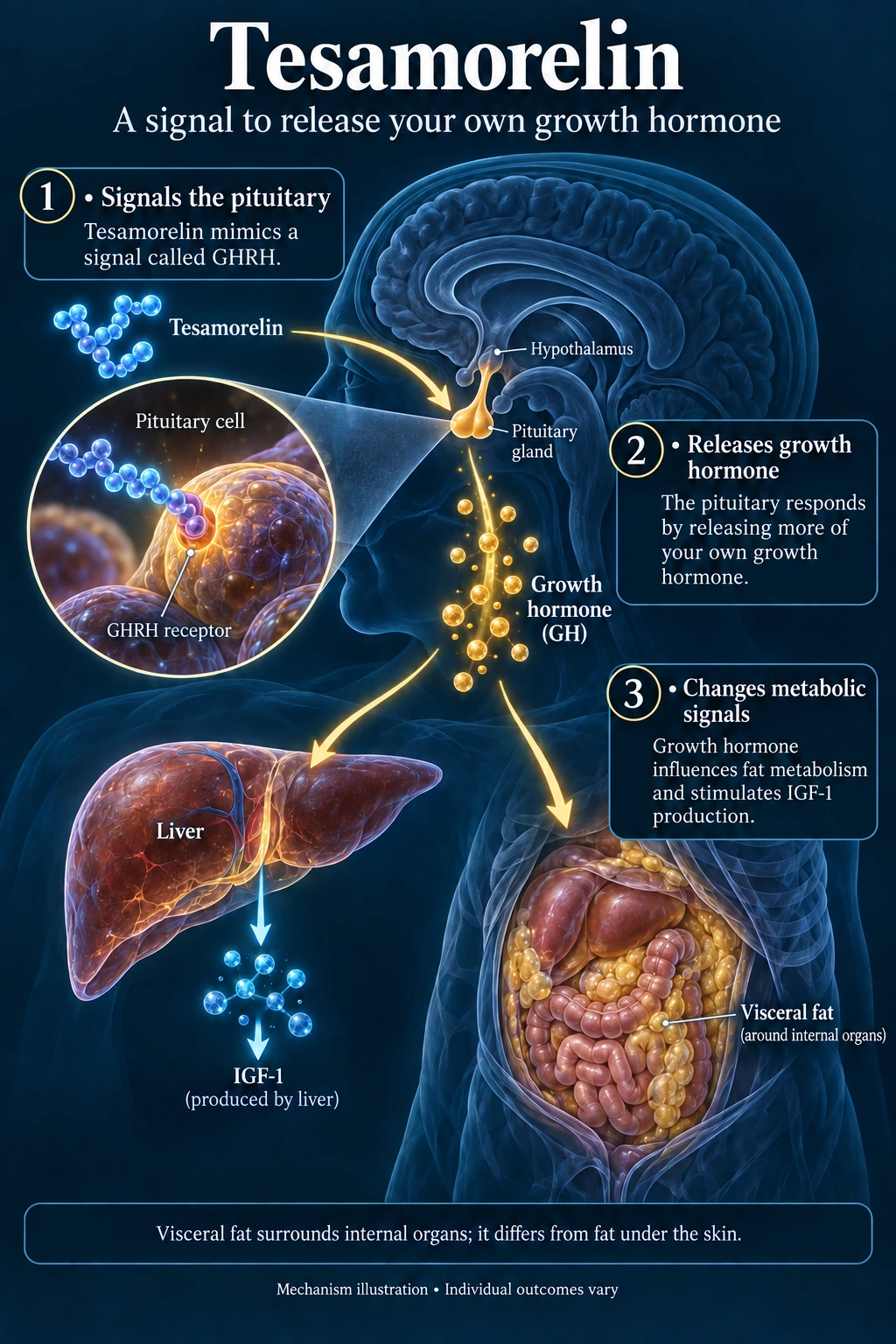
Tesamorelin is a growth hormone-releasing peptide used to reduce visceral fat—the deep fat stored inside the abdomen around your organs. It works by stimulating your own growth hormone release, which influences how your body stores and uses fat. Its main appeal is a change in body composition, particularly deep abdominal fat, rather than appetite suppression.
Body composition means what your weight is made up of: fat, muscle, water, bone and other tissue. Two people with the same weight can carry very different amounts of visceral fat. Likewise, a person can lose some abdominal fat without seeing a large change on the scale.
The fat you can pinch is a different layer
Subcutaneous fat sits directly beneath the skin. It is the softer layer you can pinch around your waist. Visceral fat sits deeper, behind the abdominal muscles. It occupies space within the abdomen rather than forming a layer just under the skin.
This distinction explains why “belly fat” is an imprecise term. A larger waist can reflect both types of fat, and its appearance can also change with bloating, posture and abdominal muscle tone. You cannot identify the amount of visceral fat simply by pinching your stomach or deciding whether it feels firm.
Why visceral fat matters
Fat tissue does more than store spare energy. It also releases signals that interact with metabolism. Excess visceral fat is associated with problems such as insulin resistance and an unfavourable blood-fat profile. Reducing it is therefore a metabolic goal as well as a change in abdominal shape.
Tesamorelin’s focus on this deeper fat compartment is what makes it different from describing a peptide simply as a “weight-loss” product. The location and type of fat changing matter, not only the total number of kilograms lost.
What it is used for
Visceral-fat reduction and abdominal body composition
Outside its licensed indication, tesamorelin is used off-label with the aim of reducing excess visceral fat and improving abdominal body composition. That is the use relevant to someone considering it for a deeper, fuller waist rather than for a condition-specific branded treatment. Its effect has also been examined in selected adults with abdominal obesity and reduced growth-hormone secretion; it should not be described as useful only in people with HIV.
The goal is a reduction in the deep fat compartment. A response may show up as a change in waist size or abdominal shape while body weight changes relatively little. Tesamorelin is not an established general-purpose obesity treatment, so the response seen in selected patients is not a promise for every person or every preparation.
Why the scale may tell only part of the story
The scale adds every compartment together. If fat decreases while lean tissue or water changes in the other direction, total weight can remain similar. “No weight change” and “no body-composition change” are therefore different conclusions.
A consistent waist measurement adds useful information. Take it at the same location, under similar conditions, rather than comparing a relaxed morning measurement with one taken after a large meal. A tape measure follows the outside of the abdomen; it does not separately measure visceral and subcutaneous fat. Imaging can distinguish those compartments when a clinical assessment calls for it.
How it differs from an appetite-focused peptide
Semaglutide and tirzepatide act strongly on hunger, fullness and the response to food. Tesamorelin works through growth-hormone signalling. The distinction matters because a lack of appetite suppression is not, by itself, evidence that tesamorelin has had no effect.
It also means that tesamorelin does not supply the same eating-related effects as those treatments. Food intake, activity and resistance exercise still shape the overall result. A smaller waist, better strength and improved metabolic measurements are separate outcomes worth following.
Other goals: separate them from visceral fat
Recovery, sleep quality, muscle gain and age-related goals are additional reasons for interest in growth hormone-releasing peptides. For tesamorelin, those benefits are less established than its effect on visceral fat. They should be assessed separately rather than bundled into a guaranteed list of benefits.
Fat stored within the liver is another distinct issue. Liver fat and visceral fat can occur together, but they are not the same compartment. A smaller waist does not establish that liver fat has resolved. If liver health is part of the treatment goal, follow the measurements chosen for that problem.
How it works
A message to release your own growth hormone
Your brain uses growth hormone-releasing hormone, or GHRH, to signal the pituitary gland. The pituitary is a small gland at the base of the brain that releases several hormones into the blood. Tesamorelin is a modified version of this releasing signal.
When tesamorelin activates the GHRH receptor on pituitary cells, it encourages growth hormone release. Think of a receptor as a receiving point for a message. Tesamorelin delivers the message; the pituitary supplies the growth hormone. That is different from injecting growth hormone itself.
Why pulses matter
Growth hormone is naturally released in pulses rather than at one constant level throughout the day. Tesamorelin stimulates this existing system. The response depends on the pituitary’s ability to respond and the body’s other control signals.
The hormone signal then affects how tissues use nutrients and handle stored fat. It also influences IGF-1, another hormone involved in growth and tissue maintenance. IGF-1 is one reason laboratory monitoring can help assess the response; a higher value is not a goal to pursue without limits.
Why injecting into the abdomen does not target belly fat
A SubQ injection places a preparation in the fatty layer beneath the skin. After absorption, tesamorelin travels through the circulation to act on hormone signalling. It does not melt the fat directly beneath the injection site. The abdomen can be an administration site without being the place where the drug first produces its intended effect.
Changes develop over time
The hormone response and the visible body-composition response happen on different timescales. A peptide can act on its receptor before a measurable change in fat has developed. Progress is assessed over months, using comparable measurements, rather than by how an injection feels or whether the scale moves the next morning.
Visceral fat can return after treatment stops. A treatment course therefore needs a follow-up plan as well as a starting point. Keeping activity, food intake and measurements consistent helps distinguish a lasting change in habits from a temporary treatment effect.
Common questions
Is it the same as growth hormone?
No. Tesamorelin stimulates release from the pituitary; injected growth hormone supplies the hormone itself.
Will it remove the fat I can pinch?
Tesamorelin primarily targets deeper abdominal fat. The fat you can pinch under the skin also affects visible abdominal definition, and it is a different compartment.
Does injecting into the abdomen burn fat at that spot?
No. The abdomen is an administration site. The effect depends on hormone signaling rather than local fat dissolution.
Is it similar to a GLP-1 appetite treatment?
No. Tesamorelin is not primarily an appetite-suppressing treatment. Avoid using expectations from another peptide class to judge it.
Can a short cycle give permanent results?
Deep abdominal fat can return after stopping. Plan the follow-up as well as the treatment; a brief course does not guarantee a lasting result.
Does WR mean weekly dosing?
No. It provides multiple daily doses from one prepared vial. Its labelled dosing remains once daily.