Educational illustration · Read the evidence and limitations below.
Medical · What is TB-500?
TB-500 is a name commonly encountered in discussions of tendon, muscle and soft-tissue recovery. It is associated with thymosin beta-4, a naturally occurring peptide involved in how cells organise themselves and move during tissue repair.
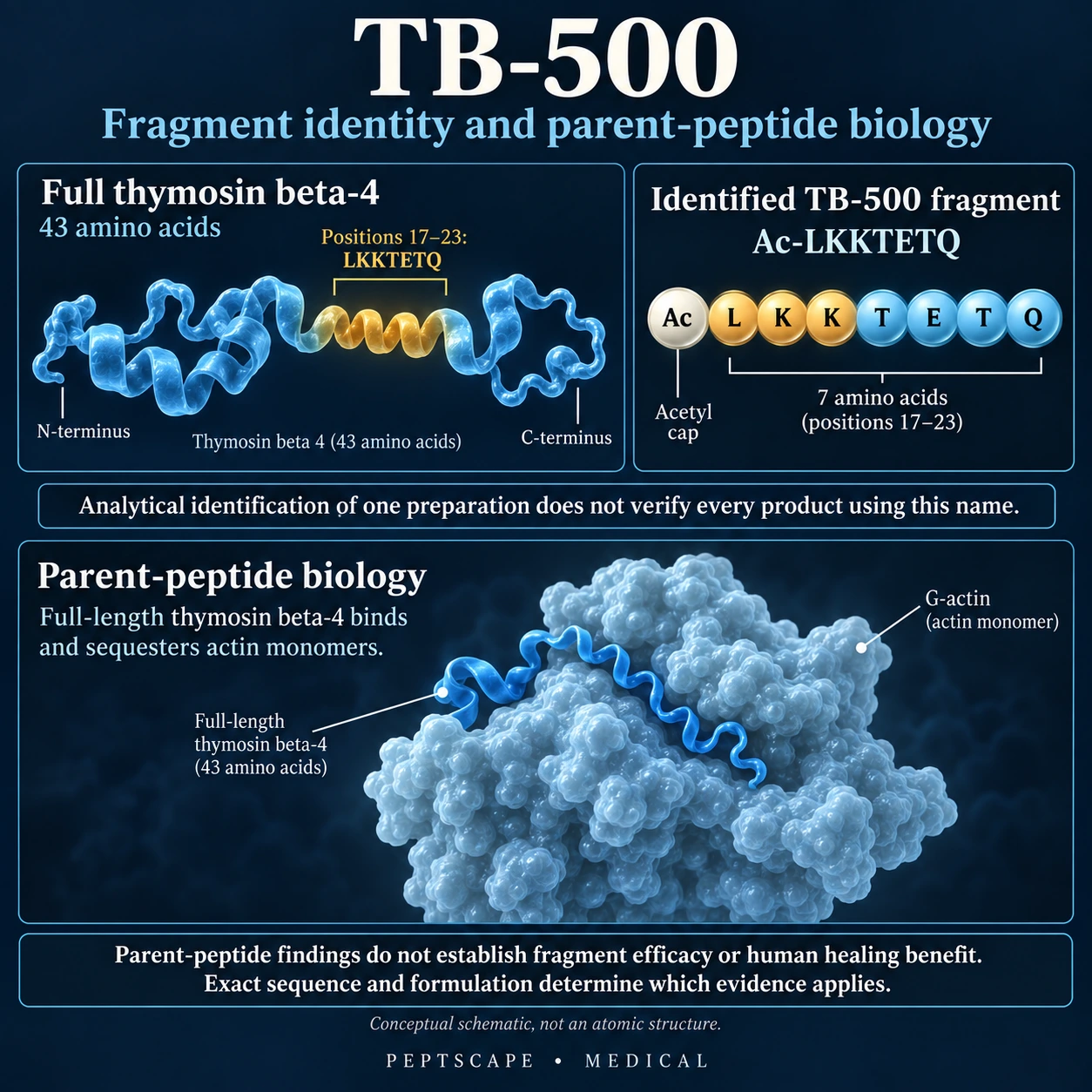
The first thing to understand is the name. Full-length thymosin beta-4 contains 43 amino acids. TB-500 has also been identified as a much shorter, acetylated seven-amino-acid fragment, Ac-LKKTETQ. These are related molecules, not simply different vial strengths of one compound.
Public descriptions often use the names interchangeably. That creates a practical problem: a study of the full-length peptide may be used to explain a product containing only a fragment. The profile therefore explains the recovery interest while keeping the two identities visible.
People investigating TB-500 are often dealing with a frustrating injury or slow return to activity. Understanding the tissue involved, the stage of healing and the rehabilitation plan is essential. A peptide discussion cannot determine whether pain comes from a strain, a tear, a nerve problem or another condition.
Medical · Benefits and common reasons for interest
Tendon, ligament and muscle recovery
Interest comes largely from the biology and experimental repair research surrounding thymosin beta-4. Cell movement, inflammatory signalling and tissue remodelling all matter during healing, so a molecule associated with these processes naturally attracts attention.
That background does not establish that a particular TB-500 vial accelerates recovery in people. Pain relief, improved movement and restored tissue strength are also different outcomes. A person may feel better before a tendon is ready for heavier loading.
Mobility and return to training
People often describe wanting to regain range of motion or tolerate exercise again. Those are useful goals to measure: the movement that hurts, load tolerated, next-day response and ability to perform ordinary tasks.
A return-to-training plan should progress according to the injury and rehabilitation assessment. Feeling less sore is not a reason to immediately test maximal strength or ignore a new loss of function.
Wound and broader repair claims
Research on full-length thymosin beta-4 includes wound and other tissue settings. It should not become a universal claim that the fragment repairs every organ or prevents scarring. Different tissues heal differently, and the preparation used in a skin or eye study is not an injection protocol for a tendon.
Medical · How does it work?
Cells have an internal framework called the cytoskeleton. Actin is one of its major components. Changing that framework helps cells move and change shape, processes that matter when tissue is being repaired.
Full-length thymosin beta-4 is well known for interacting with actin. Researchers have studied related fragments to understand which parts of the molecule contribute to different activities. A short sequence being associated with an active region does not guarantee that it reproduces all the effects of the complete peptide.
Repair also involves blood-vessel changes and inflammatory signals. These are coordinated processes, not simply things to maximise. For example, promoting cell movement is an interesting research effect but not automatically beneficial in every disease setting.
The useful explanation is therefore a tissue-repair research connection, with important differences between full-length peptide and fragment. It is not a proven “whole-body healing switch.”
Medical · TB-500, thymosin beta-4 and blends
A meaningful identity record should state the sequence or an unambiguous full name. “TB-500” alone may leave uncertainty about which material is present. “Full length” and “fragment” should not be silently merged.
BPC-157 and TB-500 are often discussed together because both attract interest in recovery. Popular co-use does not establish clinical synergy, a safe mixing ratio or stability in one vial.
Blends also make outcome tracking harder. If pain improves or an injection reaction occurs, there may be no way to identify which ingredient contributed. Record each ingredient and amount rather than using only a blend nickname.
Medical · Dosing and concentration
You may encounter loading phases followed by maintenance phases in online recovery protocols. The sources reviewed here do not establish a human TB-500-fragment dose that reliably improves tendon or muscle healing, so a loading schedule should not be presented as settled treatment.
This is more than a missing number: the label may refer to a different molecule from the one used to justify that number. Resolve identity before comparing any study amounts, and do not convert animal exposure into a self-injection dose.
Concentration arithmetic is still useful for understanding a record. A documented 5 mg amount in a final volume of 2 mL equals 2.5 mg/mL. This calculation says nothing about whether the contents are full-length thymosin beta-4 or a fragment, or whether that preparation is suitable for human use.
A clinician-directed plan needs the exact compound, formulation, amount and route. A calendar should record those decisions rather than supply a generic loading cycle merely because a vial has been added.
Medical · Preparation and reconstitution
A lyophilised vial contains freeze-dried material. Before any human-use preparation is considered, the identity and intended use must be clear. Dissolving a research vial does not establish that it is an injectable medicine.
Bacteriostatic water is often mentioned in peptide discussions. Its preservative does not resolve identity, remove endotoxin or prove that a particular TB-500 preparation is compatible with the liquid. The amount of water should come from formulation instructions, not a desired syringe marking.
For an appropriately prescribed preparation, the instructions should specify the exact peptide, diluent, volume, mixing method, final concentration and discard limit. Use clean preparation conditions and sterile single-use equipment. Do not pool materials, improvise a blend or add another solvent to make particles disappear.
Keep the preparation record attached to the batch. “Five milligrams in the vial” and “five milligrams administered” are very different statements. The final concentration is needed to understand any recorded volume.
Medical · Administration
Subcutaneous means beneath the skin, not into the injured structure. Injecting into a tendon, joint or near a nerve carries risks and is not established as a way to improve TB-500 targeting.
For any prescribed injectable medicine, site and device teaching should be specific to the preparation. Rotate appropriate sites, avoid damaged or infected skin and use new sterile equipment each time. A needle selected from a general peptide shopping list does not replace technique instruction.
Do not mistake less pain for permission to load an injury aggressively. Worsening redness, heat, swelling, fever, new weakness or an inability to bear weight requires assessment of the injury or a possible complication.
Medical · Routes and bioavailability
Oral delivery exposes peptides to digestion. A capsule may protect contents from one part of the digestive tract without proving that an intact active molecule reaches a distant tendon.
Some oral compounds act locally in the gut, where high blood exposure is unnecessary. That rationale must be demonstrated for the particular compound. It is not established simply by saying that oral TB-500 is poorly absorbed.
Subcutaneous administration bypasses initial digestion but does not establish a superior healing outcome. Studies of topical or intravenous full-length thymosin beta-4 cannot supply a route-conversion factor for the fragment.
Medical · Half-life
A dependable human half-life for the identified TB-500 fragment is not available in the sources used here. Values quoted for full-length thymosin beta-4 should not be assigned to it.
Claims of prolonged “tissue effects” do not establish weekly dosing, a loading phase or a measurable duration of benefit. The record should preserve that distinction without inventing a number.
Medical · Storage
Use storage and after-mixing instructions belonging to the identified preparation. A generic 30-day refrigerated period is not established by the peptide name or by adding bacteriostatic water.
Keep unopened expiry, preparation date and first-puncture date separate. Protect material as directed and record significant heat exposure. Do not freeze or repeatedly thaw a solution without formulation-specific instructions.
Unexpected particles, a compromised seal or an uncertain preparation history cannot be corrected by appearance checks alone. Preservatives do not make every contaminated or unstable solution usable.
Medical · Contraindications and side effects
The limited human evidence for the fragment means uncommon and long-term adverse effects are poorly characterised. Injection-related infection and immune reactions are concerns independent of any proposed repair mechanism.
Active cancer or a history requiring oncology follow-up deserves specialist discussion before exposure to experimental compounds associated with cell movement and tissue signalling. This is a precaution based on the biology and uncertainty, not proof that TB-500 causes cancer.
Pregnancy, breastfeeding and children are not settings for self-directed use. A new lump, unexplained bleeding, fever or a deteriorating injury needs medical assessment. Do not use a peptide response as a substitute for diagnosing the original problem.
Medical · Nutrition and supplement support
Feed the repair process
Injury can reduce activity and appetite, but healing still requires adequate energy and protein. Include a protein source regularly and avoid an aggressive calorie deficit during a demanding recovery period unless medically directed.
A practical food plan is usually more useful than a long supplement list. If chewing, appetite, dietary restrictions or illness makes eating difficult, address that specific barrier.
Vitamin C and collagen
Vitamin C participates in collagen formation. Fruit and vegetables are useful sources, and a deficiency should be corrected. Large doses have not been shown to turn TB-500 into a more effective treatment.
Collagen or gelatin products are sometimes discussed alongside tendon rehabilitation. They should not replace complete dietary protein or a progressive loading programme. Their own research does not establish synergy with TB-500, and improvement during combined use cannot be assigned automatically to the peptide.
Vitamin D, calcium and zinc
Bone injuries and muscle problems may prompt review of vitamin D and calcium intake. Zinc is involved in normal healing, but routine high-dose use can cause copper deficiency. Supplement according to a reason, not because every recovery peptide supposedly requires the same minerals.
Creatine and changing activity
Creatine may be relevant to strength training in an appropriate rehabilitation stage, but it is not a substitute for tissue protection or the rehabilitation plan. Record its use and any associated weight change.
Avoid disguising symptoms
Anti-inflammatory supplements, pain medicines and new training methods can all alter the experience of pain. Keep them in the record. Less pain after several simultaneous changes does not prove that damaged tissue has recovered faster.
Medical · Tracking progress and everyday questions
Track the specific movement, load, range of motion and next-day response. Keep the diagnosis and rehabilitation milestones with the record. Photos may help document visible swelling, but they cannot show internal tendon strength.
Is TB-500 definitely full-length thymosin beta-4? No; the name is used inconsistently. Does it need a loading phase? A human healing benefit from a standard loading phase has not been demonstrated here. Should it be injected beside an injury? That is not an established targeting strategy.
Medical · Medical
Analytical research identified an acetylated thymosin beta-4 fragment in material described as TB-500. This supports the identity distinction; it is not a clinical healing trial. The FDA's TB-500 assessment also separates fragment evidence from research on the parent peptide.
The correct next research question is whether an identified preparation improves a specified outcome in people, with adverse effects measured. Full-length thymosin beta-4 findings remain relevant background, not direct proof for an ambiguously named vial.