Educational illustration · Read the evidence and limitations below.
What is TB-500?
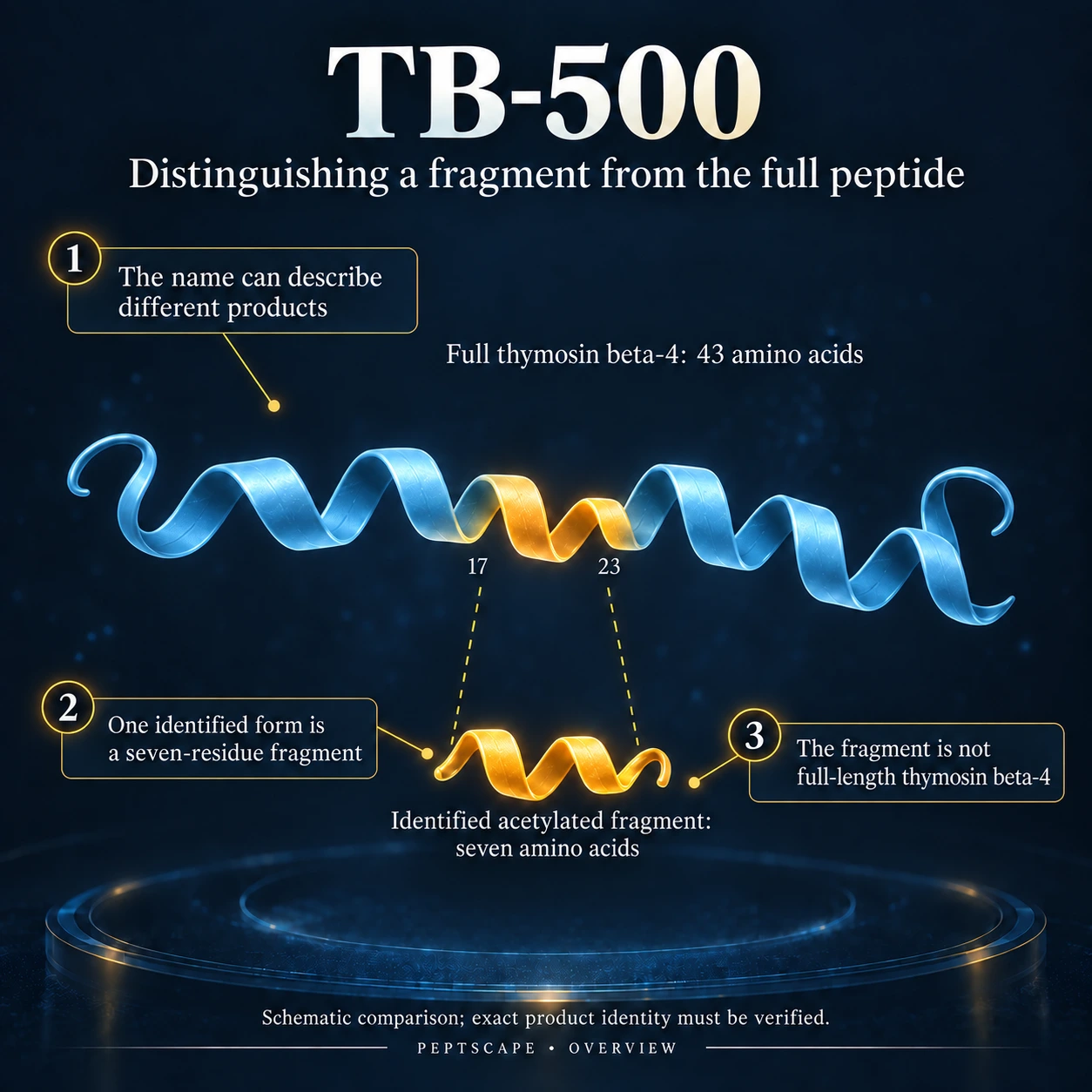
TB-500 is an experimental peptide name associated with soft-tissue repair and recovery. A crucial detail is that the name is not used consistently: it may refer to a short fragment related to thymosin beta-4, while some products use it for the full thymosin beta-4 molecule. The full peptide and a fragment are not interchangeable substances.
Thymosin beta-4 contains 43 amino acids. A seven-amino-acid fragment has been identified under the TB-500 name. This difference matters because the fragment cannot automatically be assigned every action, result or dosing instruction associated with the full molecule. A useful profile starts with that identity distinction rather than treating the label as a complete chemical description.
Why it is associated with repair
The parent molecule, thymosin beta-4, is involved in cell behaviour relevant to tissue repair, including the way cells organise themselves and move. That connection is the basis for interest in TB-500 for muscles, tendons, ligaments and other soft tissues. Reliable recovery benefits from products sold under the TB-500 name have not been established for individual users.
This is a repair-related concept rather than a growth hormone-releasing one. TB-500 should not be understood as another form of ipamorelin or CJC-1295. It is also not an anabolic steroid, and a repair-related mechanism does not mean it directly produces larger muscles.
What “soft tissue” includes
Muscle generates force. Tendons carry that force to bones. Ligaments help hold joints stable. Fascia forms sheets of connective tissue around structures. These tissues work together but differ in blood supply, organisation and the loads they need to tolerate.
A general claim about soft-tissue recovery therefore does not explain whether a preparation helps a specific injury. A painful shoulder could involve several different structures. Identifying the problem is more useful than assuming that every soft-tissue complaint has the same repair requirement.
What it is used for
Injury recovery and mobility
Experimental use of TB-500 includes recovery from muscle strains, tendon or ligament problems and reduced mobility after injury. The intended benefit is improved repair or function, not simply a temporary reduction in discomfort. Those outcomes should be kept separate because pain and structural strength do not recover at exactly the same rate.
A joint can feel less painful while still lacking strength or stability. Conversely, discomfort can persist even as function improves. Meaningful goals name the activity: walking farther, regaining a range of movement or tolerating a specific rehabilitation exercise. These give “recovery” a concrete meaning.
Exercise recovery versus healing an injury
Soreness after an unfamiliar workout is not the same as a tear or chronic tendon disorder. Normal training adaptation can make subsequent sessions less uncomfortable. That improvement should not automatically be attributed to a peptide, especially if the training programme also changed.
An injury may need controlled loading, temporary protection or a procedure. A systemic peptide does not supply the mechanical guidance that helps recovering tissue adapt to force. Progression through rehabilitation remains a separate part of recovery rather than an outcome that can be inferred from reduced soreness.
Why TB-500 and BPC-157 appear together
Both peptides are associated with experimental repair goals, but they have different proposed biological roles and different identity questions. Their frequent pairing does not establish that they complement one another clinically or that a combined vial has an effective ratio.
A blend also makes it harder to determine which ingredient preceded a change or unwanted effect. The names and amounts of both components still matter. “Recovery blend” describes an intended purpose, not a standardised molecule or a proven treatment programme.
Wound-related claims need the same identity distinction
Thymosin beta-4 has been investigated in several tissue-repair settings. Those findings cannot be transferred automatically to every TB-500 fragment or preparation. A discussion of skin, eye or other wound applications needs to identify the actual molecule and formulation involved. An injectable vial is not interchangeable with a specialised topical preparation.
How it works
Cells need an internal framework
Cells contain a framework that helps them maintain shape and move. One of its important components is actin. During repair, cells change shape, migrate and interact with surrounding tissue. Thymosin beta-4 is involved in actin regulation, which helps explain its connection to repair biology.
This explanation concerns the parent molecule. A fragment may preserve some structural features without reproducing the full molecule's behaviour. Sharing a sequence does not prove matching tissue distribution, duration or clinical effects. That is why the Medical section separates the parent evidence from fragment-specific information.
Repair is a sequence of events
An injury triggers overlapping stages: dealing with damaged material, recruiting repair cells, rebuilding support and remodelling the new tissue. An intervention that affects one signal does not necessarily improve the entire process. The final result must still tolerate the movement or load required of that structure.
This is particularly relevant to tendons and ligaments, where organisation matters as well as the amount of tissue produced. A useful explanation of repair should not reduce it to “more collagen” or “more blood flow.” Both need to occur in the right context.
Delivery is not precise targeting
A subcutaneous injection enters the tissue beneath the skin. It does not place the peptide into the injured tendon, ligament or joint, and placing it nearby has not been shown to guarantee delivery to that structure. Joint and tendon procedures are separate clinical techniques.
For a TB-500 record, preserve the exact product identity, any stated sequence or full-length designation and the intended goal. These details make later observations interpretable and prevent information about thymosin beta-4 from silently becoming instructions for an unidentified fragment.