Identity
SHLP3 is small humanin-like peptide 3, distinct from SHLP2.
Cell experiments in the cited discovery study.
Peptide library
Your guide to this compound.
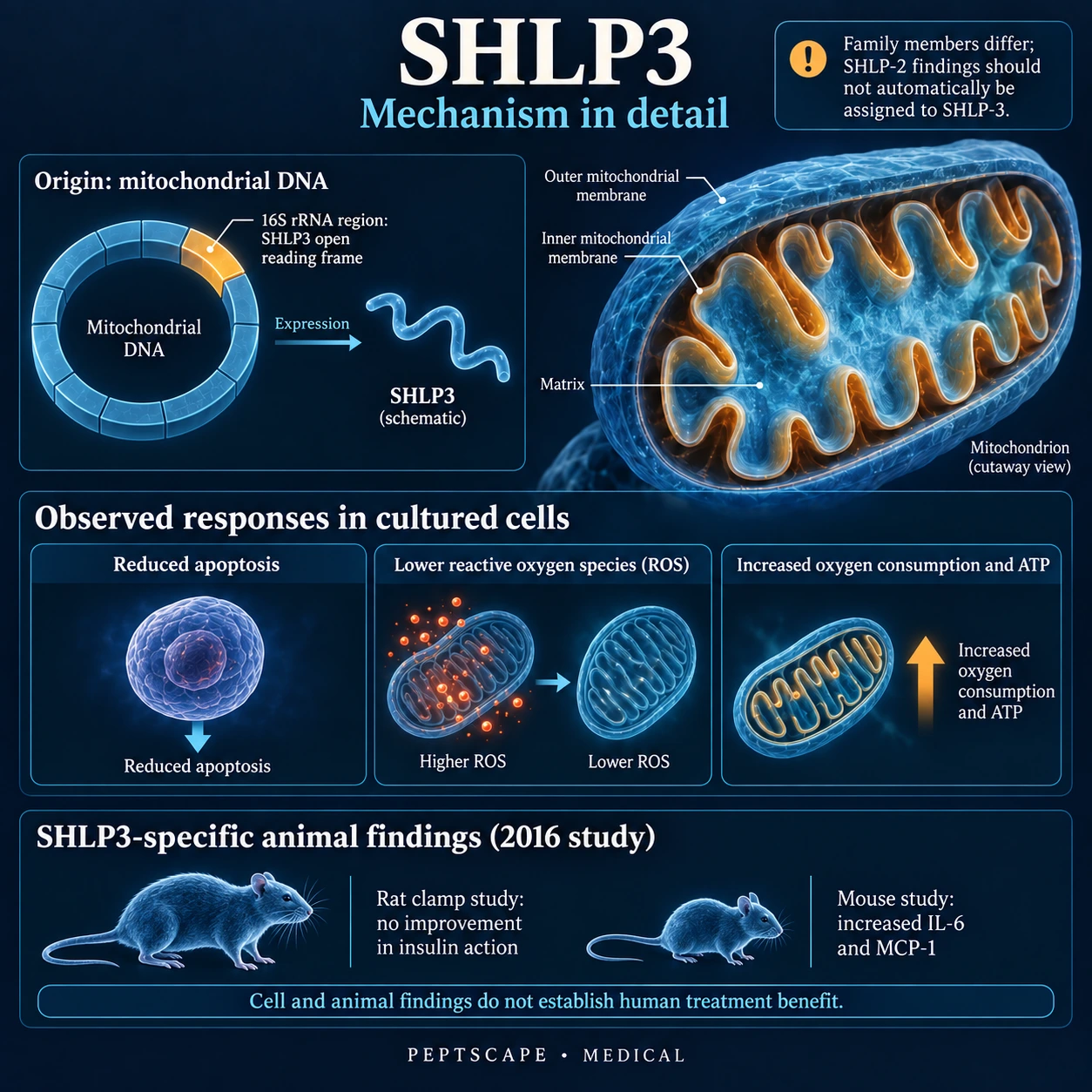
Laboratory apoptosis, oxidative-stress and mitochondrial measures are surrogate observations. They do not demonstrate a clinical anti-aging, metabolic or immune benefit.
Existing source snapshot critically reassessed.
Based on the selected source scope described in this profile, often an indexed abstract. Full methods and clinician sign-off remain pending; no systematic-review claim.
Editorial assessment · 2026-09-07
Cell experiments in the cited discovery study.
SHLP3 reduced apoptosis and oxidative stress and altered mitochondrial activity in laboratory models.
Cell experiments in the cited discovery study.
No jurisdiction-specific marketing authorization has been verified in this snapshot; study publication is not regulatory approval.
These findings do not establish human efficacy, long-term safety, or equivalence to products sold under this name. This is a focused source snapshot, not an exhaustive clinical review.
SHLP3 is small humanin-like peptide 3, distinct from SHLP2.
Read the study-specific findings and limitations in Medical. Mechanistic activity does not establish a treatment benefit.
The catalog primarily cites laboratory or animal research. Human benefit, a safe dose and long-term risks cannot be inferred from those findings.
The catalog primarily cites laboratory or animal research. Human benefit, a safe dose and long-term risks cannot be inferred from those findings.
SHLP3 is small humanin-like peptide 3, distinct from SHLP2.
Cell experiments in the cited discovery study.
SHLP3 reduced apoptosis and oxidative stress and altered mitochondrial activity in laboratory models.
Cell experiments in the cited discovery study.
Cobb et al. Naturally occurring mitochondrial-derived peptides are age-dependent regulators of apoptosis, insulin sensitivity, and inflammatory markers. 2016.
PMID: 27070352
Catalog review date: Sep 6, 2026. This date alone does not establish independent clinical review.