Educational illustration · Read the evidence and limitations below.
What is SHLP3?
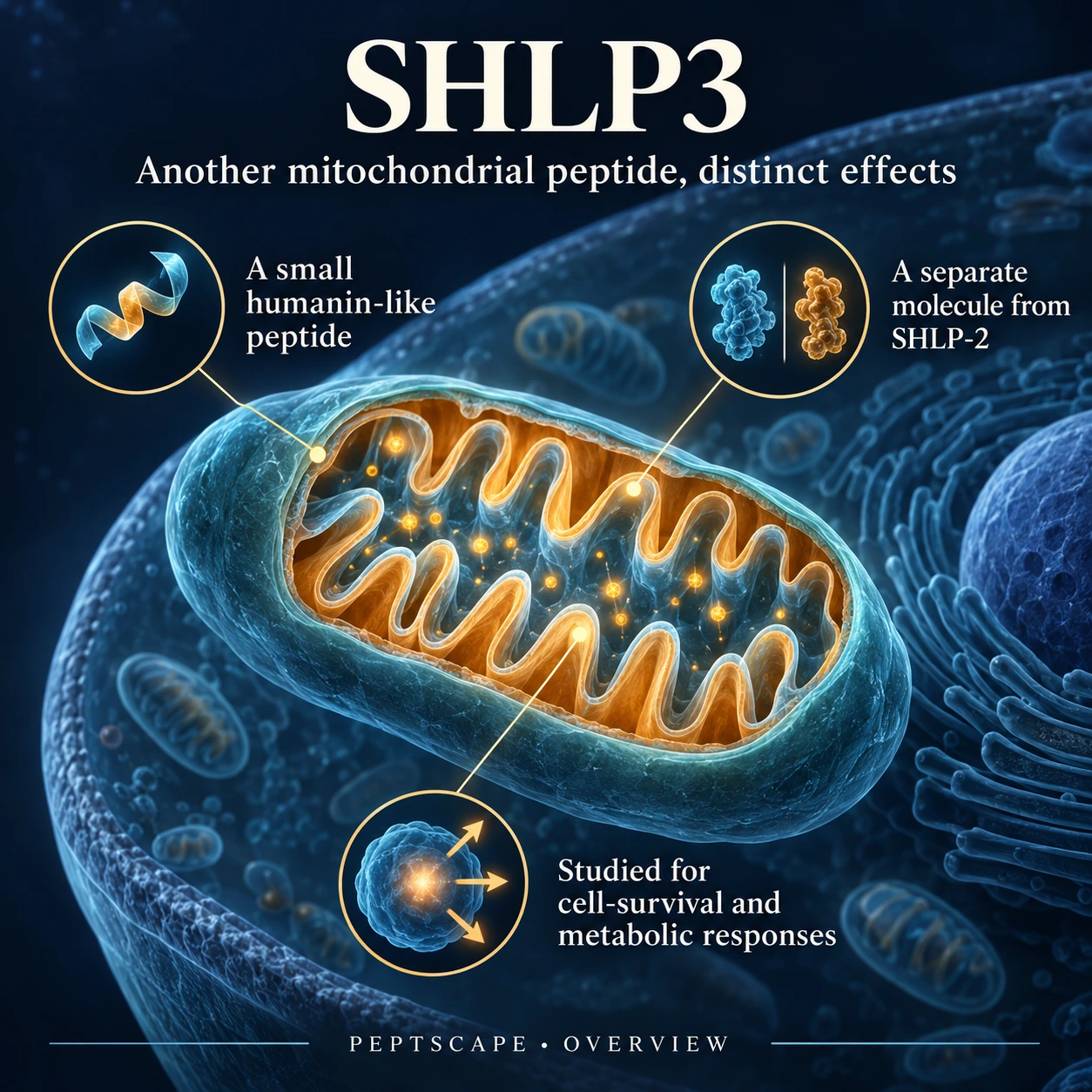
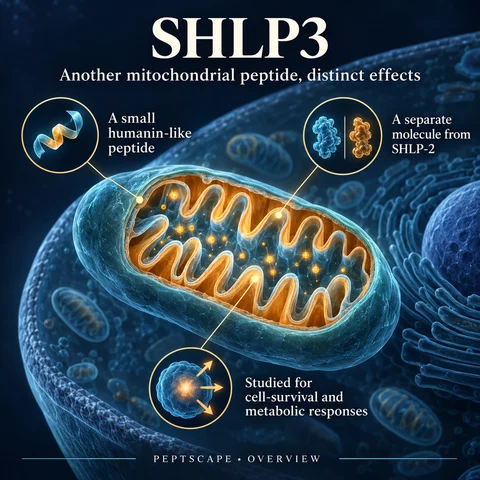
SHLP3 is small humanin-like peptide 3, one member of a mitochondrial-derived peptide research family. It is not another name for SHLP2. Its investigated actions include responses to cellular stress and changes in mitochondrial activity.
The wider picture
Mitochondria are structures inside cells that help convert food-derived fuel into usable energy. Their work supports muscle contraction, nerve activity and many other everyday functions. They also participate in cell signalling and responses to stress. A peptide associated with mitochondria may affect communication or membrane function rather than simply creating more energy. The word mitochondrial does not describe one interchangeable class of products.
ATP is often called the cell's energy currency because many activities use it immediately. Mitochondria help regenerate ATP from fuel, but energy production is only useful when it matches the cell's needs. A higher laboratory reading related to respiration is not automatically evidence of better health, just as a faster-running engine is not automatically doing more useful work.
What it is used for
Its proposed applications concern cellular protection and metabolic biology. Those themes are not equivalent to demonstrated improvements in fatigue, body composition or lifespan. The numbering of the SHLP family does not indicate increasing potency or a sequence of products that should be taken together.
Understanding the intended benefit
Fatigue can involve sleep, anaemia, thyroid function, heart or lung disease, medicines, nutrition and many other factors. A mitochondrial explanation should not be assumed from fatigue alone. For an energy-related goal, distinguish how tired someone feels from what they can do: a repeatable walk, ordinary work or a familiar exercise session. Improvements in motivation, sleep or conditioning can change those outcomes without showing that a mitochondrial disorder has been corrected.
Oxidative stress concerns an imbalance involving reactive molecules and the systems that manage them. Some reactive signals also have normal roles in adaptation. The aim is not to remove every such molecule. This helps explain why combining numerous antioxidants is not an automatic way to strengthen the effect of a mitochondrial peptide.
How it works
Short peptides with related origins can have different effects on cell survival and metabolism. Shared ancestry does not establish the same receptor interactions or the same distribution after administration. Findings for SHLP2, humanin or MOTS-c should therefore not be used to fill in a missing SHLP3 half-life or treatment schedule.
The biology in plain language
Cells produce and use energy through coordinated steps. Membranes hold some of the relevant machinery in place, while signalling molecules help cells adapt to demand. Changing a laboratory marker does not directly measure whole-body performance. A natural peptide, a modified analogue and a supplement marketed for the same pathway can have different absorption and biological effects. Shared terminology is a reason to compare their identities carefully, not a reason to combine their amounts or schedules.
Activity tolerance has several components: oxygen delivery, muscle conditioning, nerve function and motivation all contribute. A standard walk or repeated everyday task gives context that a vague energy rating lacks. Nutrition, sleep and management of the underlying condition remain relevant because they influence different parts of this system. Improvement in one part does not prove that every mitochondrial process has been normalised.