Educational illustration · Read the evidence and limitations below.
Medical · What is Sermorelin?
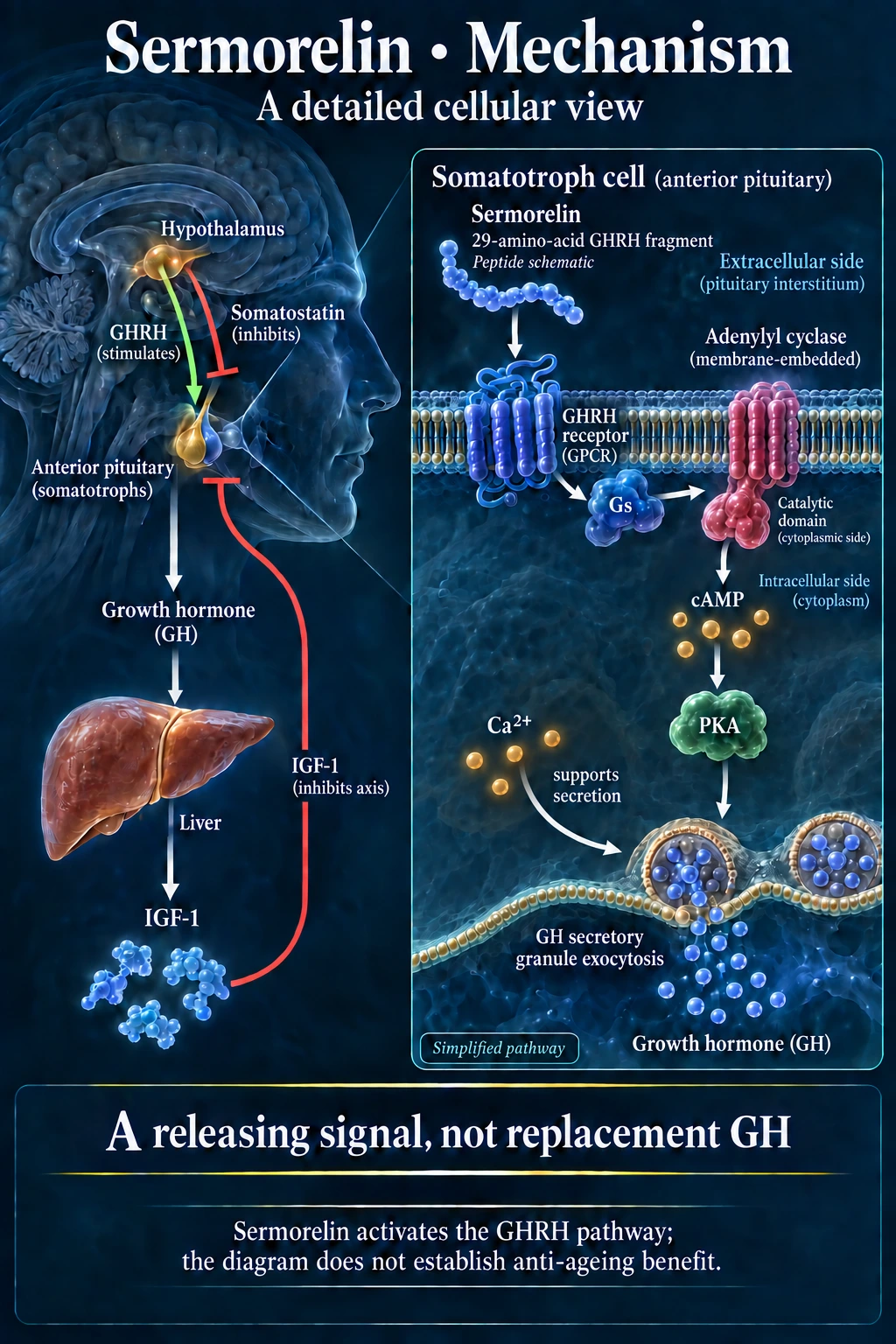
Sermorelin is a peptide that tells the pituitary gland to release growth hormone. It contains the first 29 amino acids of growth hormone-releasing hormone, usually shortened to GHRH. This is the part of the natural signal that can activate the pituitary receptor.
It is often described as a traditional or shorter-acting growth-hormone peptide. Its medical history includes evaluation of growth-hormone release and treatment of selected children with growth-hormone deficiency. Today, public interest often centres on adult recovery, sleep, energy and body composition.
Those are different settings. The fact that a peptide has been used in paediatric endocrinology does not establish every adult wellness claim. Equally, its explanation should not stop at the history of one pharmaceutical product: understanding what sermorelin signals, what people hope to achieve and what can go wrong is useful in its own right.
Sermorelin stimulates a gland rather than replacing growth hormone directly. A functioning pituitary response is therefore important. Feeling tired or having a lower growth-hormone level with age does not by itself diagnose a deficiency that needs treatment.
Medical · Benefits and common reasons for interest
Growth-hormone release
The central effect is stimulation of growth hormone. In a medical evaluation, that response can help answer a specific endocrine question. In treatment, clinicians assess actual outcomes as well as hormone measurements.
Growth hormone is naturally released in bursts. A random blood measurement may be low between bursts even in a healthy person, which is one reason diagnosis cannot rely on an isolated reading or symptoms alone.
Sleep, recovery and energy
Sermorelin is often discussed for deeper sleep, easier recovery and improved vitality. These goals relate broadly to growth-hormone physiology, but they can also change with training load, diet, mood, sleep apnoea and other medicines.
A useful approach is to define the problem clearly. “Recover better” might mean less next-day soreness or being able to maintain training. “Sleep better” might mean fewer awakenings. Recording the actual problem makes it easier to judge whether anything meaningful changed.
Body composition
Interest in fat loss and lean tissue comes from the growth-hormone pathway. However, a short-term weight change can reflect water, food intake or training changes. It does not prove that sermorelin is producing new muscle or selectively reducing abdominal fat.
Claims that it restores a universally “youthful” state go beyond what a hormone response can demonstrate. Ageing is not a single-hormone problem.
Medical · How does it work?
The brain normally coordinates growth-hormone release using both stimulating and restraining signals. Sermorelin mimics the stimulating GHRH signal at the pituitary. Growth hormone then acts on tissues and supports IGF-1 production.
Because the peptide is broken down quickly, its presence in blood is brief. The resulting hormone response can extend beyond the peptide's own half-life. This explains why short clearance does not mean that the biological effect ends immediately.
Sermorelin does not bypass all feedback controls, but “working with the body” should not be used as a guarantee of safety. Hormonal stimulation can still affect glucose regulation, fluid balance and other symptoms.
Medical · Sermorelin versus related peptides
Sermorelin is the unmodified active GHRH fragment. Modified GRF(1–29), often called CJC without DAC, includes substitutions intended to resist breakdown. CJC with DAC adds prolonged albumin binding. Tesamorelin is another modified GHRH analogue with its own clinical evidence.
Ipamorelin belongs to a different receptor pathway, associated with ghrelin. This is why it is sometimes paired with GHRH analogues. Such pairing does not establish that all combinations are equally useful or that ingredients can be mixed in the same vial.
The practical record should preserve the individual name. “GH peptide” is a category, not enough information to select preparation, timing or a dose.
Medical · Dosing and concentration
Historical medical dosing addressed specific diagnostic or paediatric treatment purposes. Those amounts should not be turned into a weight-based adult anti-ageing calculator.
Adult wellness discussions commonly quote 200–500 micrograms subcutaneously at bedtime. That range describes reported practice, not a prescription established for every person seeking better energy or sleep. Days off and “cycles” also vary in public discussions; a pattern being popular does not establish its optimal duration.
For prescribed treatment, record the actual amount, frequency and clinical reason. Do not infer a dose from vial size: a vial containing several milligrams may contain many administrations.
For arithmetic only, a documented final preparation of 5 mg in 2 mL contains 2.5 mg/mL, or 2,500 micrograms/mL. This explains concentration and does not specify the appropriate diluent, preparation volume or administration amount for a particular product.
If a syringe is marked in U-100 units, those are volume markings calibrated for insulin. They do not measure international units of sermorelin. Save the concentration with any calculated volume so it cannot silently carry over to a different vial strength.
Medical · Preparation and reconstitution
Sermorelin may be supplied as a lyophilised, or freeze-dried, preparation. Reconstitution dissolves it in a specified liquid. The appropriate diluent belongs to the formulation, not just to the peptide's name.
Bacteriostatic water contains a preservative, commonly benzyl alcohol. Some medicinal preparations specify a different liquid or immediate use after mixing. Follow those instructions rather than replacing them with a general rule about peptide water.
Before mixing, check the exact product, amount, diluent, volume and usable period after preparation. Use clean hands, a clean preparation area and sterile single-use equipment. Follow the specified mixing method; do not apply heat or add acid to rescue unexpected particles or incomplete dissolution.
Record the preparation date and final concentration clearly. Sterility and chemical stability are separate: a preservative does not prove the peptide remains potent, and a clear solution does not prove it is uncontaminated.
Medical · Administration
Subcutaneous administration means the fatty tissue beneath the skin. A prescribed product should be accompanied by teaching on site selection, the supplied device and appropriate technique. It is not an instruction to inject directly into a muscle or an area being rehabilitated.
Rotate suitable sites and avoid irritated, infected or bruised skin. Needle length, angle and whether a skin fold is needed depend on the person and device. Use new sterile equipment for each administration and discard it in a sharps container.
Bedtime schedules are often discussed because of natural growth-hormone rhythms. That does not mean every user should independently choose bedtime, fast for a fixed number of hours or add an extra amount after poor sleep. Follow the actual treatment plan and record deviations honestly.
Medical · Routes and bioavailability
Swallowed sermorelin faces digestive breakdown and limited passage across the gut lining. An oral or sublingual formulation therefore needs evidence for its own delivery method; it cannot inherit an injectable amount.
Subcutaneous delivery avoids the first digestive step, but it is still not identical to intravenous administration. A historical medical monograph reports low absolute subcutaneous bioavailability, illustrating why “injected” does not always mean complete systemic delivery.
Some oral peptides work locally in the gut despite low blood levels. Sermorelin is intended to signal the pituitary, so a local gut effect is not an established reason to prefer swallowing it. Claims of improved oral absorption should specify the formulation and measured outcome.
Medical · Half-life
Approximately 11–12 minutes after intravenous or subcutaneous administration in the historical medical monograph. The peptide's brief half-life is separate from the duration of the growth-hormone response.
This figure does not establish how frequently a wellness user should dose or how long a prepared vial can be stored.
Medical · Storage
Use the actual formulation's temperature, light protection and after-mixing instructions. Do not apply a universal 30-day refrigerated shelf life to every sermorelin preparation.
Record expiry, reconstitution and first-opening dates separately. Keep the product in its labelled container, avoid heat exposure and do not freeze unless specifically directed. Storage instructions for an unopened lyophilised vial may change once liquid has been added.
A damaged seal, uncertain temperature history, unexpected particles or changed appearance needs assessment. Extra bacteriostatic water, filtering or transferring to another container does not reliably correct those problems.
Medical · Contraindications and side effects
Growth-hormone treatment needs special review in people with active cancer, pituitary or intracranial disease, abnormal glucose control and unexplained headaches or visual symptoms. A medical evaluation should establish why the hormone pathway is being targeted.
Local reactions, flushing and headache can occur. Growth-hormone-related effects can include swelling, joint discomfort, tingling and changes in glucose control. Thyroid status also matters when evaluating growth and hormone symptoms; a fatigue complaint should not automatically be attributed to low GH.
Pregnancy, breastfeeding and paediatric use require specialist assessment rather than a wellness protocol. Review glucocorticoids, other hormone agents and glucose-related medicines with the treating clinician. Severe allergic symptoms or severe headache with vision changes requires urgent attention.
Medical · Nutrition and supplement support
Build a recovery-friendly eating pattern
Regular meals with adequate protein and energy support the goals people usually bring to sermorelin. Examples include eggs or yoghurt at breakfast, beans or fish at lunch, and tofu, poultry or another protein source at dinner. The exact foods can fit dietary preference and medical needs.
A supplement is useful when it fills a genuine gap. Protein powder does not activate sermorelin, and skipping meals to chase a hormone peak can work against recovery.
Bone and muscle nutrients
Calcium, vitamin D and magnesium contribute to normal bone and muscle function. Review dietary intake and any reason to suspect deficiency. High-dose supplementation without a need has not been shown to amplify sermorelin's benefit.
Kidney disease, a history of stones and relevant medicines can change the suitability of mineral supplements. A combined “bone” formula may duplicate ingredients already present in a multivitamin.
Creatine and training
Creatine can support repeated high-intensity exercise and strength-training performance in appropriate adults. It is an independent tool, not proof of a beneficial sermorelin stack. Record its introduction because it can affect body weight and performance.
Fatigue and deficiencies
Iron or B12 deficiency, inadequate food intake and poor sleep can all contribute to low energy. Correcting an identified cause is more useful than assuming that a hormone peptide and a broad supplement blend will solve the same symptom.
Avoid unnecessary hormone boosters
Arginine, ornithine and multi-ingredient products are sometimes promoted to increase GH. A short-lived change in a hormone test is not evidence of additional clinical benefit with sermorelin. Products containing stimulants may also undermine the sleep goal that prompted use in the first place.
Medical · Tracking progress and everyday questions
Track the goal, actual schedule, sleep, training and unwanted effects. Keep clinician-directed laboratory results with their dates and reference ranges. Avoid adjusting treatment from a single random GH result.
Is sermorelin the same as HGH? No. Does “natural release” make it automatically safe? No. Can an adult use a child's treatment dose by scaling body weight? That is not an appropriate way to create a wellness plan.
If nothing meaningful improves, a longer cycle is not automatically the answer. Revisit the original problem and the other factors that could explain it.
Medical · Medical
Sermorelin's historical medical use establishes a real endocrine pharmacology and a clinical history. It does not establish every modern adult wellness claim. The historical monograph supports the short half-life and highlights formulation-specific handling and endocrine precautions.
Related paediatric research concerns diagnosed growth problems and measured GH responses. It should remain clearly separated from claims about healthy adults, body composition and longevity.