Educational illustration · Read the evidence and limitations below.
What is Sermorelin?
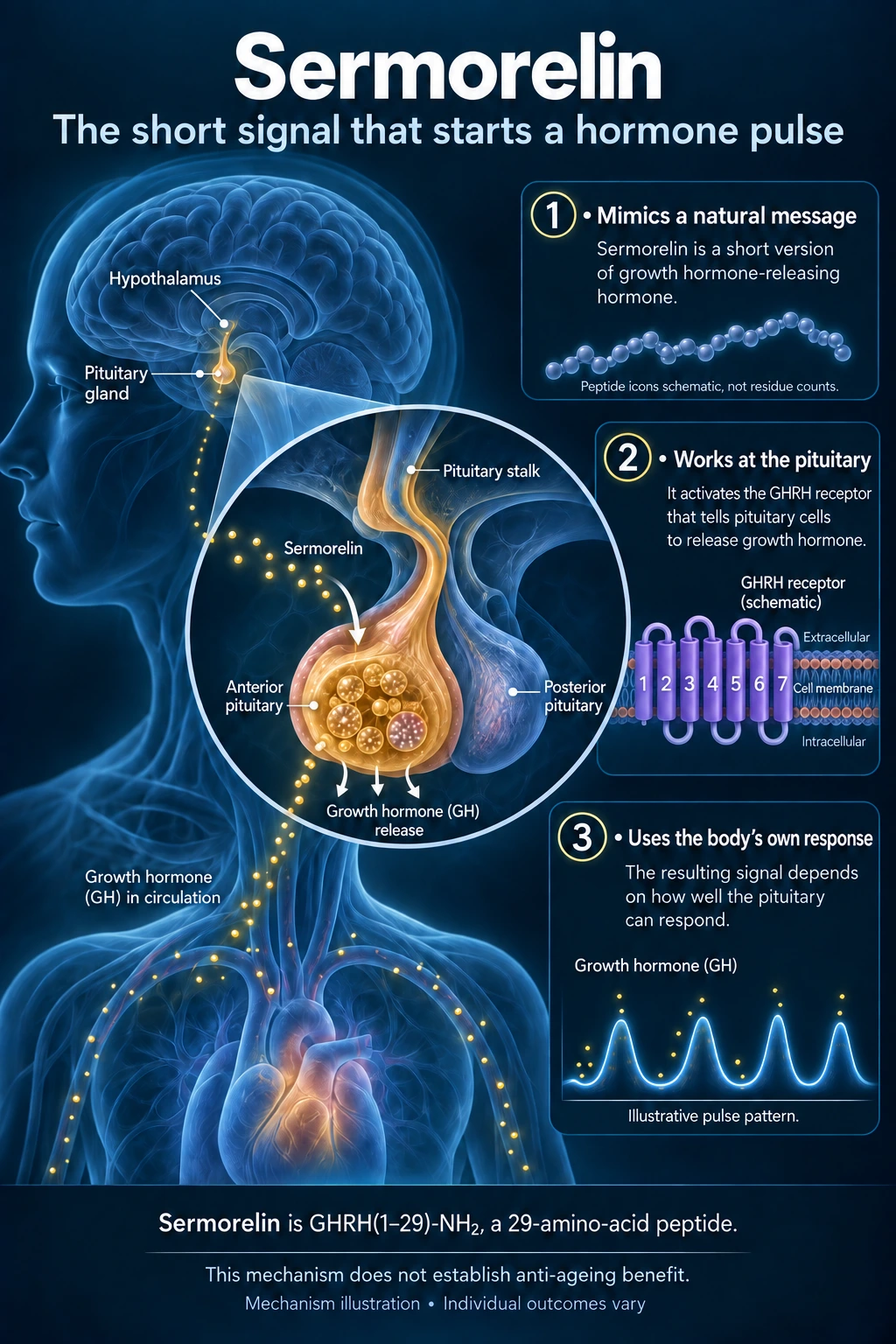
Sermorelin is a growth hormone-releasing peptide. It contains the first 29 amino acids of growth hormone-releasing hormone, or GHRH—the active part of a natural signal that tells the pituitary gland to release growth hormone. The pituitary is a small gland beneath the brain that coordinates several important hormones.
In adult peptide use, the main goals are body composition, recovery and sleep-related wellbeing. These are off-label or experimental applications, depending on the preparation and setting. Sermorelin's ability to stimulate hormone release does not establish that it reliably improves all of these outcomes in someone without a diagnosed deficiency.
A signal, rather than a replacement hormone
Sermorelin prompts the body to release its own growth hormone. Injected growth hormone supplies the hormone directly. That difference is central to understanding the peptide: sermorelin needs a responsive pituitary and acts within the body's feedback systems.
It is sometimes described as restoring a youthful signal. That phrase is too broad to define an expected result. Growth hormone secretion changes with age, but it is also affected by sleep, body composition, nutrition and illness. An age-related change is not automatically a deficiency that needs treatment.
Where Sermorelin fits among similar peptides
Sermorelin acts through the GHRH receptor. Modified GRF(1–29), often labelled CJC-1295 without DAC, is related but has changes to its amino-acid sequence. CJC-1295 with DAC has an additional feature that prolongs exposure by binding to albumin in the blood. Ipamorelin uses a different receptor associated with ghrelin.
These names describe differences in structure and action, not simply stronger and weaker versions of one treatment. A shorter-acting peptide is not automatically less effective, and a longer-acting one is not automatically better. The purpose and the resulting hormonal exposure matter.
What it is used for
Body composition
Experimental adult use often aims to reduce fat while maintaining lean tissue. Growth hormone helps regulate the release of stored fat and supports tissue maintenance. That is different from directly reducing appetite, so sermorelin should not be presented as equivalent to an appetite-suppressing weight-loss peptide.
A change in body composition may occur without a large change in total body weight, but weight changes also need context. Lean mass includes water. Fluid retention can therefore increase a lean-mass reading without representing additional muscle. Measurements taken under similar conditions are easier to interpret than readings taken after different meals, workouts or levels of hydration.
Recovery and physical performance
Sermorelin is used experimentally with the aim of supporting recovery and physical resilience. Growth hormone and its downstream messenger IGF-1 participate in tissue maintenance, which provides the rationale for this use. Their involvement does not make a releasing peptide a direct treatment for a torn tendon, joint damage or muscle injury.
Training recovery, injury rehabilitation and treatment of a hormone deficiency are different situations. In training, the useful result might be tolerance of a comparable workload. In rehabilitation, it might be a gradual return of a specific movement. A hormone level alone cannot confirm either outcome.
Sleep and energy
A major growth hormone pulse is associated with deep sleep. This relationship is one reason sleep features prominently in discussions of sermorelin. However, stimulating the hormone system is not the same as restoring every part of sleep, and sermorelin is not a sedative.
Daytime fatigue may come from short sleep, sleep apnoea, anaemia, thyroid problems, medicines or many other causes. A clear explanation of sermorelin should therefore describe its hormonal target rather than treating fatigue as evidence of low growth hormone. Easier sleep onset, fewer awakenings and improved daytime function should also be distinguished from one another.
Hormone assessment
Sermorelin has a history in growth hormone assessment and treatment. Those clinical applications help explain what the molecule does, but they are not the whole reason an adult reader may be interested in it. The Medical section provides that background separately from this discussion of adult goals and practical distinctions.
How it works
From pituitary signal to tissue response
Sermorelin binds to the GHRH receptor and encourages growth hormone release. Growth hormone then acts on multiple tissues and promotes IGF-1 production, including in the liver. IGF-1 helps mediate growth and tissue-maintenance signals throughout the body.
The body regulates this system through feedback. A higher concentration of one signal can influence the release of another. This is why hormone systems should not be imagined as a simple fuel tank where adding more always produces more useful energy or recovery.
Pulses explain why a single growth hormone result can mislead
Growth hormone is released in bursts rather than at one steady level. A blood sample taken between bursts can be low even when secretion is normal. IGF-1 is less variable over short periods, but its interpretation still depends on factors such as age and the wider clinical picture.
The distinction matters for expectations as well as testing. Feeling no immediate sensation does not measure whether a hormonal response occurred. Equally, feeling more energetic does not prove that a hormone deficiency has been corrected.
Whole-body action, not local fat removal
A subcutaneous injection is a delivery route into the body. It does not tell the peptide to work only on the fat near the injection site. The target is the pituitary signalling system, with downstream effects elsewhere.
Increased growth hormone activity can also involve fluid retention, tingling or changes in glucose control. These are relevant observations alongside any desired effects. A useful assessment connects the purpose, preparation, timing, laboratory context and actual day-to-day outcome rather than relying on the idea that more growth hormone must be beneficial.