Educational illustration · Read the evidence and limitations below.
Medical · What is Semax?
Semax is a peptide people most often encounter while looking for better focus, clearer thinking or support with mental fatigue. It belongs to the group commonly called nootropics: substances studied or used with the aim of improving aspects of brain function.
Originally developed in Russia, Semax contains seven amino acids. Amino acids are the building blocks of proteins; a short chain of them is called a peptide. Its structure was developed from part of a natural hormone called ACTH, but Semax is not the same medicine as ACTH and should not be described as hormone replacement.
The main interest is in how it may affect communication between brain cells and their response to stress or injury. Researchers have studied it in laboratory experiments, animals and people, including patients recovering from stroke. People also discuss using it for demanding work, study and concentration, although those everyday goals are not established by the stroke research.
Semax is often associated with nasal drops and sprays. Nasal delivery avoids starting in the digestive system, where many peptides are broken down. It also makes the concentration and delivery device important: two bottles can contain Semax but deliver very different amounts with each drop or spray.
This profile covers Semax itself. N-acetyl Semax and N-acetyl Semax amidate are modified molecules and should not be treated as interchangeable versions with the same dose or duration.
Medical · Benefits and uses
Focus and mental clarity
People commonly describe wanting to stay with a task, feel less mentally scattered or process information more easily. Those are the kinds of experiences behind the interest in Semax for focus.
Human research includes a small study in healthy volunteers that measured changes in brain-network activity after nasal administration. It did not show that participants became more productive or performed better at work. The distinction matters because a change on a brain scan and an improvement someone can use in daily life are different results.
A useful personal goal is concrete: completing a reading session, following a conversation or finishing a task with fewer interruptions. “Brain optimization” is much harder to evaluate.
Memory and learning
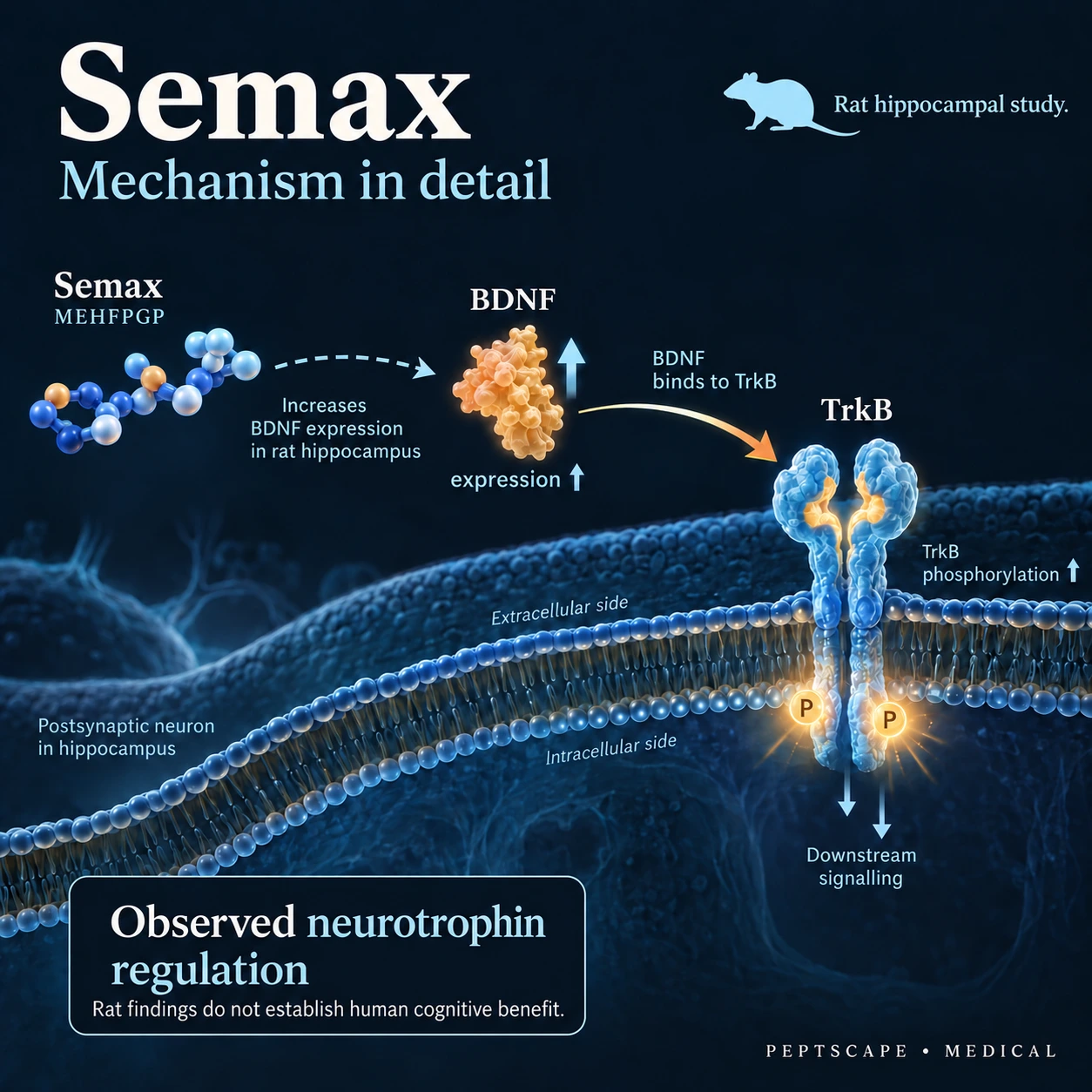
Semax is frequently discussed in connection with BDNF, a protein involved in the maintenance and adaptability of nerve cells. This gives researchers a reason to investigate learning and memory.
Animal experiments have found changes in BDNF-related signaling. These findings help explain the interest, but do not establish that a healthy person will remember more or learn faster. A benefit in a memory task needs to be measured directly.
Mental fatigue
Mental fatigue can feel like declining concentration, slowed thinking or needing more effort to complete familiar tasks. Russian medical references describe Semax use in this area.
Fatigue can also reflect sleep loss, stress, medication effects or a health problem. Persistent fatigue deserves attention to its cause, especially when it is new or is interfering with normal activities. A nootropic should not become a way to repeatedly work through inadequate sleep.
Neurological recovery
Semax has been studied alongside medical treatment and rehabilitation after ischemic stroke, which happens when blood flow to part of the brain is blocked.
This is a clinical setting with a diagnosed injury and supervised care. It does not mean a nasal peptide can replace emergency stroke treatment or rehabilitation. Sudden facial drooping, weakness or difficulty speaking needs emergency assessment.
Medical · How does it work?
Nerve cells communicate across connections called synapses. These connections can change with learning and experience, a property known as plasticity.
One research direction involves BDNF, short for brain-derived neurotrophic factor. BDNF helps regulate nerve-cell function and the strength and adaptability of their connections. TrkB is one of the receptors through which BDNF sends its signal.
In rat experiments, Semax affected BDNF and TrkB-related measurements in brain regions involved in learning and memory. Think of this as research into the signals supporting brain-cell function, rather than proof that Semax “grows a smarter brain.”
Researchers have also studied changes in human brain-network activity after nasal Semax. A network is a group of brain regions whose activity is coordinated. Detecting a change can help identify what to study next; it does not tell us that every change is beneficial.
Semax should therefore be understood as a peptide being investigated for neurological effects, with a history of medical use in Russia. It is not simply a vitamin, caffeine substitute or guaranteed cognitive enhancer.
Medical · Semax and modified Semax peptides
You may see names such as N-acetyl Semax or N-acetyl Semax amidate. These refer to chemical changes at the ends of the peptide chain.
Such modifications can be investigated to change how a peptide behaves, including its resistance to breakdown. But a proposed reason for making a derivative is not proof of greater benefit in people.
Do not assume that a modified peptide is “twice as strong,” lasts a particular number of hours, or can use the same amount as Semax. Keep the full compound name in any record. Shortening every derivative to “Semax” makes it harder to identify what was actually used.
Medical · Dosing and concentration
Why the percentage matters
A percentage on a nasal bottle describes concentration, not the amount delivered by one spray.
• A 0.1% weight/volume solution contains 1 mg per mL, or 1,000 micrograms per mL.
• A 1% solution contains 10 mg per mL, or 10,000 micrograms per mL.
The second solution is ten times as concentrated. The decimal point is therefore an important part of the label.
Reported medical-use amounts
The Russian medical reference for 0.1% nasal drops describes 400–900 micrograms per day over 3–5 days for prevention of mental fatigue. This is a description of that medical-use reference, not an instruction for an unidentified bottle or a subcutaneous injection.
Other neurological indications have different schedules. A larger amount used in stroke care is not an escalation target for someone seeking better concentration.
From concentration to an amount
For a liquid, the calculation is concentration multiplied by delivered volume.
If a device is documented to deliver 0.05 mL, a 1 mg/mL solution contains 0.05 mg—or 50 micrograms—in that volume. At 10 mg/mL, the same volume contains 500 micrograms.
These are calculation examples, not dosing recommendations. They do not establish that your dropper or pump delivers 0.05 mL. Use its documented output rather than assuming all sprays or drops are the same size.
What to record
Record the exact peptide, concentration, delivery device, documented amount per spray or drop, number administered and time. “Two sprays” alone leaves out the information needed to understand the amount.
A bottle’s total peptide content also is not a single dose. Keep total milligrams in the bottle separate from micrograms per administration.
Medical · Preparation and reconstitution
Ready-made nasal solutions
A formulated nasal solution is already prepared. Do not add bacteriostatic water to a ready-made bottle unless its own instructions specifically require it. Adding liquid changes the concentration and may change the formulation’s preservative balance and suitability for nasal tissue.
Check whether the bottle uses a dropper or a metered spray. Retain the supplied device and its directions; replacing it can change the amount delivered.
Lyophilised Semax
Lyophilised means freeze-dried. Adding liquid to a lyophilised peptide is called reconstitution. Dissolving the peptide, however, is only one part of preparing a medicine suitable for a particular route.
A nasal preparation needs a suitable liquid base, acidity, concentration, container and delivery device. Its preservative and after-opening storage instructions also matter. A laboratory vial and an empty spray bottle do not supply all of that information.
Where bacteriostatic water fits
Bacteriostatic water contains a preservative, commonly benzyl alcohol, that limits the growth of some microorganisms. It does not sterilize contaminated material.
It is not automatically the appropriate liquid for a nasal Semax preparation. Water specified for preparing one injectable product should not be assumed suitable for the nose. The preparation instructions must identify a route-compatible liquid and the required volume.
Check the finished preparation
Confirm the final concentration, device output, opening or preparation date, and discard instructions. Keep this information together on the container or in the vial record.
Do not interpret a clear-looking liquid as proof that it is sterile or chemically stable. A concentration calculation can check the arithmetic; it cannot establish the quality of the preparation.
Medical · Administration
Nasal drops and sprays
Use the technique for the supplied device. Drops and metered sprays differ in how they deliver liquid, so instructions about priming, head position and cleaning should come from that device’s directions.
Keep the tip clean, avoid sharing the bottle, and replace its cap after use. Avoid touching the tip to unclean surfaces. Do not change the pump or dropper without checking whether the delivered volume changes.
If the nose is irritated, bleeding or significantly blocked, seek advice before continuing. Do not compensate for an uncomfortable or poorly delivered administration by repeatedly adding more.
Other nasal medicines
Record other sprays or drops being used, including their timing. Nasal congestion, another medicine and changes in technique can all affect how an administration feels. This helps a clinician review irritation without assuming the peptide itself is the only possible cause.
What about injections?
The human studies discussed in this profile used nasal administration. They do not provide a conversion to subcutaneous use. An injection under the skin has a different preparation and absorption process, and the same number of milligrams cannot be assumed equivalent.
This nasal guide does not establish a preferred injection site or an injection regimen for Semax.
Medical · Oral, nasal and SubQ routes
Oral: the digestive barrier
Swallowed peptides encounter digestive enzymes that can break their chains into smaller pieces. The intestinal lining also limits the passage of many intact peptides into the blood.
Bioavailability describes the proportion of an administered amount that reaches the circulation unchanged. Surviving stomach acid is only one step; a peptide still has to cross the intestinal lining.
Nasal: avoiding the stomach first
Nasal delivery places the preparation against the lining of the nose. Some liquid may be swallowed, and absorption can vary with formulation and delivery. The route does not guarantee that all of the peptide reaches the blood or the brain.
SubQ: a separate route
SubQ means beneath the skin, in fatty tissue. It avoids initial digestive breakdown but still requires absorption from the injection site. It is not interchangeable with nasal delivery on a milligram-for-milligram basis.
Could an oral preparation act directly on the gut?
Local contact with the gut can be relevant for medicines intended to act on intestinal tissue. That does not explain Semax’s proposed effects on attention or memory. For those goals, an oral preparation needs evidence of relevant delivery and outcomes, rather than simply being described as a gut-active alternative.
Medical · Half-life
A dependable human plasma half-life is not available from the clinical sources reviewed for this profile. A claim of “one or two hours of effects” is not a measured half-life.
Half-life describes the fall in drug concentration. The duration of a feeling, or a downstream change in brain-cell signaling, can be different. Neither supplies a reliable redosing timer for Semax.
Medical · Storage
The Russian reference for the 0.1% nasal-drop preparation specifies refrigeration at 2–8°C. Keep that instruction attached to the particular preparation; it does not establish the stability of every spray, derivative or lyophilised vial.
Keep the original label and record when a nasal bottle was opened. Follow its own after-opening and discard instructions. A generic “30 days after mixing” rule is not a demonstrated Semax storage interval.
For lyophilised material, use the documented temperature, light and moisture instructions. Do not transfer the storage directions for a ready-made nasal liquid to the powder.
Avoid assuming that freezing or re-refrigerating a bottle extends its usable life. If storage conditions were lost during travel, obtain advice for that preparation rather than resetting its opening date.
Medical · Contraindications and precautions
Russian medical references list pregnancy, breastfeeding, acute psychiatric conditions, anxiety-associated disorders and a seizure history among contraindication contexts. A previous serious reaction to the peptide or its ingredients also requires medical review.
People with neurological or psychiatric conditions should involve their treating clinician. A wellness routine should not replace seizure treatment, psychiatric care or stroke rehabilitation. Children require specialist assessment rather than a scaled-down adult nootropic routine.
Bring a complete medicine and supplement list, including stimulants and other nootropics. The absence of a reported interaction is not proof that a combination is safe.
Medical · Side effects and combinations
Nasal irritation is one practical concern. Record any new discomfort, headache, sleep disruption or agitation with its timing and preparation. Some of these are symptoms worth tracking rather than established reactions with a known frequency.
If symptoms persist or worsen, stop experimenting with additional products and seek medical advice. Difficulty breathing, throat swelling or fainting after administration needs emergency care.
Semax and Selank are often discussed together online. Popularity of the combination does not show that they are compatible in the same bottle or that their effects will be predictable. Introducing several substances together also makes it difficult to tell which one caused a change.
Medical · Nutritional and supplement support
Vitamin B12: check for a real shortfall
Vitamin B12 supports normal nerve function. A deficiency can cause neurological symptoms and may affect thinking or memory.
Food sources include fish, meat, eggs and dairy; fortified foods can help people eating plant-based diets. Adults generally need 2.4 micrograms a day, but treatment of a diagnosed deficiency may require a different amount and route.
People with absorption problems, certain gastrointestinal surgery or restrictive diets may need assessment. Taking extra B12 when intake and status are adequate is not a proven way to strengthen Semax’s effects.
Magnesium: support normal function
Magnesium contributes to nerve and muscle function. Nuts, seeds, beans and whole grains are useful dietary sources.
Supplement labels can be confusing: the amount of elemental magnesium is what matters, not the total weight of the magnesium compound. Supplemental magnesium can cause diarrhea and interfere with some medicines. Kidney impairment increases the risk of accumulation.
Use it to address a nutritional need, not because “brain support” on a label proves better concentration or a special interaction with Semax.
Omega-3s: food and supplements
Oily fish supplies EPA and DHA. Walnuts, chia and flax provide ALA, a different omega-3 fatty acid.
Omega-3s have nutritional roles, but that does not establish fish oil as a Semax enhancer. High-dose supplements warrant review, particularly with a heart-rhythm history or medicines affecting bleeding. Some high-dose cardiovascular trials found increased atrial fibrillation.
Choline: a nutrient, not a required stack
Choline contributes to cell membranes and the production of acetylcholine, a chemical used by nerves to communicate. Eggs, soybeans, fish and meat are food sources.
This explains why choline appears in cognitive-supplement discussions. It does not establish that everyone using Semax needs a concentrated choline supplement.
Vitamin B6: count overlapping products
B6 is involved in neurotransmitter metabolism. More is not necessarily better: prolonged excessive supplementation can damage sensory nerves.
Check multivitamins, B-complex tablets and energy products together. A person may unintentionally combine several sources while thinking each is a modest supplement.
Start with the daily routine
Regular meals, hydration and adequate sleep support a workable baseline. Keep caffeine intake reasonably consistent when judging changes in focus; changing caffeine, sleep and several supplements at the same time makes comparison difficult.
Choose a supplement for a clear purpose, such as addressing low intake or a diagnosed deficiency. No required Semax supplement bundle has been established.
Medical · Common questions
Is Semax a stimulant?
It is not a conventional stimulant medicine such as an amphetamine. That does not establish that it cannot cause unwanted stimulation, sleep changes or interactions in a particular person.
Are 0.1% and 1% almost the same?
No. A 1% solution contains ten times as much peptide per mL as a 0.1% solution. Delivered volume still matters.
Is acetylated Semax simply stronger?
A chemical modification creates a different question about delivery, duration and safety. Do not convert between derivatives using an assumed strength multiplier.
What would meaningful progress look like?
Use a specific goal, such as completing a usual reading task or managing fewer interruptions during a familiar activity. Record sleep and caffeine alongside it. A feeling of stimulation is not automatically improved performance.
Medical · Medical
Human publications include neurological patient studies and small healthy-volunteer imaging studies. Keep rehabilitation outcomes separate from claims about cognition in healthy users.
The 2018 rehabilitation report involved 110 people after ischemic stroke and assessed BDNF and functional recovery. The healthy-volunteer imaging study involved 24 participants and measured brain-network activity. Neither establishes a universal wellness regimen.
The animal BDNF studies provide a mechanistic basis for investigation. They do not establish a quantified improvement in human memory. The Russian reference supplies formulation-specific medical-use information and storage directions, not equivalence for other preparations.