Educational illustration · Read the evidence and limitations below.
What is Semax?
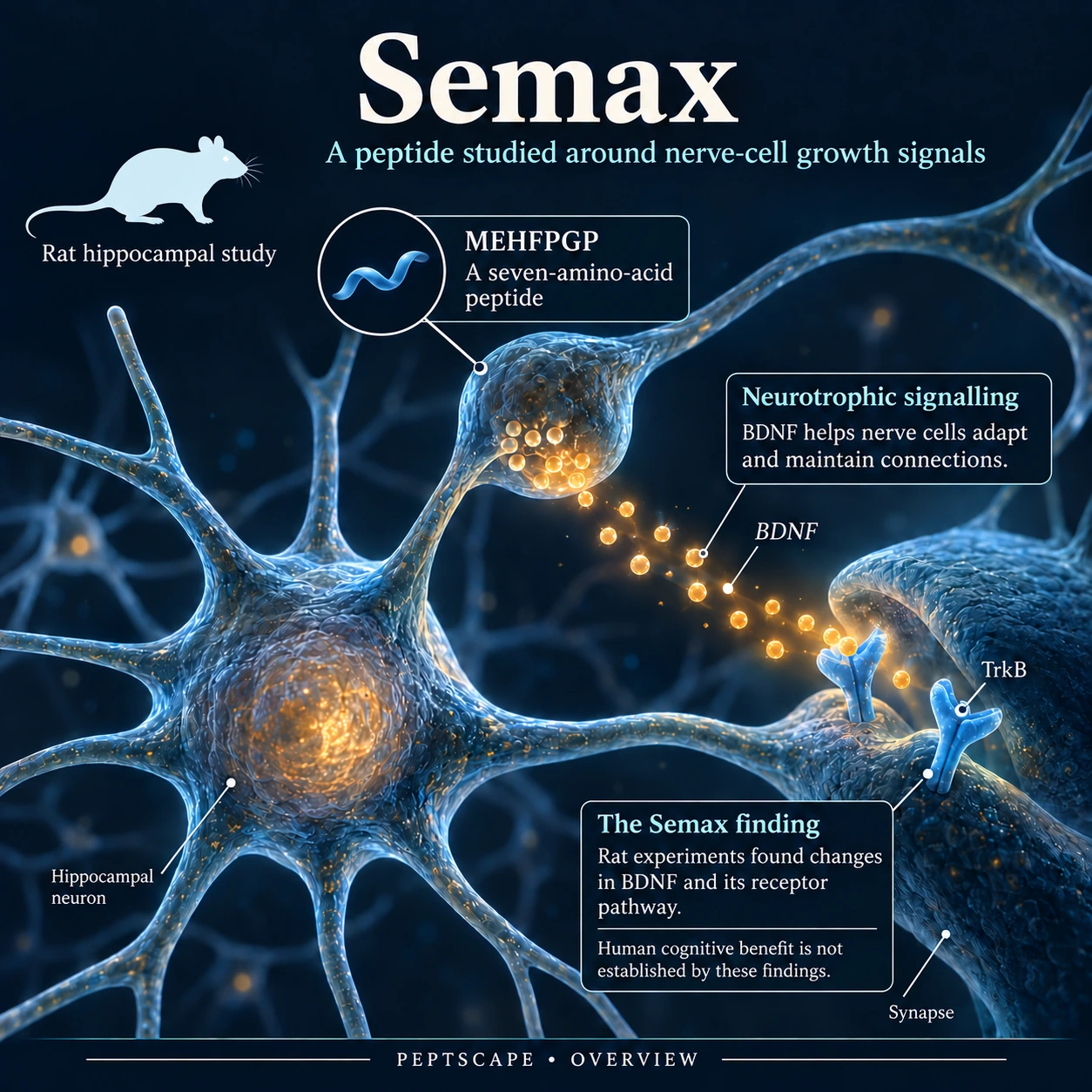
Semax is a synthetic peptide developed for neurological care, with a particular focus on brain function and recovery. It contains seven amino acids and was designed from a small portion of a naturally occurring hormone called ACTH. Although that hormone is involved in the body's stress response, Semax is not a steroid and should not be understood as cortisol replacement.
Outside its neurological applications, Semax is used experimentally for attention, mental fatigue and cognitive performance. The appeal is improved ability to stay engaged with demanding work or learning. It is not established as a reliable cognitive enhancer for healthy users, and there is no single effect that every user should expect to feel.
Attention, memory and mental energy are different
Attention is the ability to keep your mind on a task. Memory includes taking in information, keeping it and retrieving it later. Mental fatigue is the increasing effort required to continue thinking clearly. They influence one another, but an improvement in one does not prove an improvement in all three.
For example, concentrating more consistently while reading may help you remember the material because you took it in more effectively. That is different from directly improving the brain's ability to store memories. Defining the goal makes the experience easier to judge: completing a reading session with fewer interruptions is more specific than expecting to feel “smarter.”
Why Semax is usually associated with nasal preparations
Intranasal administration places a formulation on the lining inside the nose. That lining can absorb some medicines without sending them through the stomach first. Absorption still depends on the formulation, the delivered volume and the condition of the nasal lining. A blocked or irritated nose can affect how a product is tolerated and delivered.
“Nasal” does not mean that every drop travels directly to the brain. Some liquid may remain in the nose or drain into the throat. It also does not make a nasal concentration interchangeable with an injectable one. The preparation and dosing sections distinguish the amount of peptide from the volume delivered by a dropper or spray.
What it is used for
Focus and demanding mental work
The main experimental performance uses are sustained attention, mental clarity and reduced mental fatigue. These goals are particularly relevant to work that requires reading, planning or holding several pieces of information in mind. A useful record describes the actual task and the result rather than only whether a noticeable sensation occurred.
A strong stimulating feeling is not evidence of better performance. Caffeine intake, short sleep and stress can change both concentration and the way an intervention feels. Keeping those factors reasonably consistent helps make a comparison more meaningful. Semax should not be presented as a substitute for sleep or a way to make prolonged sleep loss harmless.
Learning and recall
Learning involves repeated exposure, attention and practice. Semax's proposed effects on nerve-cell signalling have led to interest in memory and learning, but taking a peptide does not supply the information or practice needed to build a skill. Useful questions are whether you followed the material more easily, recalled it later and retained that improvement across comparable sessions.
This distinction also avoids confusing confidence with accuracy. Feeling more fluent or mentally engaged can be valuable, but checking the quality of the work is a better measure of learning than the feeling alone. A short recall exercise or a consistent task can provide more useful feedback than repeatedly changing tests.
Neurological use and everyday performance
Semax has a history of use in Russian neurological practice, including recovery after neurological injury. That background explains part of its development, but treatment after a brain injury is a different situation from improving everyday focus. The Medical section covers those applications separately so that recovery outcomes are not presented as promises of enhanced performance in a healthy person.
Semax and Selank
Semax is primarily associated with cognitive and neurological goals. Selank is primarily associated with anxiety and tension. Concentration can be affected by either fatigue or anxiety, so the experiences may overlap. They remain different peptides, and that overlap does not establish that combining them is more effective.
How it works
Helping nerve cells communicate and adapt
The proposed explanation for Semax involves signalling systems that help nerve cells respond and adapt. One of these involves BDNF, a protein that helps support nerve cells and changes in their connections. Those connections are part of how the brain learns and responds to experience. BDNF is not an intelligence score, and increasing a laboratory signal does not automatically translate into better memory.
Semax may affect more than one signalling pathway. That makes a simple description such as “a dopamine booster” too narrow. The useful practical distinction is that its development centres on brain signalling and adaptation, rather than supplying a stimulant or replacing a missing nutrient. The extent to which these proposed actions translate into everyday benefits remains uncertain.
A noticeable feeling is not the only possible outcome
Some goals, such as task consistency or reduced fatigue, are assessed over repeated comparable days. A single unusually productive day has many possible explanations. Record sleep, the task, the timing and any unwanted effects alongside the result. This keeps the assessment anchored to daily function and makes the notes more useful if attention problems need medical evaluation.
Persistent or newly worsening problems with memory, concentration or mental energy deserve an explanation of their own. The aim of a useful record is to describe those changes clearly, not to assume that every difficulty has the same cause or will respond to the same peptide.
Common questions
Is Semax a stimulant?
It is not a conventional stimulant medicine such as an amphetamine. That does not establish that it cannot cause unwanted stimulation, sleep changes or interactions in a particular person.
Are 0.1% and 1% almost the same?
No. A 1% solution contains ten times as much peptide per mL as a 0.1% solution. Delivered volume still matters.
Is acetylated Semax simply stronger?
A chemical modification creates a different question about delivery, duration and safety. Do not convert between derivatives using an assumed strength multiplier.
What would meaningful progress look like?
Use a specific goal, such as completing a usual reading task or managing fewer interruptions during a familiar activity. Record sleep and caffeine alongside it. A feeling of stimulation is not automatically improved performance.