Educational illustration · Read the evidence and limitations below.
Medical · What is Semaglutide?
Semaglutide is a peptide that helps regulate appetite and blood sugar. It imitates GLP-1, a hormone the gut releases after eating. Many people describe its most noticeable effect as less hunger, earlier fullness or less persistent thinking about food. It can make a smaller meal feel satisfying without the same effort to resist eating.
It is not a stimulant, a digestive enzyme or a peptide that directly melts fat. Weight loss usually develops because appetite changes make it easier to eat less over time. Semaglutide also changes the way the pancreas responds to a meal, which explains its role in type 2 diabetes treatment.
People encounter semaglutide in weekly injections, specially formulated daily tablets and research-labelled vials. These are different preparations of the same named peptide, not interchangeable ways of measuring a dose. The practical details depend on which preparation is actually being used.
Medical · Benefits and common reasons for interest
Appetite and weight management
A quieter appetite can help someone follow a sustainable eating pattern. The STEP 1 trial studied adults with overweight or obesity without diabetes. After 68 weeks, average weight change was about −14.9% with weekly semaglutide 2.4 mg, compared with −2.4% with placebo, alongside lifestyle support. That is a group average over more than a year, not a promise of rapid loss for everyone.
Blood sugar
Semaglutide can improve glucose control in type 2 diabetes. Lower glucose and lower weight are related but separate outcomes. Someone can have a useful glucose response before seeing a dramatic change on the scale.
Everyday function
People may hope for easier movement, less preoccupation with food or better confidence around meals. Record those goals alongside weight. Losing weight while becoming weak, dehydrated or unable to eat adequately is not the outcome to aim for.
Medical · How does it work?
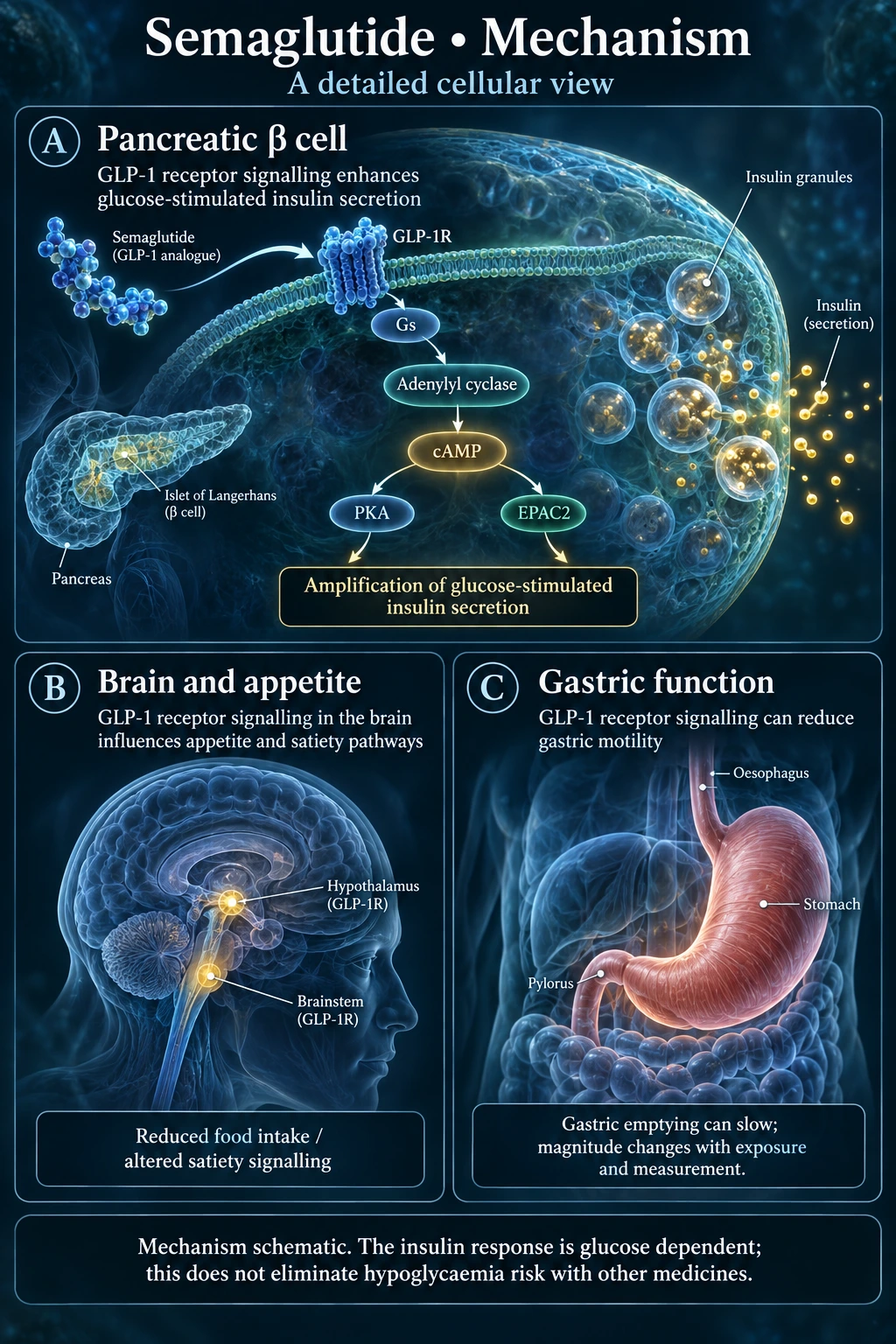
GLP-1 receptors act like receiving points for a meal-related message. Semaglutide activates these receptors in systems involved in appetite and glucose regulation. It helps the pancreas release insulin when glucose is elevated and reduces inappropriate glucagon signalling. Glucagon normally helps the liver release stored glucose.
Semaglutide also slows stomach emptying. Food may remain in the stomach longer, contributing to fullness but also to nausea, reflux or uncomfortable bloating. The size and fat content of a meal can therefore become more noticeable. Feeling very sick is an unwanted effect, not proof that more fat is being lost.
Medical · Different forms of Semaglutide
Ozempic, Wegovy and oral semaglutide medicines provide useful clinical information, but their devices, indications and strengths differ. A tablet strength cannot be converted directly into a weekly injection strength. A vial's total milligrams cannot be read as the amount for one administration.
Research-labelled semaglutide also appears as different chemical forms, including salts. A familiar name or matching milligram number does not establish the same formulation, purity or delivery as a studied medicine. Keep the exact preparation in your record rather than treating every entry simply as “sema.”
Medical · Dosing and concentration
A commonly studied adult weight-management injection schedule begins at 0.25 mg weekly for four weeks, then uses four-week stages of 0.5, 1.0 and 1.7 mg before 2.4 mg weekly. This describes that specific schedule, not a universal maximum or instructions for oral products. Escalation depends on tolerability and the prescribing plan; it is not a race to the largest dose.
A milligram is an amount of peptide. A millilitre is a volume of liquid. Syringe markings describe volume, not semaglutide strength. If a documented solution contains 2 mg/mL, 0.25 mL contains 0.5 mg. This is arithmetic, not a recommended concentration or personal dose. On a U-100 syringe, 0.25 mL occupies 25 marked units; those are not 25 international units of semaglutide.
After a long interruption, restarting at the previous high amount can be poorly tolerated. Use the missed-dose and restart directions for the actual product with the treating clinician. Do not compensate for uncertain delivery by immediately repeating an injection.
Medical · Preparation and reconstitution
A ready-to-use pen or solution does not require bacteriostatic water. Adding water changes its concentration and can interfere with the device. Keep the original medicine and its instructions together.
A lyophilised vial contains freeze-dried material. Reconstitution means dissolving it in a specified diluent to reach a specified final concentration. Bacteriostatic water contains a preservative, usually benzyl alcohol; it is not a sterilising treatment for the peptide. A research vial does not become an approved injectable medicine because it dissolves clearly.
The preparation instructions must identify the exact peptide form, compatible diluent, volume, resulting concentration and storage limit. Where a clinician has supplied a documented injectable preparation, have the matching syringe and measuring technique demonstrated. Do not choose a water volume solely to make an online “units” chart fit.
Medical · Administration
Clinical injections are given subcutaneously, into fatty tissue beneath the skin. The abdomen, thigh and upper arm are used with appropriate product instructions. Injecting the abdomen does not preferentially remove abdominal fat. Rotate locations, and avoid bruised, inflamed, scarred or damaged skin.
Wash hands, prepare on a clean surface and use a new sterile needle and syringe or the specified pen needle. Never share a pen, even with a new needle. Let cleaned skin dry, follow the device's insertion and hold-time instructions, and put used sharps directly into a sharps container. Needle length and technique should suit the device and body tissue; a vial guide is not a pen guide.
Medical · Oral versus subcutaneous delivery
Ordinary swallowed peptides face acid, digestive enzymes and a barrier to absorption through the gut wall. Oral semaglutide tablets address this with a specialised formulation that includes an absorption enhancer, SNAC. Research shows uptake through the stomach lining near the dissolving tablet. This is why oral semaglutide can work despite a much smaller fraction reaching the circulation.
Oral dosing instructions about fasting, water and time before food are part of that delivery system. Swallowing injectable liquid or putting lyophilised peptide into a capsule does not recreate it. Oral semaglutide is intended to reach the bloodstream, not primarily to treat the gut lining locally.
Subcutaneous delivery bypasses digestive breakdown. Greater absorption does not mean an oral dose can be converted to an injection by a simple percentage; the entire dosing schedule and formulation differ.
Medical · Half-life
Injected semaglutide has a half-life of about one week. Levels fall gradually, and peptide can remain in the circulation for several weeks after stopping. A missed day does not mean the previous weekly dose has disappeared.
Medical · Storage
Storage belongs to the presentation. For example, the cited U.S. single-dose Wegovy injection instructions specify refrigeration at 2–8°C, protection from light and no freezing; their limited room-temperature allowance is not a rule for every semaglutide vial or tablet.
Tablets need their own moisture-protection instructions. Keep any prepared vial labelled with concentration, preparation or opening date and its assigned discard date. A refrigerator slows many degradation processes but cannot reverse freezing, heat damage or contamination. Do not apply a pen's expiry allowance to reconstituted research material.
Medical · Contraindications and side effects
Semaglutide injection labels contraindicate use with a personal or family history of medullary thyroid carcinoma, MEN2, or serious hypersensitivity to the product. These are specific conditions, not a statement that every thyroid disorder is equivalent. Pregnancy planning matters: the cited injection label advises stopping at least two months before a planned pregnancy.
Nausea, vomiting, diarrhoea and constipation deserve attention when persistent. Severe abdominal pain, inability to keep fluids down, fainting or signs of an allergic reaction need prompt medical assessment. Tell the clinician about pancreatitis, gallbladder problems, severe stomach-emptying difficulty, kidney disease and diabetic eye disease. Insulin or sulfonylureas can increase hypoglycaemia risk when combined with improved glucose control.
Before surgery or deep sedation, tell the anaesthesia team about semaglutide and recent gastrointestinal symptoms. Do not invent a stopping interval: the team should plan around the procedure and current condition.
Medical · Nutrition and supplement support
Make smaller meals count
Reduced appetite makes food quality more important. Build meals around a protein source, some vegetables or fruit and a tolerable carbohydrate or other energy source. Eggs, yoghurt, fish, poultry, tofu and beans offer different practical options. A protein shake can help when a full meal is difficult, but repeated liquid supplements should not crowd out all ordinary food.
Protect strength
Weight loss can include lean tissue. Resistance exercise and adequate protein support strength; neither requires an expensive peptide-specific supplement stack. Discuss protein needs individually if kidney disease, frailty or very low food intake is present. Tracking the ability to climb stairs or maintain usual lifts can reveal problems hidden by a falling scale weight.
Nausea, constipation and hydration
Smaller meals, slower eating and stopping at comfortable fullness may help. Large fatty meals can be difficult to tolerate. Increase fibre gradually rather than suddenly adding a large fibre supplement during severe bloating. Drink regularly; persistent vomiting needs assessment rather than simply more electrolyte powder.
Vitamins and minerals
Vitamin D, B12, iron and other supplements should address dietary gaps or diagnosed deficiency. Semaglutide does not create a universal requirement for B12 injections. Iron may worsen constipation; magnesium may cause diarrhoea and needs caution with kidney disease. Avoid adding stimulants or “fat burners” to overcome the fatigue of under-eating.
Medical · Tracking progress and common questions
Record the actual amount and formulation, appetite, bowel symptoms, hydration and a consistent weight trend. Note dose changes beside symptoms so a clinician can review the timing. A plateau can reflect normal variation, constipation or a longer-term energy balance change; it is not an automatic instruction to escalate.
“Will I regain weight after stopping?” Appetite commonly returns, and weight regain has been observed after treatment withdrawal. Plan maintenance support before stopping rather than viewing treatment as a brief detox. “Should I never feel hungry?” No. Normal hunger and the ability to eat nourishing meals remain useful signals.
Medical · Medical
The weight-loss trial describes a particular population, dose and support programme. Oral absorption findings describe a specialised tablet. Product instructions below are formulation-specific; they do not certify research-labelled material.