Educational illustration · Read the evidence and limitations below.
What is Semaglutide?
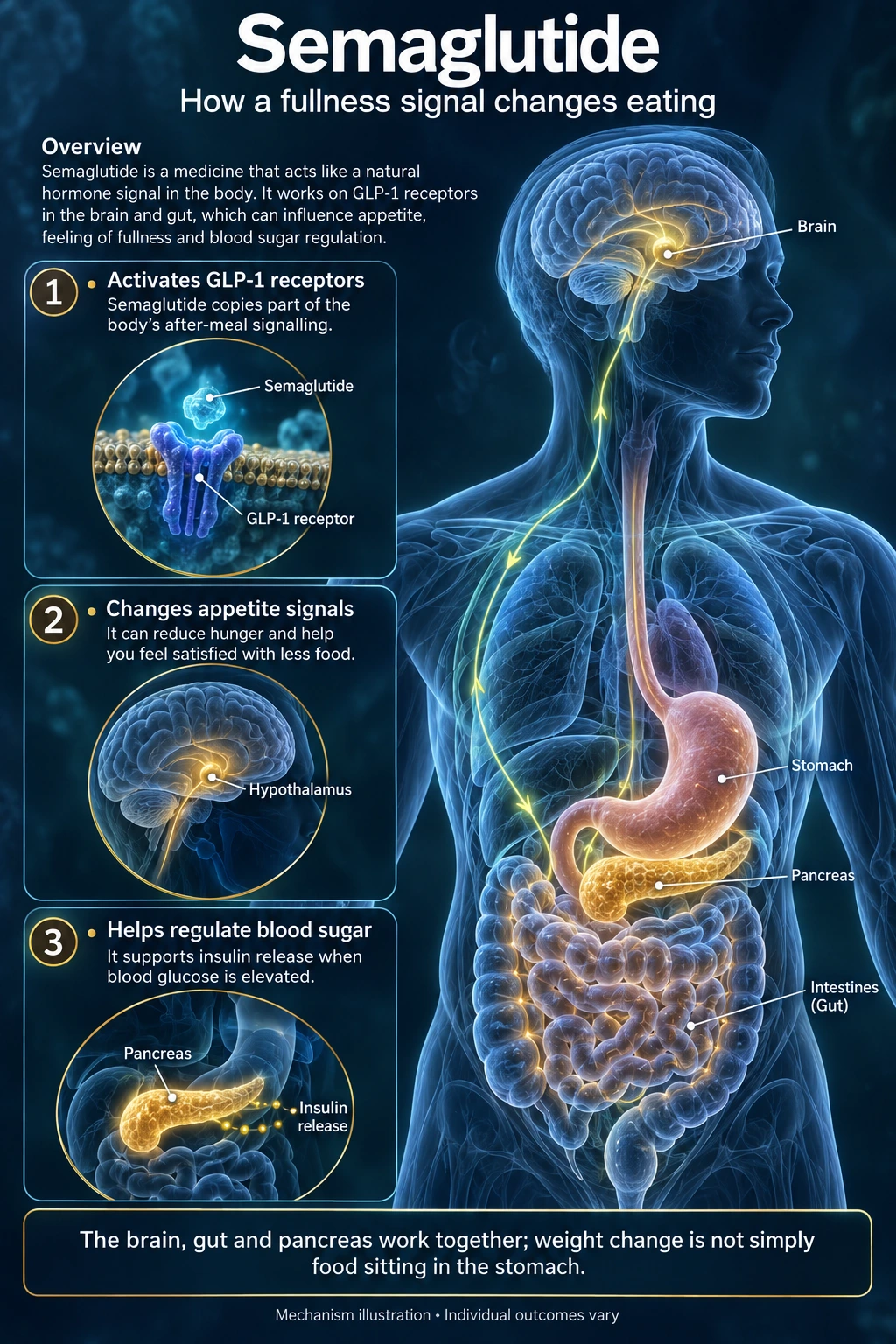
Semaglutide is a peptide that reduces appetite and helps regulate blood glucose by activating the GLP-1 receptor. GLP-1 is a natural meal-related signal. Semaglutide is designed to act for much longer than that short-lived natural signal, allowing a sustained effect on appetite and glucose regulation.
For weight management, its main practical effect is that eating less can become easier. Meals may feel satisfying sooner, hunger between meals may decrease and persistent thoughts about food may become less intrusive. These experiences vary; complete loss of appetite is not the goal.
Hunger, fullness and food thoughts
Hunger is the drive to eat. Satiation is the process of reaching the point at which a meal feels sufficient. Satiety is the period of reduced hunger after eating. Semaglutide can influence these connected experiences, which is why its effect is broader than simply making the stomach feel full.
The phrase “food noise” describes recurring thoughts about eating rather than a formal diagnosis. A reduction in those thoughts can make food choices less effortful. It does not mean someone should stop eating regular, nourishing meals or interpret every return of hunger as treatment failure.
A peptide with several pharmaceutical presentations
Semaglutide is the active molecule in more than one pharmaceutical product. Its effects can be explained without making the brand the focus. However, the presentation still matters: an injection and a specially formulated oral tablet do not deliver the molecule in the same way.
A research-labelled vial or an unspecified oral preparation cannot be assumed to match those finished products. The name of the active peptide does not establish the concentration, absorption or quality of a particular preparation. Those details remain essential to the Practical information.
What it is used for
Weight reduction and weight maintenance
Semaglutide is used for weight management because it can reduce energy intake over time. It does not selectively dissolve fat at an injection site. As body weight falls, both fat and some lean tissue may be lost, so the quality of nutrition and the preservation of strength deserve attention alongside the scale.
Weight loss is usually assessed over time rather than from day-to-day changes. Water, bowel contents and recent food intake can move the scale independently of fat loss. A slowing trend also does not automatically mean that the peptide has stopped acting: a smaller body often needs less energy than it did before.
Glucose regulation
Semaglutide helps the pancreas release insulin when glucose is elevated and influences glucagon, another hormone involved in glucose balance. This is relevant to diabetes care as well as the wider metabolic discussion. It does not make every lower glucose reading desirable or remove the need to consider other glucose-lowering medicines.
The risk of low glucose is particularly important when insulin or medicines that stimulate insulin release are also used. Changes in eating can further alter that balance. The peptide and the rest of a person's treatment need to be considered together.
Changes beyond total body weight
Reduced waist size, improved mobility and easier performance of everyday activities can matter even when a particular weekly weight target is not met. Blood pressure, glucose and other health measures answer additional questions. A change in one should not be assumed from a change in another.
Semaglutide is not a direct muscle-building or exercise-performance peptide. If eating becomes much easier to restrict, maintaining enough protein and tolerable physical activity becomes especially important. The nutrition section expands on eating well with a smaller appetite rather than adding supplements by default.
How it works
A longer-lasting meal signal
The GLP-1 receptor is a receiving point involved in appetite and glucose regulation. Semaglutide activates that receptor and resists the rapid breakdown that limits natural GLP-1. This gives it an extended period of action and explains why an injection is not simply a brief signal at the moment of administration.
Its effects involve the brain's appetite pathways as well as digestive and pancreatic responses. Describing it only as “slowing the stomach” misses the central appetite component. The degree of stomach-emptying delay can also change with ongoing exposure.
Digestion and tolerability
Nausea, constipation, diarrhoea and uncomfortable fullness can occur. These are unwanted effects, not a measure of fat loss. Eating far less because of severe nausea is different from comfortably reaching satisfaction with a smaller meal.
Persistent vomiting, inability to maintain hydration or severe abdominal pain should not be treated as normal progress. The Practical section covers precautions and contraindications. Planned procedures involving anaesthesia also warrant a discussion of the medication because stomach contents and emptying can matter to procedural care.
Oral delivery is a formulation problem
Peptides can be broken down in the digestive tract and often cross its lining poorly. The existence of an oral semaglutide tablet does not mean that any swallowed semaglutide will work similarly. Specialised formulation is part of how oral delivery is achieved.
For the same reason, milligrams in an oral product cannot be compared directly with milligrams injected under the skin. The amount in the product and the amount reaching the bloodstream are different quantities. Route-specific instructions should never be replaced by a simple conversion between them.
Long-term appetite regulation
If treatment is stopped, its appetite effect can diminish and weight regain can occur. This reflects the return of biological pressures on eating and weight, not a moral failure. Maintenance planning therefore belongs in the discussion from the beginning.
The most useful goal is a sustainable pattern of eating and function with acceptable tolerability. Neither maximum appetite suppression nor the fastest possible weight loss is a complete measure of a good outcome.