Educational illustration · Read the evidence and limitations below.
Medical · What is PT-141?
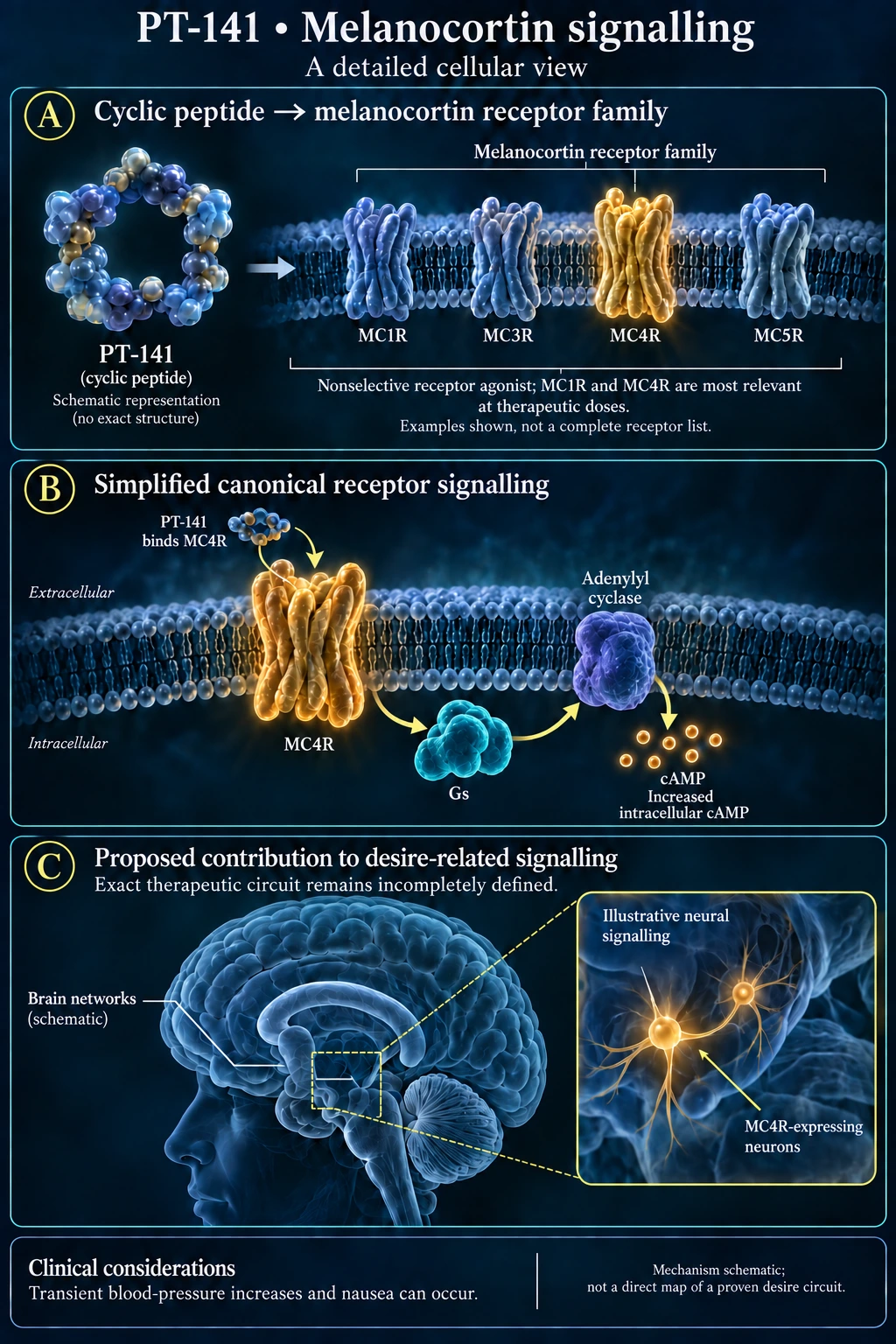
PT-141, also called bremelanotide, is a peptide studied and used for low sexual desire. It acts on melanocortin receptors, part of a signalling system involved in several functions, including sexual responses.
Its main distinction is that it is not simply a blood-flow treatment. Desire, arousal, lubrication, erection, orgasm and comfort are related but different parts of sexual function. PT-141 is most relevant to the desire and arousal discussion; it does not automatically solve every difficulty during sex.
The peptide has an approved pharmaceutical presentation, Vyleesi, for a specific type of distressing low desire in premenopausal women. PT-141 is also discussed and studied outside that population, including in men. The existence of those discussions does not make all uses equally established.
The compound's name should remain central, while formulation-specific information stays clearly labelled. A ready-made autoinjector, a lyophilised vial and a nasal preparation are not equivalent products just because each is described as PT-141.
Medical · Benefits and common reasons for interest
Sexual desire
Low desire becomes a medical concern when it is persistent, unwanted and distressing to the person experiencing it. Desire naturally varies, and it should not be judged against a partner's expectations or a fixed frequency of sex.
Clinical trials of bremelanotide found improvements in desire and associated distress in a defined population. That supports a real treatment discussion, but it does not guarantee an immediate or dramatic effect for every user.
Arousal and sexual function
People may seek PT-141 because they want more interest, easier arousal or a more satisfying sexual experience. These outcomes should be tracked separately. A change in physical response does not necessarily mean a change in desire or satisfaction.
Pain, dryness, erectile difficulty, medication effects and relationship stress may need different treatments. PT-141 should not be presented as a universal sexual-performance enhancer.
Use in men
Earlier research has explored sexual responses in men, including erectile outcomes. The U.S. approved indication is not for men, and a female-labelled autoinjector schedule is not automatically an established male prescription.
A man with new erectile difficulty may need assessment of cardiovascular health, diabetes, medicines or hormone symptoms. Treating it only as a libido problem can miss a relevant underlying condition.
Medical · How does it work?
Bremelanotide activates melanocortin receptors. These receptors participate in brain and body signalling. The precise way the clinical effect on desire is produced is not fully resolved, but it differs from medicines whose principal action is to increase genital blood flow.
This difference explains why PT-141 is discussed when the concern is interest or arousal rather than only erection mechanics. It also explains why it should not be expected to correct every vascular, hormonal or psychological cause of sexual difficulty.
Melanocortin signalling is involved in more than sexual function. Blood-pressure changes and pigmentation effects are therefore relevant to the practical discussion. A targeted goal does not mean the compound acts only on that goal.
Medical · PT-141, melanotan and other sexual-health treatments
PT-141 is related to melanocortin research but is not interchangeable with Melanotan II. Tanning effects and sexual effects should not be treated as a reason to exchange the compounds or their amounts.
PDE5 inhibitors, hormone treatments and PT-141 also address different problems. Combining them is a medical decision, not a simple way to cover every part of sexual function. Existing cardiovascular conditions and medicines matter.
No treatment removes the need for consent, comfort and communication. A physiological response is not consent, and a partner should never be given a substance without their knowledge.
Medical · Dosing and concentration
The documented pharmaceutical schedule
The U.S. autoinjector delivers 1.75 mg subcutaneously at least 45 minutes before anticipated sexual activity. Its instructions limit use to one dose within 24 hours and do not recommend more than eight doses per month. These directions apply to that prescription presentation and indication.
Other preparations
A lyophilised research vial does not inherit the autoinjector's quality controls or ready-to-use concentration. Nasal research likewise does not establish that a spray can use the same amount as an injection. An appropriate prescribing decision must identify the exact preparation and person being treated.
Do not repeat an amount early because an effect has not been noticed, or chase a stronger response by increasing exposure. Nausea and blood-pressure effects can occur even when the desired effect feels absent.
Reading a concentration
Milligrams on the vial describe total content, not necessarily one administration. A documented final concentration of 5 mg/mL means each mL contains 5 mg. To interpret a recorded volume, multiply that volume by concentration. This explains the measurement, not a recommended preparation or dose.
Medical · Preparation and reconstitution
Ready-made autoinjector
A prefilled device is already prepared. It should not be opened, diluted or transferred into another container. Inspect and use it according to its own instructions, including whether the solution and device appear normal.
Lyophilised PT-141
Lyophilised means freeze-dried. Reconstitution requires a specified liquid, volume and handling method for the actual medicinal preparation. Bacteriostatic water is a preserved diluent, not a universal instruction for every vial labelled PT-141.
The final preparation must have clear identity, concentration, route, storage and after-mixing directions. A correct calculation does not establish sterility, remove contaminants or make laboratory material suitable for injection.
For a prescribed preparation, use clean handling and sterile single-use equipment as taught. Do not substitute a different diluent or create a nasal spray from an injectable formula. The nose has different formulation requirements from tissue under the skin.
Medical · Administration
The approved device is used subcutaneously in the abdomen or thigh according to its instructions. For another legitimately prescribed preparation, the clinician should teach the correct site, device and technique. Do not inject into the penis, genital tissue or a vein to try to target the effect.
Rotate suitable sites and avoid irritated or damaged skin. Use new sterile equipment for each administration and dispose of sharps safely. Keep the actual time in the record so a later decision does not rely on memory.
Allow for the possibility of nausea or feeling unwell. A plan for intimacy should not create pressure to proceed when someone is uncomfortable, dizzy or no longer interested. An unwanted effect is a reason to reassess, not evidence that a stronger sexual response is coming.
Medical · Routes and bioavailability
Subcutaneous delivery bypasses the digestive tract, but bremelanotide can still affect how quickly the stomach empties. This matters because it can change absorption of oral medicines even though the peptide itself was injected.
Nasal and oral products require separate absorption evidence. A spray's delivered volume and concentration both matter; an injection amount cannot simply be divided into a number of sprays.
Some oral peptides are intended to act directly on the gut lining. PT-141's sexual-health use is not based on that local-gut rationale. Reduced oral absorption does not make swallowing it a demonstrated alternative.
Medical · Half-life
About 2.7 hours after the studied subcutaneous pharmaceutical dose. This describes elimination from blood, not a guaranteed duration of desire or sexual response.
Nasal preparations and reconstituted products should not automatically be assigned the same exposure. A half-life does not override the product's minimum interval or monthly-use limit.
Medical · Storage
The U.S. autoinjector is stored at or below 25°C, protected from light, and should not be frozen. Keep it in its labelled packaging and follow the current product instructions.
A reconstituted vial needs its own storage and discard directions. The autoinjector's room-temperature handling cannot establish stability for a different solution, and bacteriostatic water does not create a universal 30-day refrigerated period.
Record preparation and opening dates separately from expiry. Do not leave a product in a hot car or assume it remains suitable because the liquid looks clear. Keep all preparations away from children and prevent mix-ups with other peptide vials.
Medical · Contraindications and side effects
Bremelanotide is contraindicated with uncontrolled hypertension or known cardiovascular disease in its U.S. label. It can temporarily raise blood pressure and reduce heart rate. Cardiovascular assessment is therefore part of treatment, not an optional precaution after a reaction.
Nausea is common; flushing, headache, vomiting and injection reactions also occur. Changes in pigmentation can develop and may persist. Do not use additional doses to overcome a disappointing response while adverse effects are increasing.
Pregnancy requires stopping the approved treatment and contacting the clinician. Review breastfeeding and reproductive plans before use. Severe chest pain, fainting, severe headache or allergic symptoms needs urgent assessment. An erection lasting more than four hours is an emergency, particularly when other sexual-function drugs are involved.
Medical · Medical interactions
Bremelanotide can slow stomach emptying and affect oral drug absorption. Oral naltrexone is a particularly important interaction in the approved label because its exposure may be reduced. Tell the prescriber about every oral medicine, including those where reliable timing or absorption is important.
Do not independently stop psychiatric medicines that may affect libido. Their benefits, alternatives and withdrawal risks need a separate review. An interaction discussion should include supplements and other sexual-health treatments, not only prescription tablets.
Medical · Nutrition and supplement support
Address the person, not a libido stack
Low desire is not automatically a nutrient deficiency. Sleep, stress, pain, mood, medication effects and relationship circumstances may matter more than a supplement. A regular, adequately nourishing eating pattern supports general health without promising a peptide-specific sexual benefit.
Nausea and hydration
If treatment causes nausea, record timing, severity and any vomiting. Maintain fluids as tolerated and seek advice if vomiting persists or dehydration develops. Do not use alcohol, a large supplement stack or unprescribed anti-nausea medicines to force tolerance of a treatment that is making you unwell.
Meal and medication timing should follow clinical advice where gastric emptying is relevant. A food strategy does not remove the cardiovascular precautions.
Iron, B12 and vitamin D
A deficiency can contribute to fatigue or other symptoms that affect wellbeing. Correcting a confirmed problem may improve the broader situation, but it is not evidence that these nutrients enhance PT-141. Iron should have a clear indication rather than being included automatically in a sexual-health blend.
Zinc and “testosterone support”
Zinc is necessary for normal physiology, but high doses do not reliably improve desire in someone who already has adequate intake. Excess zinc can cause copper deficiency. Suspected hormone problems deserve appropriate testing rather than a supplement selected solely from a libido claim.
Herbal and stimulant products
Products described as natural sexual enhancers can contain multiple active ingredients, and some products in this category have been found to contain undeclared medicines. Avoid combining them with PT-141 without a full ingredient and interaction review. Stimulant effects or blood-pressure changes can complicate the situation.
The most useful supplement list is one where every item has a specific purpose and its own safety review. There is no established mandatory nutritional stack for bremelanotide.
Medical · Tracking progress and everyday questions
Track desire, distress, comfort and satisfaction separately, along with nausea, headache and timing. The record should reflect the user's experience rather than a partner's expectation or a target number of sexual encounters.
Does PT-141 guarantee an erection or orgasm? No. Is it intended to make someone want sex against their wishes? No. Can a stronger dose solve pain or relationship difficulties? That is not an appropriate treatment strategy.
If a prescribed treatment does not provide worthwhile improvement, review continuation with the clinician rather than escalating indefinitely. The aim is a meaningful improvement in wellbeing with acceptable tolerability.
Medical · Medical
Two phase 3 trials studied bremelanotide in premenopausal women with acquired, generalised hypoactive sexual desire disorder. Improvements in desire and distress supported the approved indication; these results do not establish a universal performance benefit or an approved indication for men.
The pharmaceutical label supplies the precise dose, interval, contraindications and formulation-specific pharmacokinetics. Those details are retained without making that brand the whole explanation of PT-141.