Educational illustration · Read the evidence and limitations below.
What is PT-141?
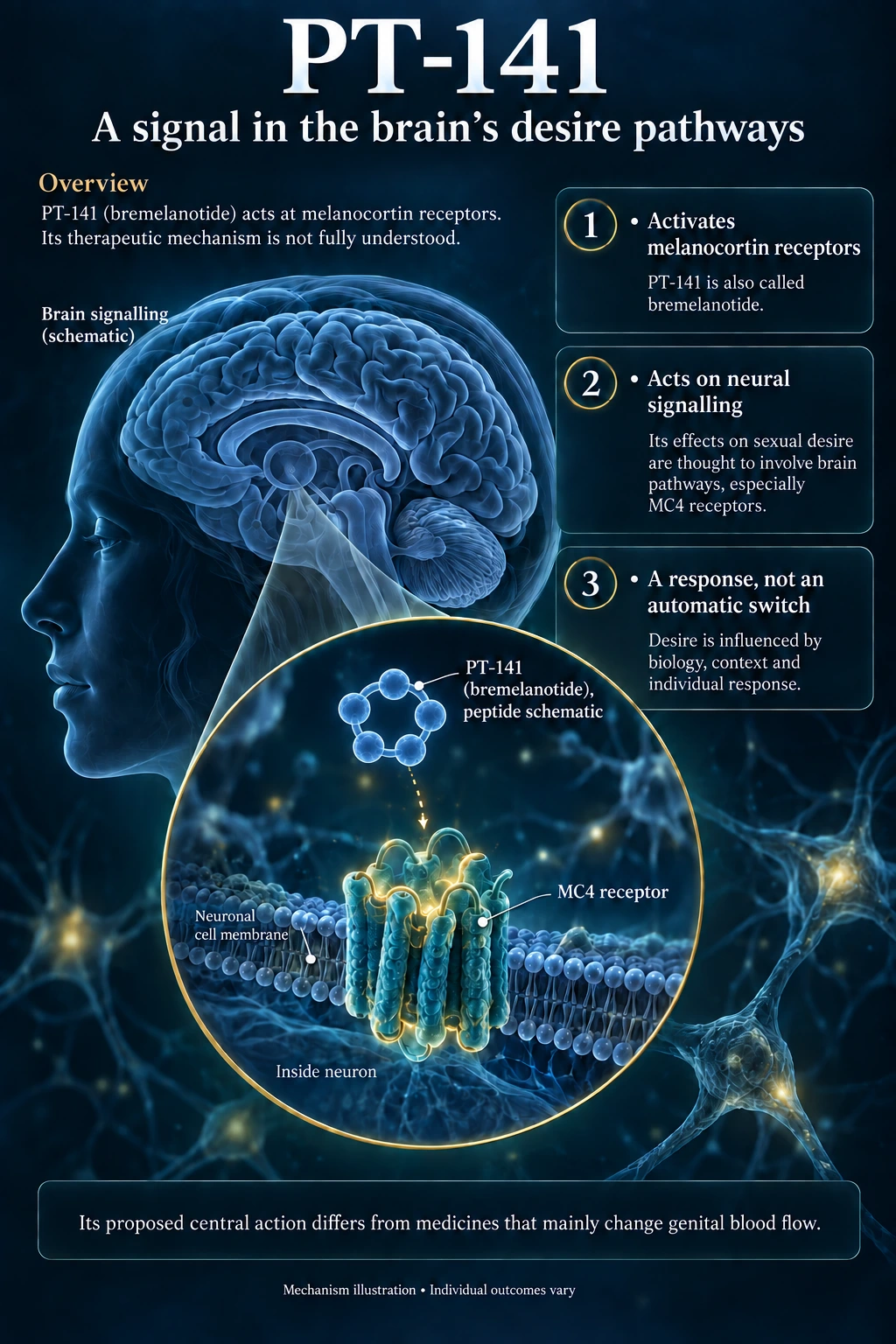
PT-141, also called bremelanotide, is a peptide that acts on brain pathways involved in sexual desire and arousal. Its main distinction is where it works: it influences the nervous system's sexual response rather than primarily increasing blood flow to the genitals. It is not testosterone, an oestrogen replacement or a general stimulant.
Sexual response has several parts. Desire is interest in sexual activity. Arousal includes the mental and physical response to stimulation. Erection and lubrication are physical components, while orgasm is another distinct response. These processes interact, but improving one does not automatically resolve a difficulty with another.
Desire is different from physical performance
Someone can have strong desire but difficulty achieving an erection. Someone else can have a normal physical response yet little interest in sexual activity. PT-141 is relevant to the brain's contribution to that response, which is why its purpose differs from medicines that primarily help blood vessels relax.
This also explains why “libido” is not a complete description of every sexual concern. Pain, changes after menopause, medicines, relationship difficulties and vascular disease can affect different parts of sexual function. Understanding the particular problem makes the peptide's role clearer than treating all of these experiences as low desire.
What the name tells you
Bremelanotide and PT-141 refer to the same active peptide. A pharmaceutical presentation exists, but the molecule's mechanism is not defined by its brand name. Equally, a research-labelled vial is not automatically equivalent to a regulated finished product in concentration, delivery or quality. The Practical section keeps those preparation details separate from this explanation of the peptide.
What it is used for
Low sexual desire
PT-141 is used to address low sexual desire in selected settings. Its strongest established application concerns a specific form of distressing low desire in premenopausal women. Broader use, including use in men and other circumstances, is off-label or experimental and does not carry the same certainty of benefit.
For a reader, the useful distinction is between a change that is personally troubling and a normal variation in interest. Sexual desire changes with circumstances, health and life stage. There is no universal frequency of sexual activity that a peptide should make someone achieve.
Arousal and erectile response
PT-141 also attracts use for arousal and erectile difficulties because the brain contributes to initiating the physical sexual response. This is different from directly treating impaired circulation. A central signal cannot be assumed to correct every vascular, nerve or medication-related cause of erectile difficulty.
It should not be treated as interchangeable with sildenafil or tadalafil. Those medicines have different targets, timing and precautions. Combining treatments is a separate clinical decision, not an automatic way to cover every part of sexual response.
An occasion-related effect, not hormone replacement
PT-141 is generally discussed in relation to an intended occasion rather than as a way to replace a deficient sex hormone. Its action does not mean testosterone or oestrogen levels have been corrected. Likewise, an improvement in desire does not establish that a hormone deficiency caused the original concern.
Timing and duration vary with the actual preparation and individual response. A desired effect and an unwanted effect can also have different timelines. Nausea or flushing is not evidence that a stronger sexual response is about to occur and should not be used to judge whether enough has been taken.
How it works
Melanocortin signalling
PT-141 activates melanocortin receptors, receiving points used by a family of natural signalling molecules. Some of these receptors participate in sexual behaviour and arousal pathways. Activating them can influence the central nervous system's contribution to sexual response without directly supplying a sex hormone.
The melanocortin system also has functions outside sexual response. This helps explain why a peptide intended for desire can cause effects such as nausea or changes in skin pigmentation. A biological target is rarely confined to one desired outcome.
Why blood pressure matters
PT-141 can temporarily increase blood pressure and reduce heart rate. Existing cardiovascular disease or uncontrolled high blood pressure therefore matters even though the peptide is not primarily a blood-flow treatment. These are concrete precautions, not simply a question of whether the injection itself is tolerated.
The full contraindications and interaction information belongs with the Practical and Medical material. One important distinction is that good sexual performance does not establish cardiovascular suitability. The two questions need their own assessment.
A response involves context as well as signalling
A peptide cannot supply consent, comfort, attraction or relief from painful intercourse. Desire and arousal remain responses influenced by context. That does not make a pharmacological effect unreal; it explains why a drug can help one component while another concern remains.
A useful account of the experience separates interest, physical response and adverse effects. That is more informative than describing the result only as “worked” or “did not work.” It also helps avoid mistaking a physical response for a change in desire, or escalating use to solve a problem the peptide does not address.