Identity
Petrelintide is an investigational long-acting amylin analogue.
Selected study only; not a complete clinical review.
Peptide library
Your guide to this compound.
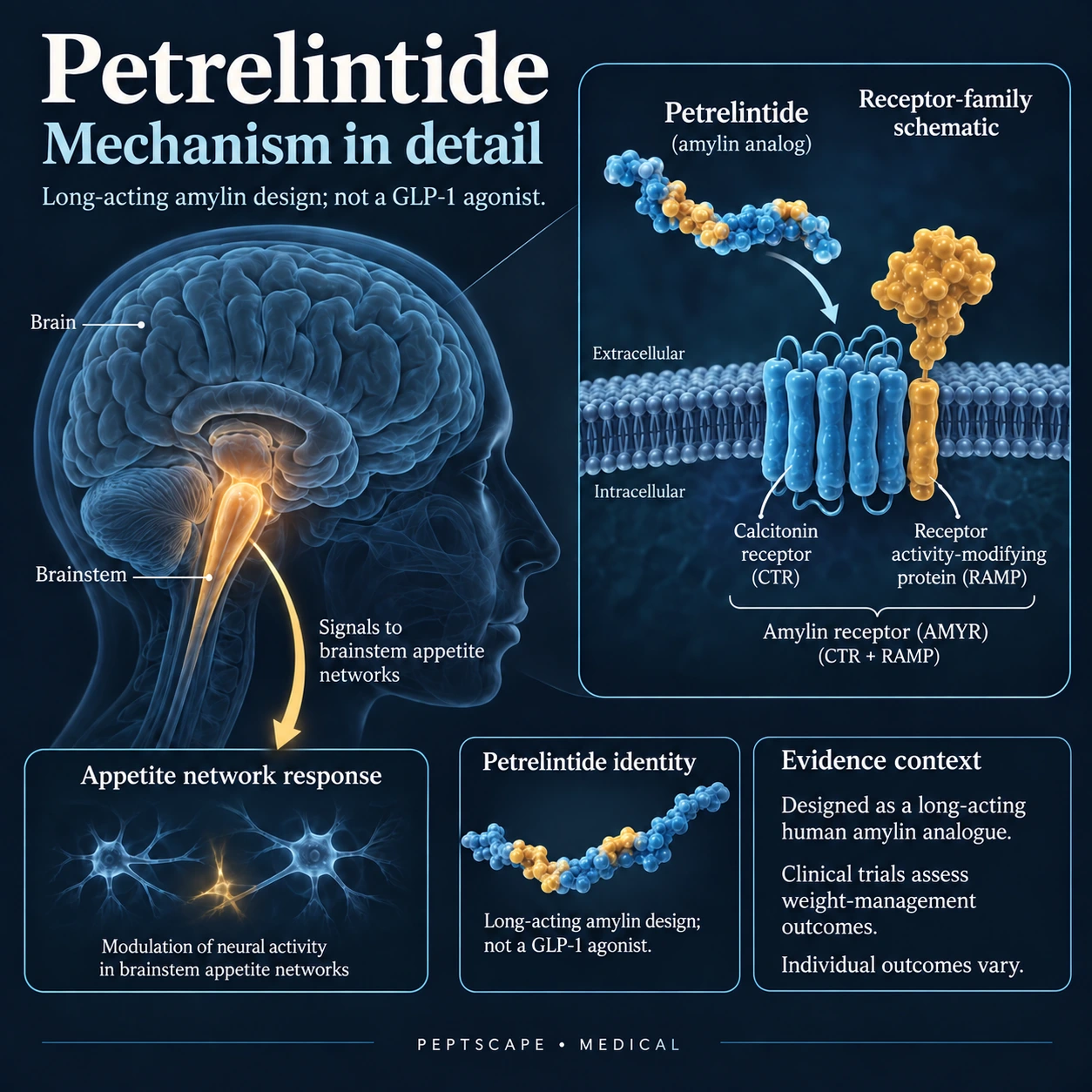
The controlled phase I studies characterize tolerability and exposure, with exploratory weight change. Small sequential cohorts and short follow-up cannot establish fewer adverse effects than other drugs. Sponsor involvement is disclosed and requires consideration, not automatic dismissal.
Selected full-text methods/results or correction sections assessed.
This assessment covers selected sources and sections. It is not a systematic review, formal risk-of-bias score, or clinician sign-off.
Editorial assessment · 2026-09-07
Two phase 1 trials spanning normal weight, overweight and obesity.
Early trials reported weight reduction and prolonged exposure; larger trials are needed to assess treatment benefit and uncommon harms.
Current authorization for the exact product and jurisdiction was not independently checked in this snapshot. A clinical trial is not marketing authorization.
Selected indexed primary-study abstract reviewed. Full methods, bias, all safety outcomes, product stability, current jurisdictional authorization and a comprehensive literature search remain outstanding. This is not a complete clinical review.
Petrelintide is an investigational long-acting amylin analogue.
The study-specific findings below distinguish biological activity from demonstrated treatment benefit.
This catalog identifies human research. A trial can be early, small or negative; its existence does not establish approval or benefit for every proposed use. Check the study population and outcomes.
Selected study only; not a complete clinical review.
This catalog identifies human research. A trial can be early, small or negative; its existence does not establish approval or benefit for every proposed use. Check the study population and outcomes.
Petrelintide is an investigational long-acting amylin analogue.
Selected study only; not a complete clinical review.
Early trials reported weight reduction and prolonged exposure; larger trials are needed to assess treatment benefit and uncommon harms.
Selected study only; not a complete clinical review.
Gastrointestinal symptoms were reported, with one treatment discontinuation; no serious or severe treatment-emergent event was reported.
Selected study only; not a complete clinical review.
The phase 1 abstract reports approximately 10 days, but pools subcutaneous and intravenous study context. Exact route-specific PK tables must be checked before assigning a general numeric half-life.
Selected study only; not a complete clinical review.
Safety, Tolerability, Pharmacokinetics, and Pharmacodynamics of Petrelintide for Weight Management: Two Randomized, Controlled Phase 1 Trials. 2026.
PMID: 42017294
Catalog review date: Sep 7, 2026. This date alone does not establish independent clinical review.