Educational illustration · Read the evidence and limitations below.
Evidence in perspective
The name can be linked to a defined research compound. Animal cognitive and pathology findings still do not establish a human nootropic, administration route or half-life.
About this assessment
Identity sources and selected source evidence assessed; scope below.
Chemical record and indexed study abstract assessed. No human pharmacokinetic or efficacy inference; full methods appraisal and clinician sign-off remain pending.
Female 3xTg-AD and wild-type mice; chronic oral experimental exposure, not human treatment.
What the sources found
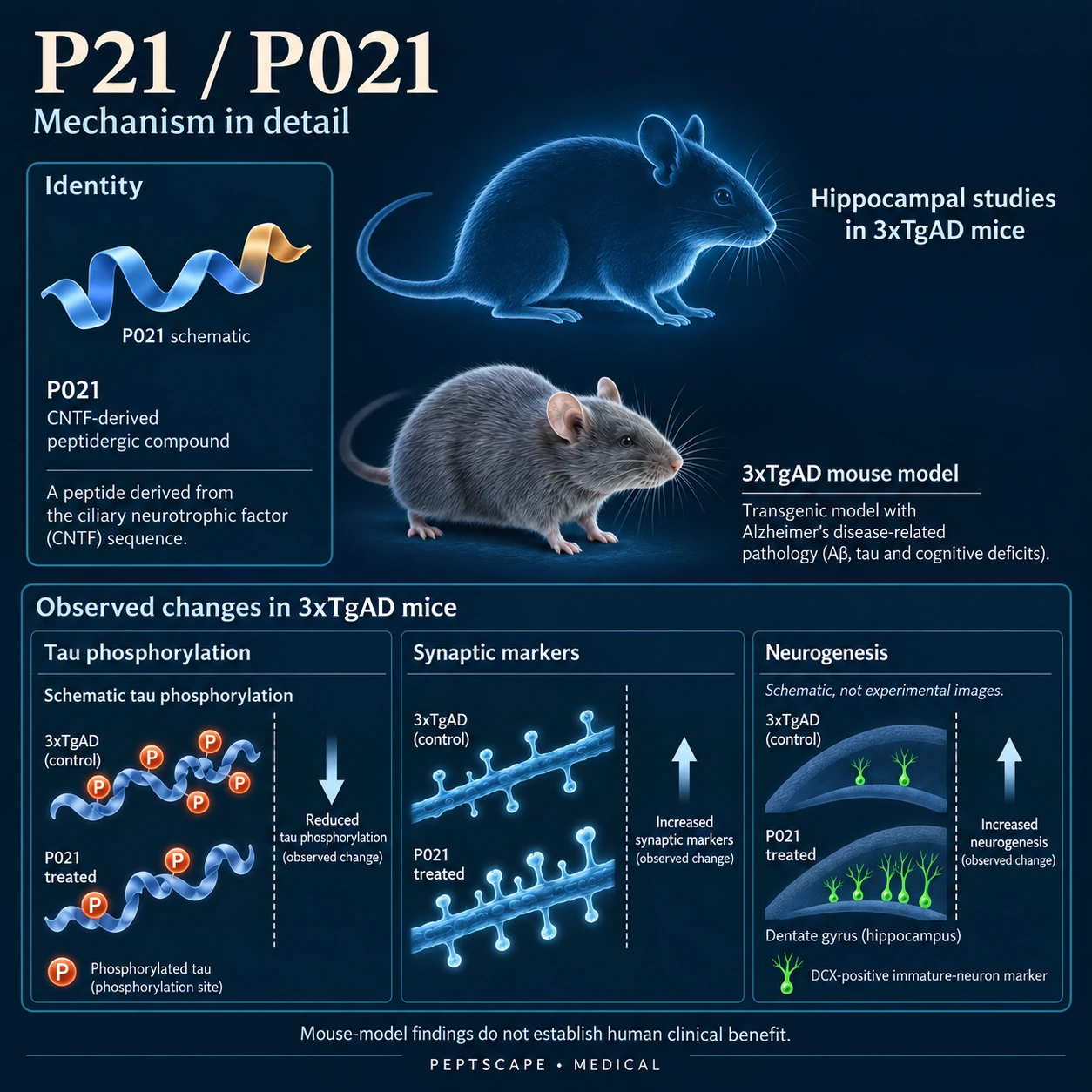
The mouse study reports changes in cognitive and pathological measures after prolonged exposure to P021. These findings cannot establish human cognitive benefit.
Female 3xTg-AD and wild-type mice; chronic oral experimental exposure, not human treatment.
Identity documentation and publication do not confer marketing authorization. No new jurisdiction-specific approval claim is made.
What remains unknown
Chemical record and indexed study abstract assessed. No human pharmacokinetic or efficacy inference; full methods appraisal and clinician sign-off remain pending.
How it works
Identity and evidence must be read separately.
The name can be linked to a defined research compound. Animal cognitive and pathology findings still do not establish a human nootropic, administration route or half-life.
Preclinical research
The catalog primarily cites laboratory or animal research. Human benefit, a safe dose and long-term risks cannot be inferred from those findings.
P21/P021 denotes the CNTF-derived peptidomimetic indexed as P-21 in the ChemIDplus substance record linked to PubChem CID 56599151. It contains an acetylated DGGL core and a terminal adamantane-based modification; it is not the p21/CDKN1A protein.
Catalog identity only; not authentication of a purchased vial or clinical approval.
The mouse study reports changes in cognitive and pathological measures after prolonged exposure to P021. These findings cannot establish human cognitive benefit.
Female 3xTg-AD and wild-type mice; chronic oral experimental exposure, not human treatment.