Educational illustration · Read the evidence and limitations below.
What is P21 / P021?
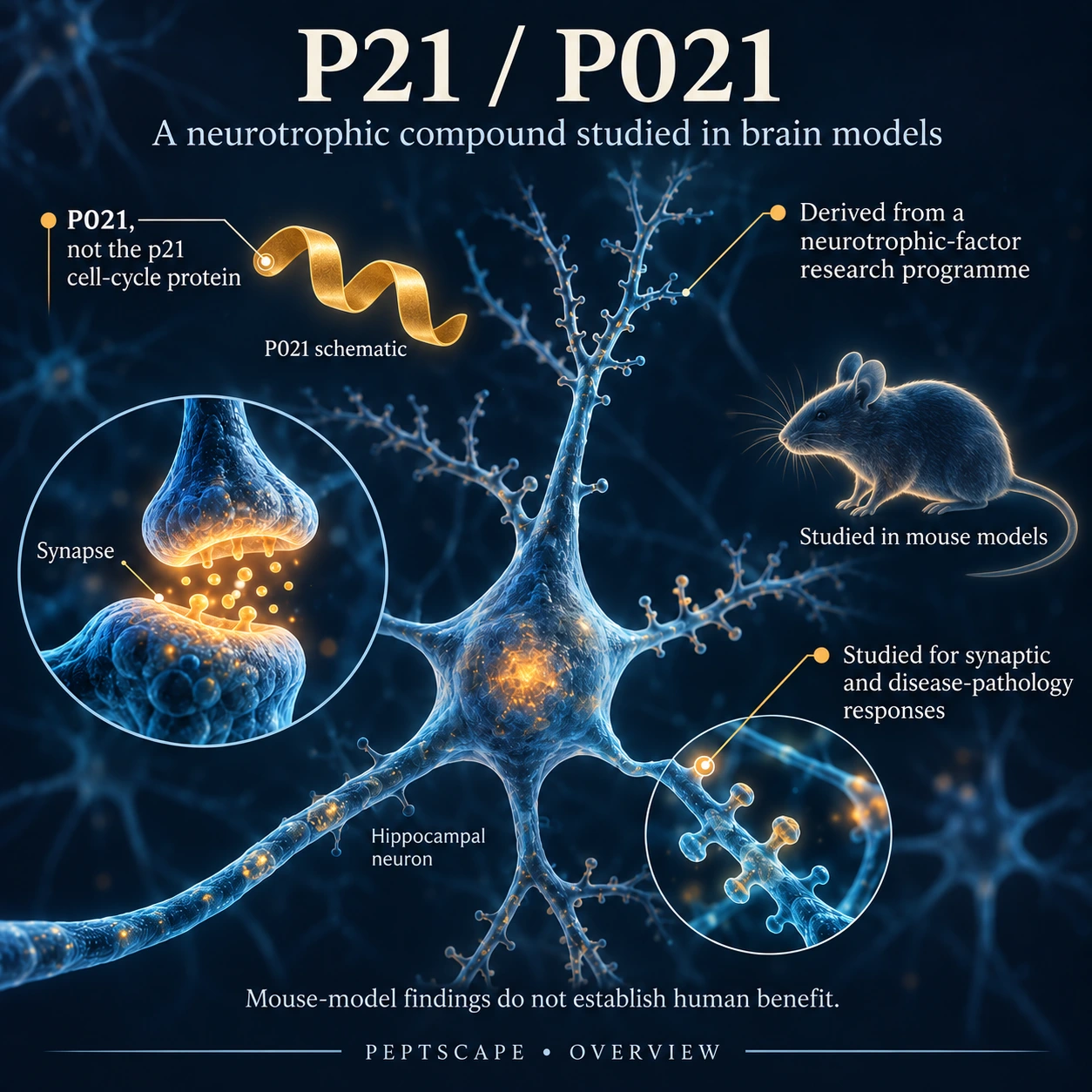
P21 or P021 in this catalog refers to a small CNTF-derived peptidomimetic investigated for cognition. It is not the p21 protein involved in cell-cycle regulation. The naming distinction prevents two unrelated areas of biology from being combined into one profile.
The wider picture
Cognition includes attention, learning, memory, language and planning. These abilities overlap, but a change in one does not necessarily improve the others. Alertness is also different from memory: feeling more awake can make work easier without changing the ability to retain information. Clear descriptions of the intended effect are more useful than treating every brain-related compound as a general intelligence enhancer.
Memory has stages. Information has to be noticed, learned, stored and later retrieved. Poor attention during the first stage can feel like a memory problem even when storage is intact. Explaining which stage a proposed compound might influence is more informative than promising a broad increase in brain power.
What it is used for
The intended application is support of learning-related processes and nerve-cell function in neurodegeneration research. This is different from a short-term stimulant effect or an established treatment for memory loss. New or progressive cognitive problems still need assessment of their cause, even if a product is marketed for neurogenesis.
Understanding the intended benefit
A useful cognitive goal is specific: following a conversation, sustaining attention during a task or recalling information after a delay. Sleep, stress, alcohol, medicines and mood can influence each of these. A notebook or journal helps identify the surrounding circumstances, although it cannot by itself establish that a peptide caused a change. Sudden confusion, new weakness, a severe unusual headache or a rapid change in function needs medical assessment rather than a nootropic adjustment.
Stress can affect concentration, sleep and the perception of cognitive effort. Relief from anxiety may make tasks easier without directly increasing memory capacity. Conversely, a stimulant-like feeling may increase confidence without improving accuracy. A useful personal record includes errors, task completion and sleep as well as the subjective feeling of mental sharpness.
How it works
The molecule was designed from features associated with ciliary neurotrophic factor and includes chemical modifications that affect its behaviour. Proposed changes in nerve-cell development or growth signals do not by themselves demonstrate improved memory in daily life. The exact modified molecule matters more than the informal P21 abbreviation.
The biology in plain language
Nerve cells communicate through electrical activity and chemical signals. Some molecules act at receiving points on the cell surface; others influence how cells respond to injury or maintain their connections. A proposed effect on nerve-cell survival is different from restoring a lost skill in daily life. Likewise, changing a peptide's chemical ends or attaching another group can change its behaviour. It does not automatically make a derivative more effective, longer lasting or equivalent to the original molecule.
The brain is protected by a selective barrier between the blood and nervous tissue. Reaching the bloodstream is not the same as reaching a particular brain target. Nasal, oral and injected preparations therefore raise different delivery questions. A label claiming brain penetration or a chemical modification cannot establish the absorbed amount or expected effect on its own.