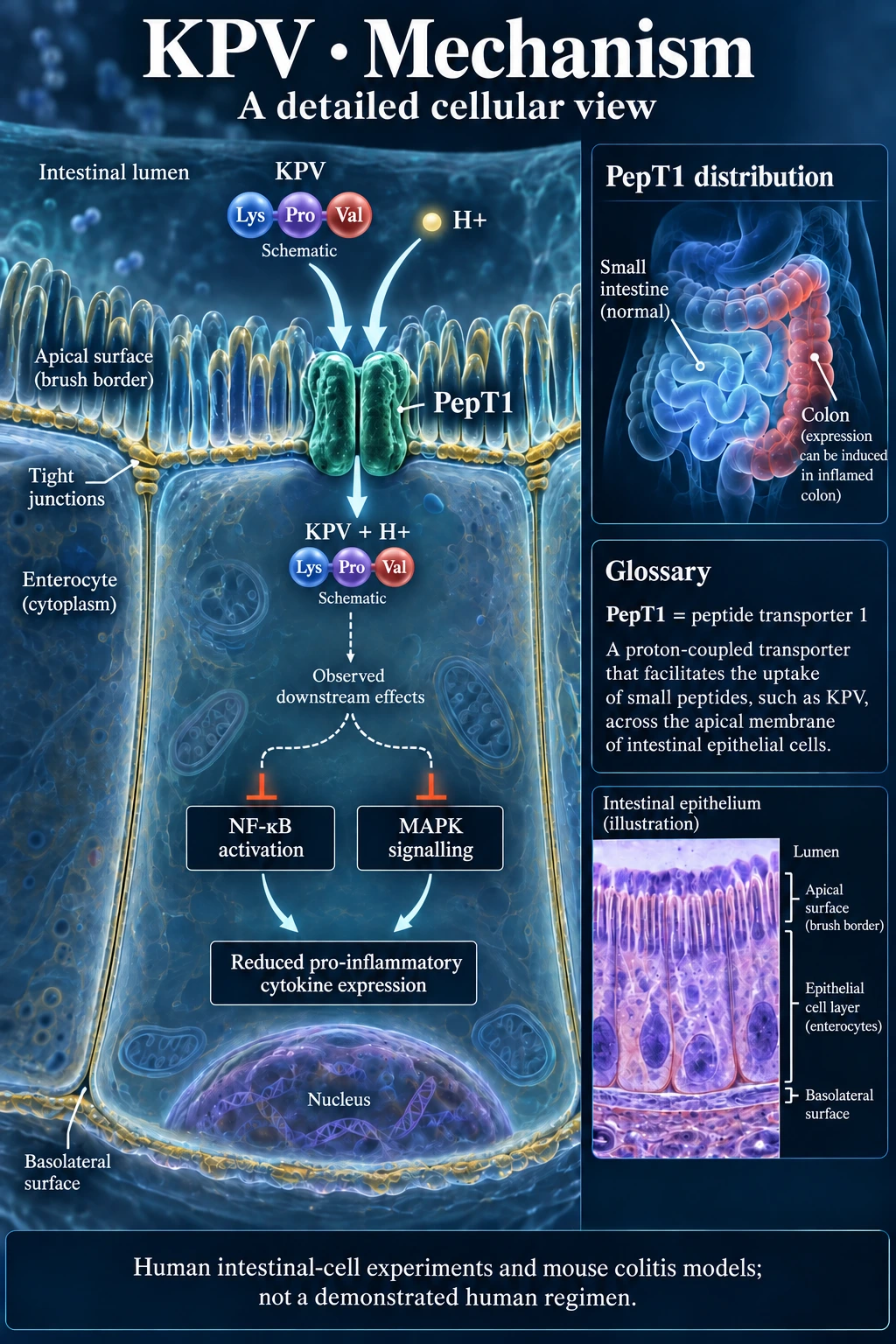
Educational illustration · Read the evidence and limitations below.
Medical · What is KPV?
KPV is a three-amino-acid peptide made from lysine, proline and valine. It corresponds to a short sequence at the end of alpha-melanocyte-stimulating hormone, usually shortened to alpha-MSH. KPV is discussed mainly for inflammation, especially in the digestive tract and skin.
Its appeal is the possibility of influencing inflammatory signals without using the entire parent hormone. That does not make KPV a general treatment for every inflammatory symptom. The most informative gut research involves cells and animal models, rather than a settled treatment programme for people with bowel disease.
For someone learning about peptides, KPV is a useful example of why route matters. An oral peptide does not always need high bloodstream absorption to be scientifically interesting: researchers may want it to reach cells in the gut itself. Whether a particular human capsule does that successfully is a separate question.
Medical · Benefits and common reasons for interest
Gut inflammation
Researchers have studied KPV in intestinal cells and mouse models of colitis, where it reduced inflammatory activity. These findings explain the interest in bowel symptoms. They do not establish that KPV treats Crohn's disease, ulcerative colitis or an undiagnosed “leaky gut” condition in people.
Skin irritation
KPV is also discussed in skin-related research and topical preparations. A topical effect would depend on the formulation, penetration and skin condition. It should not be assumed that a capsule, cream and injection have the same result.
A focused inflammatory signal
People may prefer the idea of modulating inflammation rather than broadly suppressing immunity. That is a research concept, not proof that KPV has no infection risk, no interactions or an advantage over established treatment.
Medical · How does it work?
Cells use signalling systems to increase or reduce inflammation. One of the pathways studied with KPV is NF-kB, which helps control production of inflammatory messages. Researchers have also investigated MAPK signalling. In plain language, the question is whether KPV can turn down an overactive cellular response.
A key intestinal study examined PepT1, a transporter that moves certain small peptides into cells. KPV uptake through this transporter helped explain its effects in the experimental setting. This is more specific than saying it simply “heals the gut.”
Inflammation has different causes. Infection, autoimmune disease, medication injury and food-related symptoms are not interchangeable. Turning down a signal in a model does not identify the cause of a person's symptoms or establish the best treatment.
Medical · KPV, alpha-MSH and peptide combinations
KPV is a short fragment associated with alpha-MSH, not the complete hormone. It should not inherit every pigmentation, appetite or immune claim attached to alpha-MSH or other melanocortin peptides.
KPV is sometimes discussed alongside BPC-157 or other gut-focused products. Two plausible mechanisms do not demonstrate that a combination works better. Adding several compounds at once can also hide which one caused a symptom change. Keep each identity, route and amount separate in the record.
Medical · Dosing and concentration
Amounts around 250–500 micrograms appear in wellness discussions of oral or subcutaneous KPV. These are reported practices, not a verified human bowel-disease dose. The animal drinking-water experiments cannot be turned into a human dose by simply scaling body weight.
Oral, topical and injected quantities describe different exposures. A cream's concentration is not a capsule dose, and a capsule amount cannot supply an injection instruction. Formulation, location of release and the condition being studied all matter.
Keep micrograms and milligrams distinct: 500 micrograms is 0.5 mg. Record the exact capsule strength or documented solution concentration. Peptscape's calculator can check a volume calculation, but it cannot establish which amount reaches inflamed gut tissue or improves a person's disease.
Medical · Preparation and reconstitution
An oral capsule is already a dosage form; it should not be opened and dissolved for injection. A topical preparation may contain ingredients suitable for skin that are unsuitable for injection or swallowing. Route is part of the preparation, not an optional label.
For lyophilised KPV, reconstitution requires instructions identifying the compatible liquid, final concentration and intended route. Bacteriostatic water usually contains benzyl alcohol. It is not automatically appropriate for making an oral or topical formulation and does not sterilise research material.
Enteric coatings and delayed-release capsules are designed to affect where material is released. Dissolving their contents can remove that feature. Do not improvise a gut-delivery system from a vial recipe. Keep preparation, opening and discard dates with any documented solution.
Medical · Administration
Oral delivery is particularly relevant to KPV's gut research because the target may be within the intestinal lining. That does not establish an optimal human meal-timing rule or justify treating severe bowel symptoms without assessment.
Topical products need instructions appropriate to intact or affected skin. Do not put an unverified preparation into eyes, deep wounds or other sensitive areas. A skin formulation is not an injectable medicine.
Subcutaneous use bypasses the gut lumen, so it does not reproduce oral exposure at the intestinal surface. There is no established “best injection site for the gut.” For any prescribed injection, device training, clean handling, new sterile equipment and appropriate site rotation remain necessary.
Medical · Oral versus subcutaneous delivery
Bioavailability usually describes how much intact substance reaches the bloodstream. For a systemic treatment, a low value may limit effect. For a locally acting gut treatment, blood exposure may not be the main goal: getting the compound to relevant intestinal cells can be more important.
KPV's cell and mouse research supports investigating that local approach. PepT1-mediated uptake is one proposed explanation. It does not mean that every oral preparation survives digestion, releases in the correct region or reaches a useful concentration in a person.
Subcutaneous injection may produce a different exposure pattern but is not automatically superior for a gut target. A meaningful comparison needs actual oral and injected formulations with human outcomes. “Higher absorption” and “better for bowel symptoms” are different claims.
Medical · Half-life
A dependable human half-life for oral or subcutaneous KPV is not available from the cited research. Its short sequence does not establish a specific duration. For local gut delivery, where and how long the formulation contacts tissue may matter more than a blood half-life number.
Medical · Storage
Capsules, creams and reconstituted solutions need their own storage instructions. Protect a capsule from moisture as directed; do not assume that refrigerating it improves stability. Condensation from repeated temperature changes can also be relevant to packaging.
A prepared solution needs a documented temperature range and discard date. Bacteriostatic water's label cannot provide KPV's stability period. Record changes in appearance or temperature exposure and do not use a clear solution as proof that it is uncontaminated.
Medical · Contraindications and side effects
Pregnancy, breastfeeding, childhood, significant immune suppression and active serious disease need medical review because human safety information is sparse. KPV should not replace prescribed treatment for inflammatory bowel disease or be used to postpone diagnosis.
Blood in stool, persistent fever, severe abdominal pain, dehydration, unexplained weight loss or symptoms waking someone at night warrant assessment. These are not signs to interpret casually as a “healing reaction.” New symptoms after a product should be recorded with timing and preparation details.
Allergy, skin irritation and injection-related infection remain possible concerns. Lack of a detailed human adverse-event database is not evidence that KPV has no side effects or that every supplement combination is safe.
Medical · Nutrition and supplement support
Start with the cause of the symptoms
A useful diet for irritable bowel symptoms may differ from nutrition needed during active inflammatory bowel disease. Avoid assuming that everyone needs the same elimination diet. Severe restriction can remove protein, energy and micronutrients without resolving the underlying problem.
Fibre needs individual adjustment
Soluble fibre can be helpful in some bowel patterns, but more fibre is not always better during a flare, significant narrowing or severe symptoms. Increase gradually where appropriate and review tolerance. A low-FODMAP approach, when suitable, is usually a structured trial with reintroduction rather than permanent avoidance of many foods.
Deficiency support
Iron, B12, folate, vitamin D and zinc may warrant assessment in people with bowel disease or restricted intake. Replacement should target the actual deficit. Excess zinc can contribute to copper deficiency; iron can cause gastrointestinal symptoms. These are nutritional considerations, not established KPV enhancers.
Probiotics and hydration
Probiotic effects are strain- and condition-specific. A generic “gut health” blend is not guaranteed to help and needs extra caution with severe immune compromise. Persistent diarrhoea can cause fluid and electrolyte loss; inability to keep up with losses requires medical advice rather than more supplements alone.
Medical · Tracking progress and common questions
Record stool frequency and form, urgency, pain, bleeding, meals and any existing treatments. A simple daily record can be more useful than changing several supplements after each bad day. Clinical markers, where appropriate, answer different questions from symptom scores.
“Why oral if absorption is low?” A local intestinal target can make oral delivery worth investigating. “Does that prove it works in humans?” No. “Does less pain mean bowel inflammation is controlled?” Not necessarily; symptoms and objective disease activity can differ, so keep medical follow-up in place.
Medical · Medical
The intestinal study used cell systems and mouse colitis models. It supports a mechanism and research rationale, not a human treatment recommendation. The regulatory review provides additional clinical and safety context.