Educational illustration · Read the evidence and limitations below.
What is KPV?
KPV is a three-amino-acid peptide made from lysine, proline and valine. Those letters are the shorthand symbols for its sequence. It corresponds to the final three amino acids of alpha-melanocyte-stimulating hormone, often shortened to alpha-MSH.
Its main experimental areas of use are inflammation involving the digestive tract and skin. The interest is in reducing certain inflammatory signals rather than increasing growth hormone or directly building tissue. A dependable treatment benefit for a particular gut or skin condition has not been established for routine use.
A small fragment can have a different role
Alpha-MSH participates in several biological processes, including pigmentation-related signalling. A fragment is not automatically a miniature version of the entire hormone. KPV should therefore not be understood as a tanning peptide simply because of its origin.
The same principle separates it from PT-141 and other melanocortin-related peptides. Related sequences or a shared family connection do not establish the same receptor behaviour, uses or instructions. The exact molecule matters more than the broad family name.
What inflammation means in this context
Inflammation is a coordinated response to injury or a perceived threat. It involves messages between cells, changes in local tissues and recruitment of immune activity. It can help protect and repair tissue, but persistent or misdirected inflammation can contribute to illness.
An anti-inflammatory aim is therefore not the same as shutting down every immune response. The proposed value of KPV concerns particular signalling processes. It does not follow that every symptom described as “inflammation” has the same cause or will respond to the same intervention.
What it is used for
Digestive inflammation and the intestinal lining
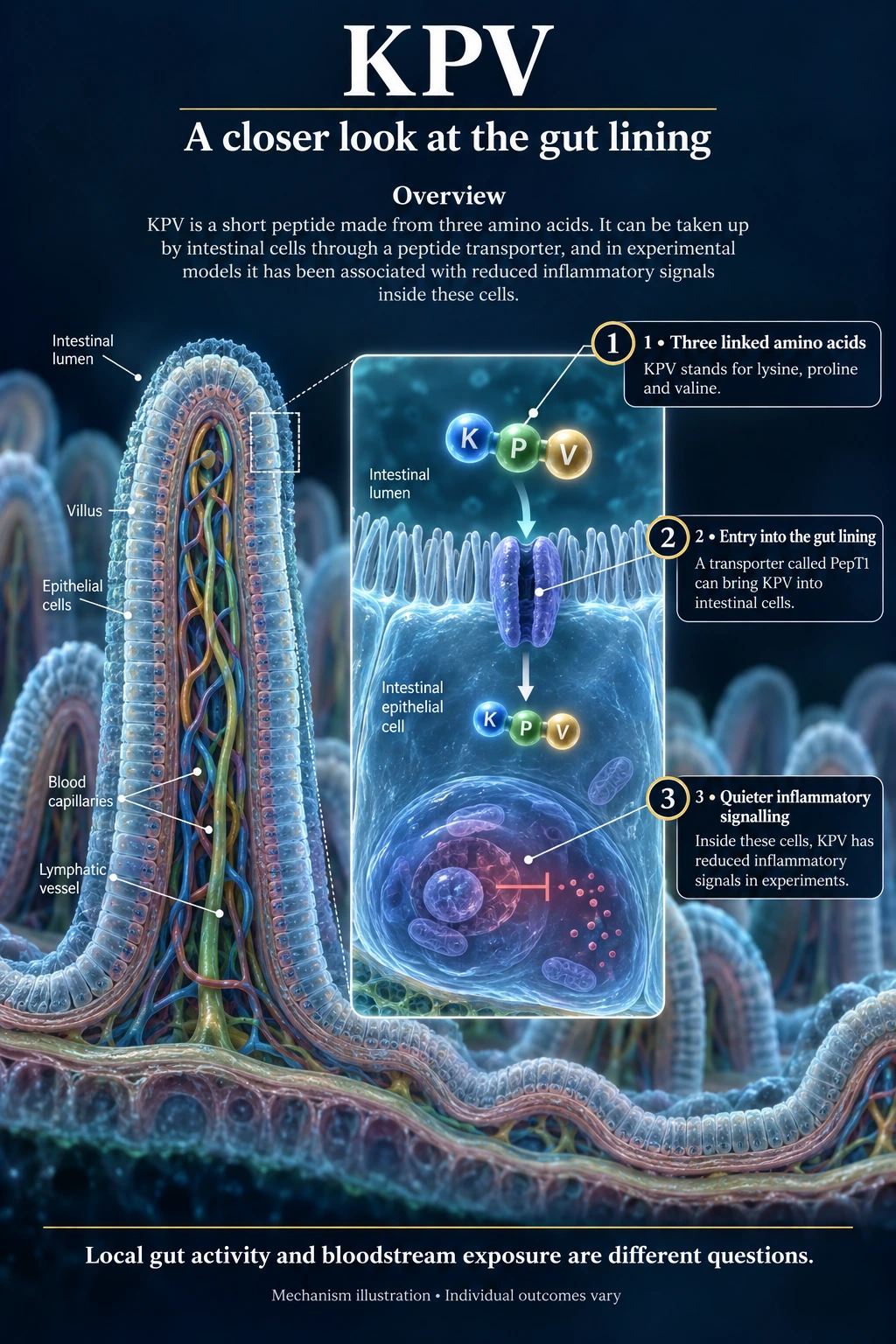
The gut is a major focus of KPV's experimental use. Its lining absorbs nutrients while helping regulate contact between the contents of the intestine and the body's tissues. Cells in that lining communicate with immune cells and participate in inflammatory responses.
Bloating, abdominal pain and altered bowel habits can arise for many reasons. They do not by themselves establish inflammatory bowel disease or damage to the gut barrier. KPV's anti-inflammatory rationale should not be turned into a diagnosis based on symptoms alone.
Why an oral route can be relevant
An oral preparation travels through the digestive tract and may bring a peptide into contact with intestinal tissue. For a local intestinal target, reaching the bloodstream is not necessarily the only route to a useful effect. This is why low systemic absorption does not automatically mean that a gut-directed approach has no biological rationale.
KPV has been investigated in connection with PepT1, a transporter that helps cells take up certain small peptides. That is a specific reason for intestinal interest, not proof that any swallowed KPV preparation reaches the appropriate tissue in an effective amount. Formulation and the location of the target still matter.
Skin-related use
Experimental topical interest concerns inflammatory skin responses. Redness, itching and irritation can involve inflammation, but they can also reflect infection, allergy or damage to the skin barrier. These problems should not be treated as interchangeable simply because they look red.
A topical preparation is designed for a particular surface exposure. It does not establish an equivalent amount for oral or injectable use. Likewise, an ingredient intended for intact skin should not automatically be used on an open wound or recently treated skin.
KPV versus repair-oriented peptides
KPV's main rationale concerns inflammatory signalling. BPC-157 and thymosin-related peptides are often discussed in relation to repair, but those are not identical aims. Calming a signal, restoring a barrier and rebuilding mechanically strong tissue are different outcomes.
This distinction also matters for combinations. Pairing peptides because they are associated with “gut health” or “recovery” does not demonstrate a useful combined effect. Each molecule and route need their own explanation rather than being merged into one broad benefit claim.
How it works
Messages inside inflammatory cells
Proposed actions of KPV involve signalling pathways that influence inflammatory messages. One frequently discussed pathway is NF-kB, a system involved in switching on sets of genes during immune and stress responses. It is not a substance that is always harmful or should always be eliminated.
The useful plain-language idea is that KPV may affect how strongly certain cells send inflammatory messages. That is more precise than saying it “heals the gut,” which could imply repair of every kind of intestinal problem. The extent to which the proposed action produces useful clinical outcomes remains unresolved.
Getting to the intended tissue
Digestive enzymes can break peptides into smaller pieces, and the intestinal lining limits what crosses into the bloodstream. KPV's small size and transporter-related work make its delivery questions different from those of a much larger peptide, but they do not remove the need to consider the actual formulation.
An injection bypasses the initial digestive barriers. It does not automatically deliver more useful exposure to the gut lining, where an oral preparation might have local contact. Oral and subcutaneous routes therefore cannot be ranked simply as weak and strong or converted using an assumed absorption percentage.
The location of gut disease matters
The stomach, small intestine and colon perform different jobs and have different environments. A preparation that releases its contents in one location may not behave the same as one designed to reach another. “Oral” describes entry through the mouth, not the exact tissue exposed.
This is why discussions of gut-directed delivery need more than the peptide name. The intended location and preparation matter, particularly when interpreting information about specialised delivery systems. Those findings cannot automatically be assigned to a plain capsule or reconstituted vial.
Symptoms and inflammation are separate outcomes
Feeling more comfortable is valuable, but symptom relief does not by itself show that an inflammatory condition has resolved. Conversely, an inflammatory marker can change without explaining every symptom. Keeping those outcomes distinct makes a gut or skin record more useful and prevents a broad wellness label from replacing a clear account of the condition.