Educational illustration · Read the evidence and limitations below.
Medical · What is Ipamorelin?
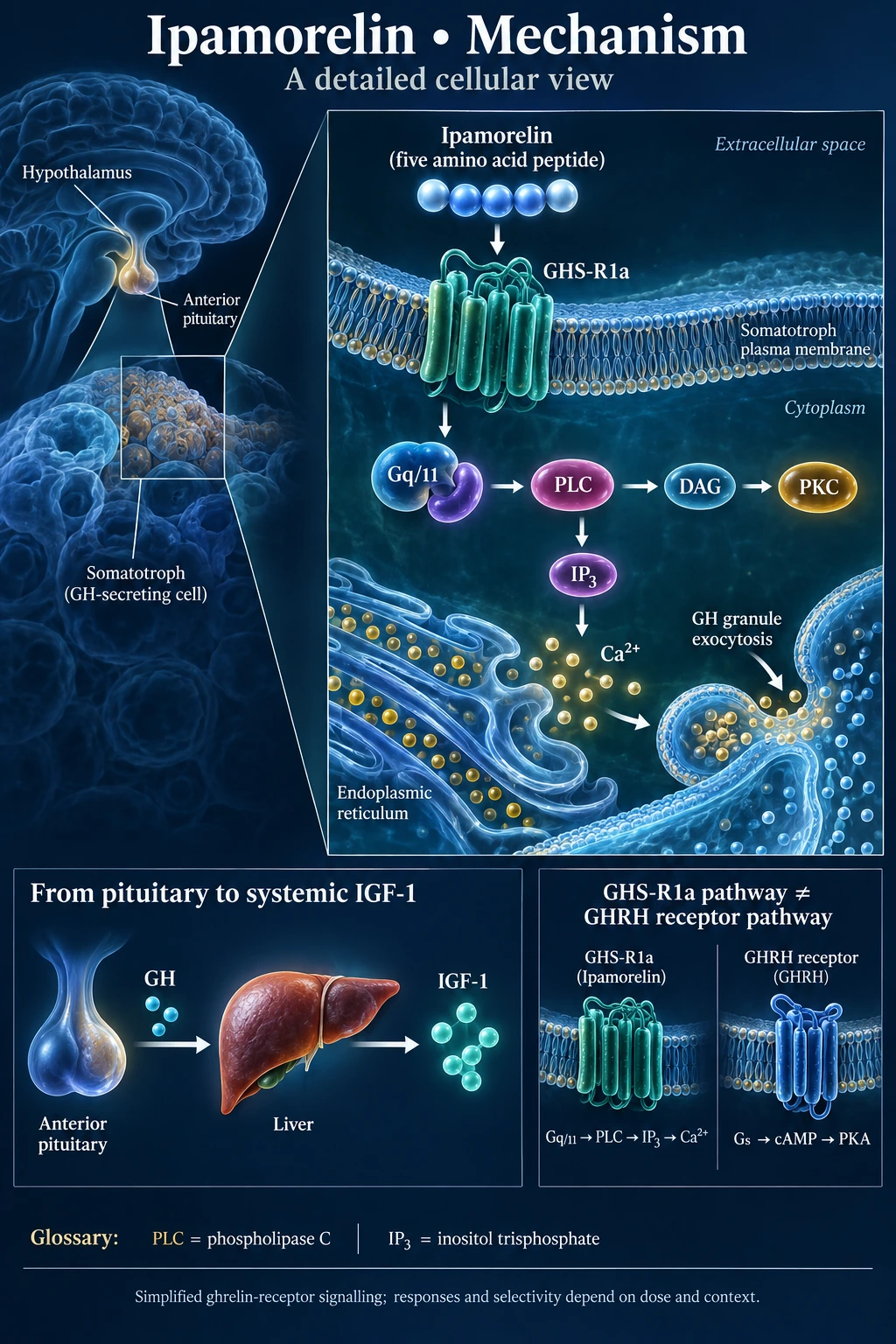
Ipamorelin is a five-amino-acid peptide that encourages the pituitary gland to release growth hormone. The pituitary is a small gland beneath the brain. It helps coordinate several hormone systems, including the signals involved in growth, metabolism and reproduction.
Ipamorelin belongs to a group called growth hormone secretagogues. “Secretagogue” simply means a substance that prompts a gland to release something it already makes. Ipamorelin therefore differs from injecting growth hormone itself: it stimulates release rather than supplying the hormone directly.
People most often investigate it for recovery, sleep and body composition. Its reputation as a relatively selective growth-hormone signal is part of the appeal. However, “selective” describes findings about hormone responses; it does not mean the peptide is free of side effects or proven to improve all of those goals.
It is frequently discussed alongside CJC-1295 without DAC, also called modified GRF(1–29). These act through different receptors. Understanding the difference is more useful than treating a combined vial as one interchangeable “growth peptide.”
Medical · Benefits and common reasons for interest
Growth hormone release
Stimulating growth hormone is the clearest demonstrated pharmacological effect. Human research has measured hormone changes after ipamorelin administration. A measurable rise in growth hormone is not, by itself, proof of better strength, sleep or long-term health.
Recovery and body composition
Growth hormone participates in tissue turnover and influences how the body uses nutrients. This creates interest in recovery and changes in fat and lean tissue. Nevertheless, a peptide-induced hormone rise does not substitute for adequate food, resistance exercise and recovery time.
A rapid increase in scale weight or a fuller appearance can reflect fluid retention rather than new muscle. Useful monitoring separates body weight, waist measurements, training performance and swelling.
Sleep and energy
Growth hormone normally rises in pulses, including during sleep. That connection is often used to explain bedtime protocols. It does not establish ipamorelin as a treatment for insomnia or daytime fatigue. Sleep apnoea, under-fuelling, anaemia and medication effects can all produce similar complaints.
Digestive motility
Ipamorelin has also been studied after bowel surgery because ghrelin-related signalling affects gut movement. This is a separate research question from muscle recovery. It does not establish an at-home treatment for constipation, gastroparesis or postoperative symptoms.
Medical · How does it work?
Ipamorelin activates the ghrelin receptor, also called GHS-R1a. Ghrelin is a natural signal associated with hunger and growth hormone release. Different compounds acting on this receptor can have different effects on appetite and other hormones.
Early ipamorelin research found a more selective growth-hormone response than with some older releasing peptides, particularly concerning ACTH and cortisol. That is the basis of descriptions such as “cleaner” or “gentler.” Those words should not be mistaken for a guarantee that appetite, blood sugar or other hormones remain unchanged in every person.
Growth hormone can stimulate production of IGF-1, a hormone involved in growth and tissue activity. This pathway remains subject to the person's underlying health and pituitary function. It is not an unlimited repair switch.
Medical · Ipamorelin and CJC combinations
A GHRH analogue and a ghrelin-receptor agonist stimulate growth hormone through different routes. That explains why combinations are discussed. It does not prove that a specific blend improves recovery more than either ingredient alone or has an acceptable long-term risk profile.
Keep both names and both amounts in a record. A vial labelled “5 mg + 5 mg” contains two separate ingredients; it is not 10 mg of ipamorelin. Equal milligram quantities are a blend ratio, not proof that the two ingredients should be administered in equal amounts.
The DAC version of CJC lasts much longer than the short-acting version. A blend must identify which one it contains. Mixing compatibility, co-administration and a demonstrated clinical benefit are three separate questions.
Medical · Dosing and concentration
Wellness protocols commonly discuss 100–300 micrograms subcutaneously one to three times daily. This describes a pattern encountered in wellness discussions, not a dose established by the human trials for better sleep, muscle gain or healthy ageing. It should not be used as an automatic starting schedule.
The human pharmacokinetic study used intravenous administration in healthy volunteers. A later postoperative trial also studied a monitored hospital setting. Neither provides a direct conversion to a personal subcutaneous wellness cycle.
A dosing record needs the prescribed amount, route and concentration. For calculation literacy, 2 mg is 2,000 micrograms. If a documented preparation has a final volume of 2 mL, its concentration is 1,000 micrograms/mL. This is an arithmetic example, not an instruction to prepare or administer that vial.
Syringe markings describe volume. A U-100 insulin syringe has 100 marked units per mL; those markings are not international units of ipamorelin. Reusing an old “units” value after changing concentration changes the amount delivered.
Medical · Preparation and reconstitution
Ipamorelin may be described as lyophilised, meaning freeze-dried. The powder's appearance does not establish identity, amount or sterility. A product intended only for laboratory research is not made suitable for human injection simply by dissolving it.
Bacteriostatic water is a preserved diluent commonly discussed in peptide preparation. It usually contains benzyl alcohol. Whether it is suitable depends on the actual medicinal formulation and its written preparation directions. Sterile water, saline and bacteriostatic water are not automatically interchangeable.
For a legitimately supplied injectable preparation, the preparation plan should specify the diluent, volume, mixing method, final concentration and after-mixing limit. Work on a clean surface, use hand hygiene and sterile single-use equipment, and keep used needles away from both the peptide and diluent vials. Follow the product's handling instructions rather than shaking, heating or improvising another solvent to force dissolution.
After preparation, label the concentration and date clearly. If the amount on the vial or the intended final volume is uncertain, stop the calculation there. A precise calculator output cannot correct uncertain inputs.
Medical · Administration
Subcutaneous means into the fatty layer beneath the skin. It does not mean into a tendon, joint or painful muscle. A location near an injury has not been shown to direct ipamorelin's hormonal effects to that tissue.
For a prescribed injection, a clinician should demonstrate the appropriate site and technique for the supplied device. Needle length and angle depend on the device, site and body habitus; there is no universal “peptide needle” that settles all three. Rotate suitable sites and avoid damaged, infected or bruised skin.
Use a new needle and syringe for every administration and dispose of them in a sharps container. Do not save a used syringe for the next entry into a vial. Record the actual time and amount, including missed administrations; do not double a later amount to repair the calendar.
Medical · Routes and bioavailability
Swallowing a peptide exposes it to digestion and an intestinal barrier that limits passage into blood. Subcutaneous injection bypasses that initial digestive breakdown, but absorption from the tissue and later clearance still matter. Bypassing the gut does not mean 100% predictable exposure.
The clinical intravenous data are not a measurement of subcutaneous bioavailability. Likewise, a nasal or oral product requires its own evidence and formulation instructions.
Some oral peptides intentionally work on the gut lining. Ipamorelin's gut-motility research concerns receptor effects and studied administration routes, not proof that a swallowed research vial provides a useful local treatment. Do not assume that reduced systemic absorption automatically creates a gut benefit.
Medical · Half-life
About two hours was measured after intravenous ipamorelin in healthy volunteers. This is the clearest human half-life estimate used here; it is not a verified half-life for every subcutaneous blend.
The growth-hormone response and the peptide's clearance are different curves. A two-hour half-life does not establish how often someone should administer it or how long a perceived recovery benefit lasts.
Medical · Storage
Use the temperature, light protection and after-preparation limit specified for the actual medicine. Keep the original label and the preparation record together. A lyophilised vial's expiry and a mixed solution's usable period are different dates.
The familiar 28-day rule for opened multidose medicines does not establish the chemical stability of reconstituted ipamorelin. Adding bacteriostatic water does not create a universal 28- or 30-day peptide shelf life.
Avoid heat exposure, repeated temperature changes and freezing unless the product specifically permits it. Do not use unexpected particles, cloudiness or a damaged vial as something to “fix” by filtering or adding more liquid.
Medical · Contraindications and side effects
Potential concerns include injection reactions and effects associated with increased growth-hormone activity, such as fluid retention, tingling, joint discomfort and changes in glucose control. These symptoms should be recorded rather than interpreted as proof the peptide is working.
Active cancer, a pituitary disorder, diabetes, significant swelling or unexplained headaches need medical review before considering a growth-hormone-releasing compound. Pregnancy, breastfeeding and use in children are not settings for a self-directed wellness protocol.
Review other growth-hormone agents and glucose-lowering medicines together. An absence of published interaction reports is not a guarantee of compatibility. Sudden breathlessness, facial swelling, fainting or severe headache with visual changes requires urgent assessment.
Medical · Nutrition and supplement support
Protein and adequate energy
Recovery needs building materials and enough energy. Include a protein source at meals: eggs, dairy, fish, meat, beans, lentils, tofu or another suitable option. Protein powder can be convenient when food intake falls short, but it is not required to activate ipamorelin.
Repeatedly under-eating while increasing training can worsen fatigue, sleep and recovery. A more aggressive peptide schedule does not correct that mismatch. Track appetite and meal regularity alongside training rather than attributing every change to hormones.
Creatine
Creatine has evidence for supporting repeated high-intensity exercise and resistance-training performance in appropriate adults. That evidence stands on its own; it does not show synergy with ipamorelin. It can also increase body weight through water held in muscle, which should be distinguished from peptide-related swelling.
People with kidney disease or relevant medical concerns should discuss supplementation with their clinician. A supplement should have a clear purpose and be recorded when introduced.
Vitamin D, calcium and magnesium
These nutrients contribute to bone, muscle and normal physiological function. Correcting a deficiency may be worthwhile. Taking large amounts despite adequate status has not been shown to make ipamorelin more effective.
Food choices and, where indicated, blood testing are better starting points than a compulsory supplement stack. Calcium and magnesium supplements can interfere with absorption of some medicines, so timing may need review.
Blood sugar and “GH boosters”
Fibre-rich foods, an appropriate overall energy intake and regular activity are useful foundations for metabolic health. Do not add glucose-lowering supplements to counteract a rising glucose reading without evaluating the cause.
Arginine, ornithine and multi-ingredient “GH boosters” are often marketed alongside secretagogues. A short-term hormone measurement does not establish improved recovery or added benefit with ipamorelin. More products also make unwanted effects harder to identify.
Medical · Tracking progress and everyday questions
Track sleep, training performance, waist measurement, weight and swelling separately. Use the same measurement conditions rather than comparing a morning weight with an evening one. If a clinician orders IGF-1 or glucose monitoring, retain the laboratory range and collection date.
Is ipamorelin growth hormone? No; it stimulates release. Is it guaranteed not to increase hunger? No. Does a stronger tingling or flushing sensation mean better results? No; sensations are not a dose target.
A useful review asks whether the original goal improved enough to justify continuing, whether adverse effects appeared, and whether other changes explain the result. “I completed the cycle” alone does not answer those questions.
Medical · Medical
The 1998 selectivity work, 1999 human pharmacokinetic study and 2014 postoperative trial address different questions. The first informs receptor and hormone comparisons; the second supports the approximately two-hour intravenous half-life; the third concerns bowel recovery after surgery. They should not be combined into a claim that long-term subcutaneous wellness use has been clinically established.
Ipamorelin has no FDA-approved medicinal indication. Its clinical research remains relevant, but trial setting, route and outcomes must accompany any quoted numbers.