Educational illustration · Read the evidence and limitations below.
What is Ipamorelin?
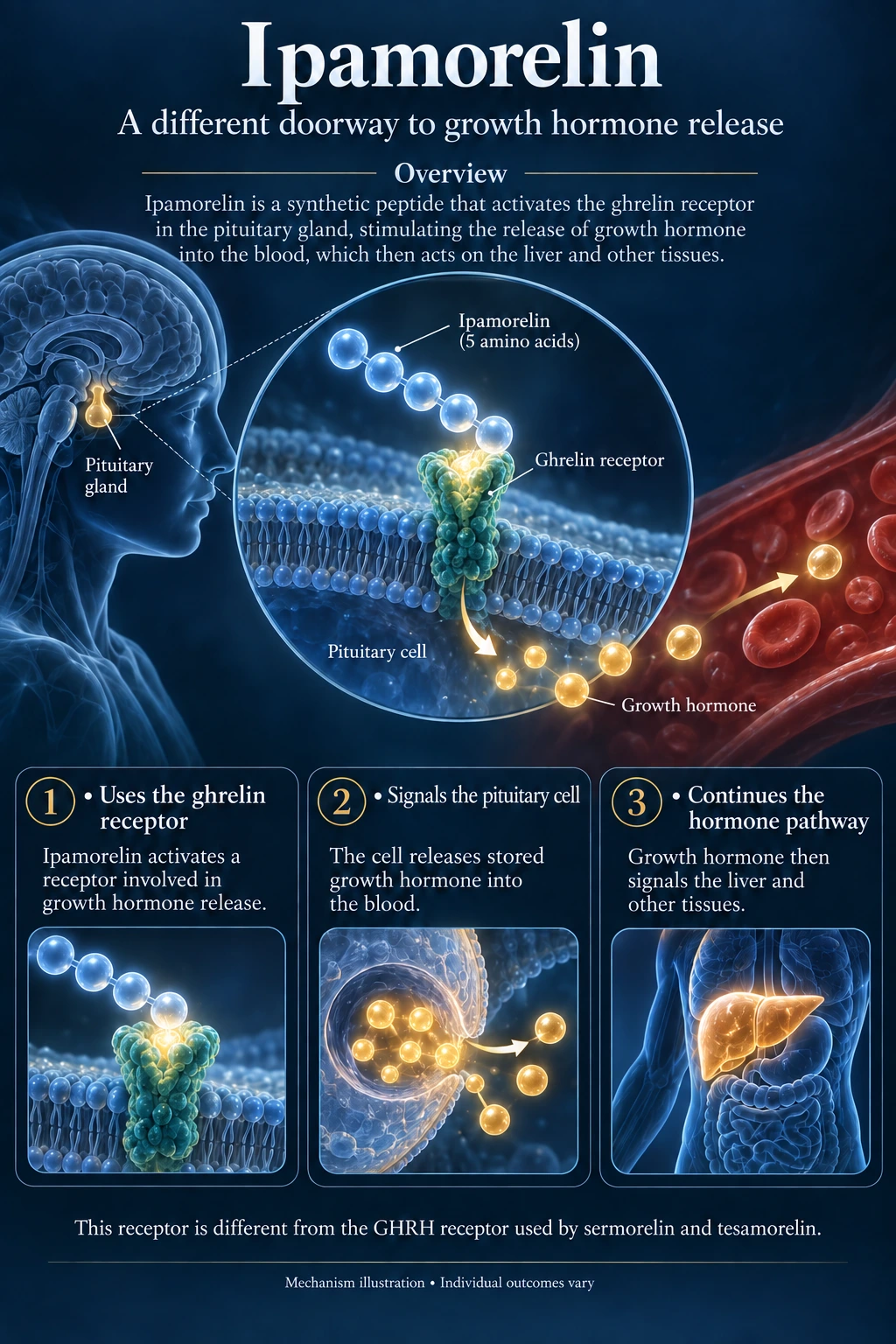
Ipamorelin is a peptide that stimulates the body to release growth hormone. It contains five amino acids and belongs to a group called growth hormone secretagogues. “Secretagogue” simply means a substance that prompts a gland to release a hormone it makes itself.
Its experimental uses include changes in body composition, recovery and sleep. These goals come from the roles growth hormone plays in the body, but a rise in growth hormone does not by itself establish improved recovery, fat loss or sleep in a healthy adult. The peptide's hormonal action and the result a user hopes to achieve are separate parts of the explanation.
Growth hormone release versus growth hormone replacement
Growth hormone is made in the pituitary, a small gland beneath the brain. Ipamorelin signals that gland to release hormone. An injection of growth hormone supplies the hormone directly. This is the essential difference between a releasing peptide and hormone replacement.
The distinction matters because a releasing peptide depends on the body's capacity to respond. It also works within a hormonal system that has feedback controls. Those controls do not make every amount harmless, but they mean that the resulting exposure is not simply the same as injecting a fixed amount of growth hormone.
Why it is called a ghrelin-receptor agonist
A receptor is a receiving point on a cell. Ipamorelin activates a receptor also used by ghrelin, a hormone involved in appetite and growth hormone release. “Agonist” means it activates that receptor. This explains its route into the growth hormone system without requiring it to resemble growth hormone itself.
Activating a receptor does not mean reproducing every effect of the natural hormone. Ipamorelin was developed for a relatively selective growth hormone response compared with some earlier releasing peptides. That does not justify a promise of no hunger, no changes in other hormones or no side effects for an individual user.
What it is used for
Body composition
The aim of body-composition use is generally less body fat with preservation or improvement of lean tissue. Growth hormone affects the release of fat from storage and interacts with processes involved in tissue maintenance. This is different from the appetite-reducing action of peptides used to make eating less easier.
Body weight alone does not show which tissue changed. Lean mass includes water as well as muscle and other non-fat tissue. A rapid increase in weight or a fuller appearance can therefore reflect fluid rather than new muscle. Waist measurements, strength and consistent body-composition measurements answer different questions and are more useful together than as interchangeable results.
Recovery and training
Ipamorelin is used experimentally with the aim of improving recovery between training sessions. Recovery includes several processes: replenishing fuel, repairing tissue, resolving soreness and restoring performance. A growth hormone response does not guarantee that all of these improve, or that a damaged tendon or joint is ready for more load.
The useful distinction is between training adaptation and injury healing. Becoming less sore after a familiar workout can reflect adaptation to that workout. Recovery from a tear, operation or persistent tendon problem requires a separate plan. Ipamorelin should not be described as directly repairing a particular injured structure.
Sleep-related goals
Growth hormone is released in pulses, including a prominent release associated with deep sleep. This relationship has led to experimental use of growth hormone-releasing peptides for sleep and overnight recovery. However, reproducing a hormonal signal does not necessarily reproduce the processes of healthy sleep.
Sleep duration, ease of falling asleep and feeling refreshed are separate outcomes. A peptide that stimulates hormone release is not a sleeping medicine. Its short action also does not, on its own, establish a universal bedtime schedule. The timing section should be read with the actual preparation and clinical plan in mind.
How it works
Two routes into the growth hormone system
Ipamorelin acts through the ghrelin receptor. Sermorelin and CJC-related peptides act through the growth hormone-releasing hormone, or GHRH, receptor. Both routes can influence release from the pituitary, but they are different receiving systems.
This is the reason these peptides sometimes appear together in experimental combinations. A biological rationale for combining two signals is not proof that the combination produces better body-composition or recovery outcomes. It also does not establish an appropriate ratio, schedule or lower risk. Each ingredient remains a separate exposure that needs to be identified correctly.
Growth hormone and IGF-1
Growth hormone acts on several tissues and encourages production of IGF-1, an important messenger involved in growth and tissue maintenance. IGF-1 is often measured because it varies less rapidly than a single growth hormone reading. It is not a score for how well a recovery programme is working.
The body normally releases growth hormone in bursts. A random blood sample can miss a burst or capture one, which makes a single measurement difficult to interpret on its own. Symptoms such as fatigue or poor recovery also have many possible explanations and do not establish growth hormone deficiency.
More hormonal activity is not always a better result
Growth hormone-related effects can include fluid retention and changes in glucose control. Swollen fingers, tight rings or tingling are not signs of productive muscle growth. These observations belong alongside any desired effects when assessing the experience.
Ipamorelin's defining feature is the signal it sends to the pituitary. It does not select one body area for fat loss, deliver a direct repair treatment to an injury or create an immediate measure of biological age. Understanding that action makes the practical information more useful and keeps expectations tied to the actual peptide.