Peptide library
Glepaglutide
Your guide to this compound.
Evidence in perspective
Reduction in parenteral support is relevant to short bowel syndrome, but specialist fluid/nutrition management is part of that outcome. The twice-weekly result cannot validate every schedule. A linked corrigendum remains to be reconciled in full.
About this assessment
Existing source snapshot critically reassessed.
Based on the selected source scope described in this profile, often an indexed abstract. Full methods and clinician sign-off remain pending; no systematic-review claim.
Editorial assessment · 2026-09-07
Source 1 · pubmed.ncbi.nlm.nih.gov
Who was studied
Patients with short bowel syndrome requiring parenteral support.
What the sources found
A phase 3 trial found reduced parenteral-support needs with twice-weekly treatment.
What remains unknown
Parenteral support must be adjusted under specialist monitoring; findings are not evidence for routine gut wellness use. A linked 2025 corrigendum was identified. Its full content was not accessible in the retrieved record, so the affected details remain under review.
How it works
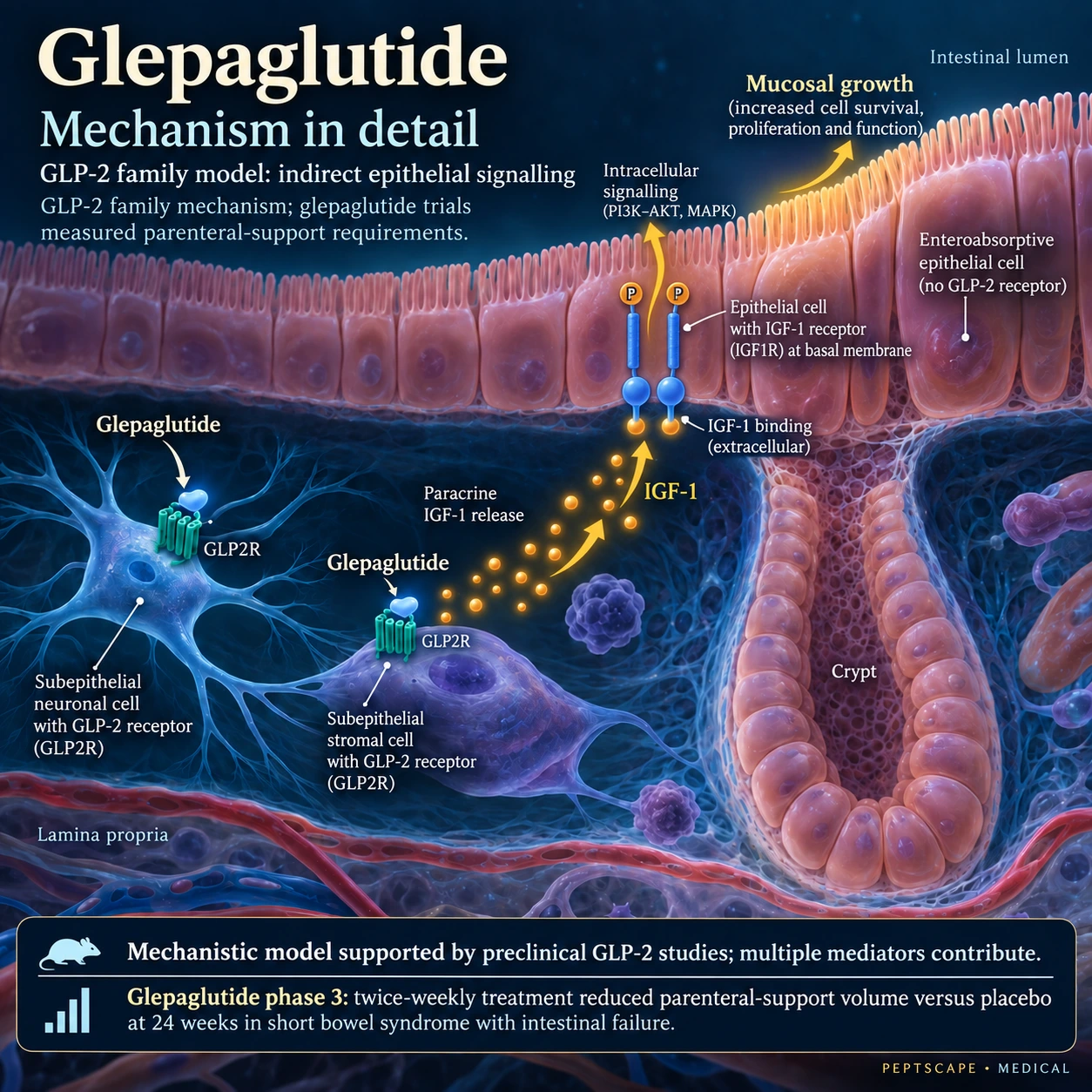
Activates GLP-2 receptors to support intestinal absorption.
Activates GLP-2 receptors to support intestinal absorption. Parenteral support must be adjusted under specialist monitoring; findings are not evidence for routine gut wellness use.
Human trials
This catalog identifies human research. A trial can be early, small or negative; its existence does not establish approval or benefit for every proposed use. Check the study population and outcomes.
Reported adverse effects
- Earlier trial reports included stoma complications, injection reactions, edema, nausea and abdominal pain.
Contraindications
- This snapshot is not a complete contraindication or interaction review.
Human trials
This catalog identifies human research. A trial can be early, small or negative; its existence does not establish approval or benefit for every proposed use. Check the study population and outcomes.
Sources used for this snapshot
Source 1 · pubmed.ncbi.nlm.nih.gov
References
Primary publication · PMID 39708985
PMID: 39708985
Primary publication · PMID 30880176
PMID: 30880176
Corrigendum. 2025.
PMID: 40788252
Catalog review date: Sep 6, 2026. This date alone does not establish independent clinical review.