Educational illustration · Read the evidence and limitations below.
What is Glepaglutide?
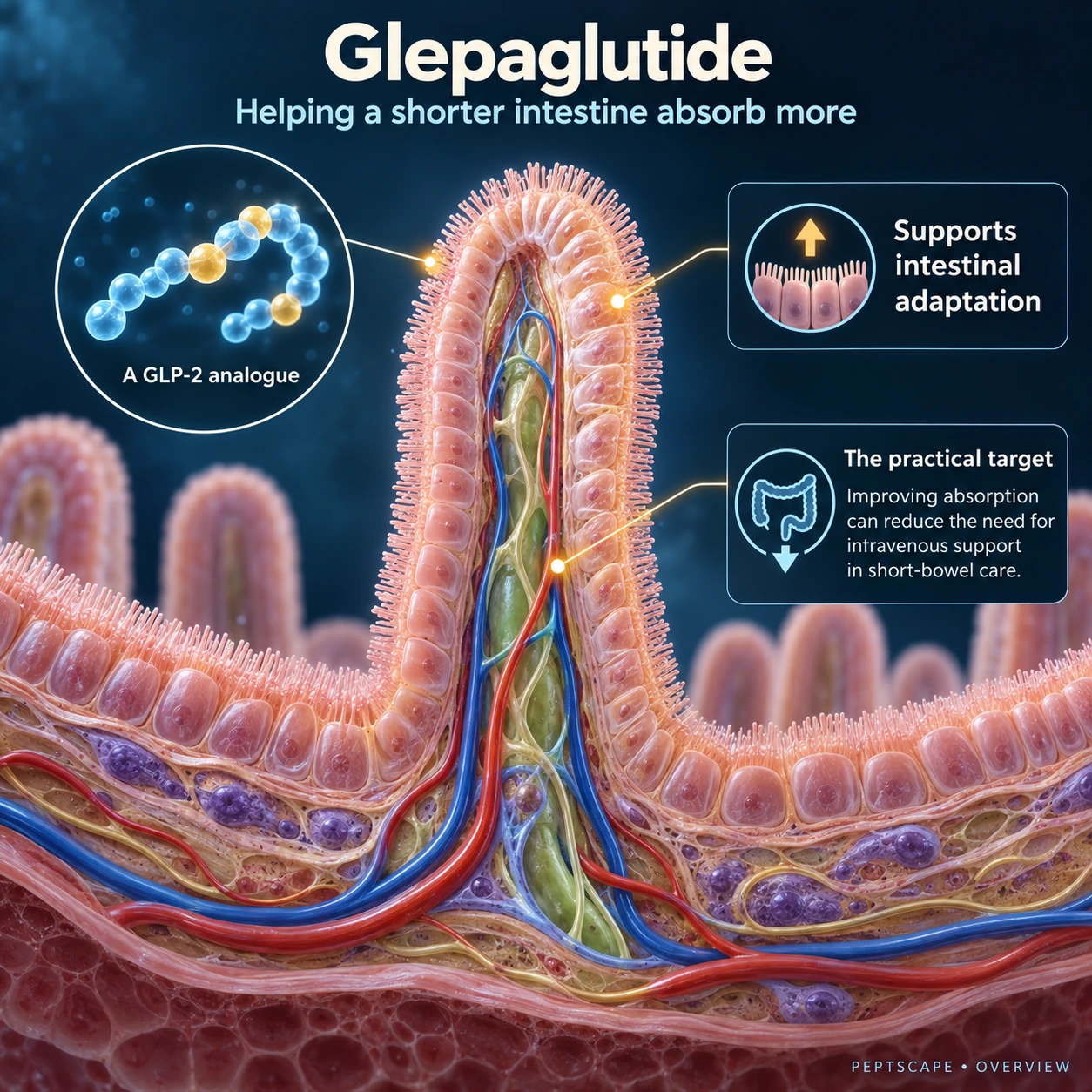
Glepaglutide is a long-acting GLP-2 analogue developed for short bowel syndrome. It is intended to support the ability of the remaining intestine to absorb fluid and nutrients. It is different from GLP-1-based weight-management peptides and should not be described as another appetite suppressant.
The wider picture
GLP-2 is a gut hormone involved in maintaining the intestinal lining and supporting absorption. It has a different main role from GLP-1, the hormone better known for appetite and glucose control. Similar names do not mean similar uses. Increasing the intestine's ability to absorb fluid and nutrients is a different objective from reducing appetite to support weight loss.
The remaining bowel adapts after resection, but its ability to do so depends on which sections remain and whether the colon is in continuity. The same bowel length can therefore have different practical consequences in different people. Absorption is a function of anatomy and tissue health, not just a peptide receptor response.
What it is used for
Its clinical goal is to reduce the need for parenteral support, meaning fluid or nutrition delivered outside the digestive tract. This can matter greatly to daily life, but it requires careful monitoring rather than a self-directed reduction in prescribed fluids. Better absorption and weight loss are not the same objective.
Understanding the intended benefit
Short bowel syndrome occurs when the remaining intestine cannot absorb enough after major loss of bowel. Some people need fluids or nutrition delivered into the bloodstream. In that setting, reducing the amount of outside support can be a meaningful benefit even if the person still needs treatment. This is not equivalent to treating ordinary bloating or improving a healthy person's digestion.
A person can lose fluid through the bowel while also developing swelling from another problem. Body weight alone is therefore not a sufficient guide to fluid needs. Teams managing intestinal failure use symptoms, intake and output, weight and laboratory results together. The aim is reliable hydration and nutrition rather than the fastest possible withdrawal of support.
How it works
The peptide is designed to maintain GLP-2-related signalling for longer than the natural hormone. That affects treatment timing and exposure but does not make it interchangeable with apraglutide or teduglutide. The amount of bowel remaining, its anatomy and the person's current nutritional support all influence what improvement would mean.
The biology in plain language
The intestinal lining adapts over time. Its surface area, blood flow and movement all influence how much is absorbed. GLP-2-based treatment is intended to support parts of that adaptation. As absorption changes, fluid balance and other medicines can change too. Adjustments to intravenous support require the treating team: maintaining hydration, kidney function and nutritional status is more important than pursuing a particular reduction in litres on its own.
As the intestine absorbs more, previously appropriate amounts of fluids, nutrients or other medicines may need review. That is a consequence of the intended biological change, not necessarily treatment failure. The preparation-specific monitoring plan matters because GLP-2-based treatment affects a working organ system over time, rather than providing a brief correction of one symptom.