Educational illustration · Read the evidence and limitations below.
Medical · What is GHRP-6?
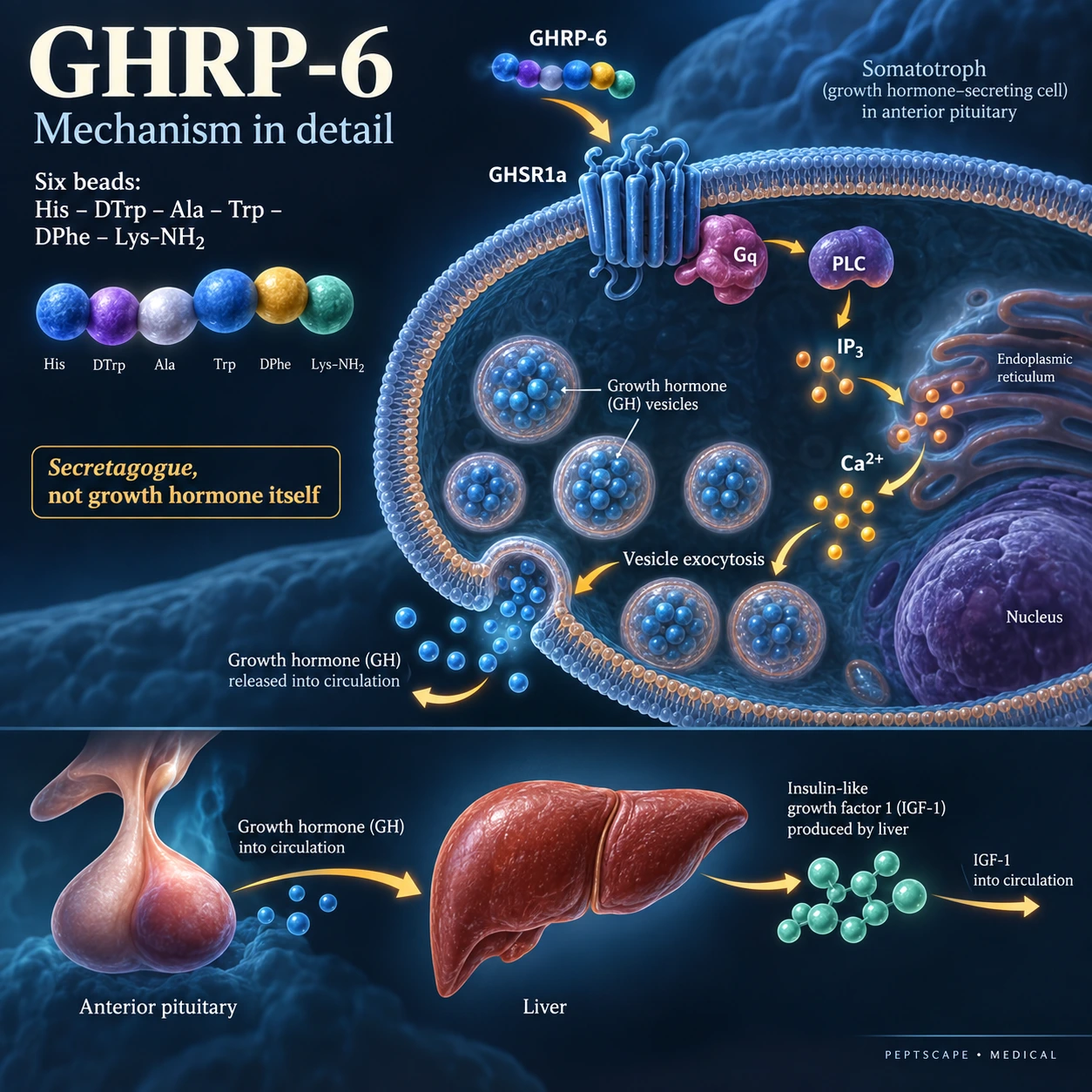
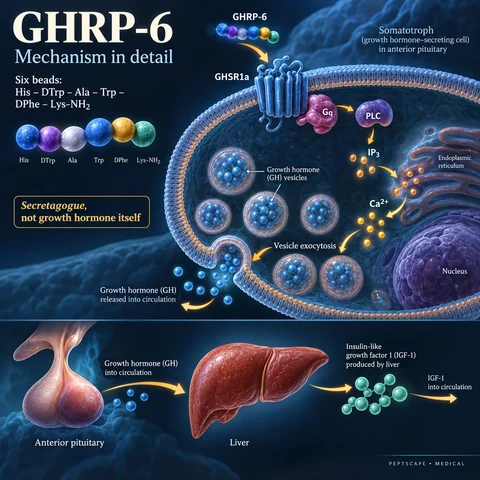
GHRP-6 is a six-amino-acid peptide that stimulates the body to release growth hormone. Its name stands for growth hormone-releasing peptide-6. It acts through the ghrelin receptor, a system also involved in appetite, which helps explain why increased hunger is one of its best-known effects.
It is a growth hormone secretagogue: a substance that encourages secretion rather than supplying growth hormone directly. The response depends on the person's own hormone system. It is not interchangeable with growth hormone replacement, and a measurable hormone pulse does not automatically translate into more muscle or better recovery.
People often explore GHRP-6 for appetite, body composition, training recovery or sleep. Understanding which of those goals is realistic is more useful than describing it as a general “anti-ageing” peptide. Increased appetite may be welcome for one person and work against another person's goals.
Medical · Benefits and common reasons for interest
Growth hormone release
Human physiology studies show that GHRP-6 can stimulate growth hormone secretion. This supports its mechanism, but it is not the same as demonstrating long-term improvements in strength, injury healing or healthy ageing.
Appetite
Ghrelin-related activity helps explain its reputation for hunger. Eating more may help someone who struggles to meet nutritional needs, but unexplained poor appetite or weight loss deserves a diagnosis. A hunger signal does not determine whether the extra food becomes muscle, fat or neither.
Recovery and sleep
These are common wellness claims. Better recovery depends on training load, food, sleep and health. A growth hormone response is not proof that GHRP-6 repairs an injury or reliably improves sleep quality.
Medical · How does it work?
The ghrelin receptor participates in signalling between the brain and hormone-releasing systems. GHRP-6 activates that receptor and can increase growth hormone release from the pituitary. GHRH, another hormone involved in growth hormone release, interacts with this response.
Growth hormone can influence IGF-1, metabolism and fluid balance. These effects explain why monitoring extends beyond whether someone feels hungry. More hormone activity is not automatically desirable, particularly if it affects glucose control or produces swelling.
The pathway is different from taking protein or amino acids as food. A six-amino-acid peptide can act as a signal at very small amounts; it does not supply meaningful dietary protein or replace adequate nutrition.
Medical · GHRP-6, GHRP-2 and Ipamorelin
These peptides belong to a related secretagogue group but differ in activity and reported tolerability. GHRP-6 is particularly associated with appetite effects. Names and dose ranges should not be swapped simply because all can stimulate growth hormone.
GHRH analogues such as sermorelin or CJC-1295 act through a different part of the system. Physiological interaction provides a reason for combination research, but it does not establish that a wellness stack is safer or more useful. Keep each compound's identity and schedule separate.
Medical · Dosing and concentration
Wellness discussions commonly describe 100–200 micrograms per administration, sometimes several times daily. This is a reported practice, not an established muscle-building or anti-ageing prescription. Human hormone-response experiments do not supply a complete long-term wellness schedule.
Meal timing and fasting rules are often presented with more certainty than the outcome evidence supports. A larger growth hormone pulse under a particular experimental condition does not establish better body composition or a need for repeated daily injections.
Record micrograms, concentration and volume separately. One milligram equals 1,000 micrograms. If a documented solution contains 1 mg/mL, 0.1 mL contains 100 micrograms; this is a measurement example, not a recommended preparation or dose. A U-100 syringe marks that volume as 10 units, but GHRP-6 is not dosed in insulin potency units.
Medical · Preparation and reconstitution
A lyophilised vial contains freeze-dried GHRP-6. Reconstitution needs a compatible diluent, defined volume, final concentration and storage limit for the exact preparation. Bacteriostatic water is commonly discussed, but its preservative does not establish peptide stability or sterilise a research vial.
Do not select a water volume solely to make syringe markings convenient. The instructions should identify the compound, amount, route and discard date as well as the arithmetic. Different vial strengths can produce very different doses from the same marked volume.
Do not mix GHRP-6 with a GHRH analogue in one syringe without verified compatibility instructions. A proposed hormonal combination and a stable injectable mixture are separate questions. Keep containers labelled and do not transfer oral or nasal preparations into injection equipment.
Medical · Administration
Subcutaneous administration is common in wellness discussions, while physiology research has also used other routes. Those studies should not be treated as identical delivery methods. There is no evidence that injecting beside a particular muscle directs growth to that muscle.
For a prescribed injectable preparation, a clinician should demonstrate the device and suitable fatty tissue. Wash hands, prepare on a clean surface, use new sterile equipment and rotate sites. Avoid inflamed or damaged skin and dispose of sharps immediately. Needle length and insertion technique should match the device and body tissue.
Do not repeat an amount because hunger did not appear. Appetite is not a potency test. Similarly, intense hunger does not prove a beneficial growth hormone or body-composition response.
Medical · Oral versus subcutaneous delivery
Swallowed peptides encounter digestive breakdown and an absorption barrier. GHRP-6's small size does not guarantee that an ordinary capsule delivers an effective systemic amount. Oral research, where relevant, concerns its own doses and formulations.
Subcutaneous delivery avoids the initial digestive route, but it does not guarantee a better long-term outcome. The hormone system can respond differently depending on physiology, timing and exposure. A local gut-targeting rationale is not established for using oral GHRP-6 as a bodybuilding treatment.
Medical · Half-life
GHRP-6 is short acting. The commonly repeated 15–30-minute estimate should not be treated as a precise measurement for every human subcutaneous preparation. The growth hormone response can follow a different time course from peptide levels, so a brief half-life is not a reason to keep redosing.
Medical · Storage
Use the exact preparation's temperature and discard instructions. Lyophilised material and a mixed solution may have different requirements. Mark concentration, preparation date and assigned discard date clearly.
A general rule such as “all peptides last a month in the refrigerator” is unreliable. Bacteriostatic water's own expiry does not establish the mixed peptide's expiry. Protect the container as directed, avoid damaging temperature exposure and do not attempt to repair an unexpected cloudy or particulate solution.
Medical · Contraindications and side effects
Growth hormone-related activity warrants particular review with diabetes, impaired glucose tolerance, significant swelling, active cancer or pituitary disease. Pregnancy, breastfeeding and childhood are not settings for unsupervised wellness experimentation.
Possible concerns include increased appetite, fluid retention, tingling, headache and changes in glucose regulation. Other pituitary hormones, including cortisol and prolactin, have also been examined in secretagogue research. GHRP-6 should not be described as guaranteed to affect only growth hormone.
Persistent swelling, severe headache, visual symptoms, fainting or signs of an allergic reaction need medical assessment. A random growth hormone blood test is difficult to interpret because secretion is pulsatile; ask the clinician which measurements actually address the concern.
Medical · Nutrition and supplement support
Decide what increased appetite is for
If appetite rises, plan ordinary meals rather than responding automatically with unrestricted snacks. For someone trying to gain strength, adequate protein and a sensible training programme matter. For someone trying to lose fat, increased hunger may make the plan harder rather than easier.
Protein and energy
Spread practical protein sources through the day: dairy, eggs, fish, meat, tofu or legumes according to preference. Protein powder can help when food intake falls short, but GHRP-6 does not create a requirement for special amino-acid mixtures. More calories do not become lean tissue simply because a peptide stimulates growth hormone.
Creatine and micronutrients
Creatine has separate uses in resistance training; a proven GHRP-6 synergy has not been established. Vitamin D, B12, iron or zinc should address a dietary or clinical need. High-dose “GH booster” supplements are not a substitute for evaluating hormone symptoms.
Glucose and fluid balance
Food quality and monitoring matter if glucose control is a concern. Do not add berberine or other glucose-active supplements to counter a suspected peptide effect without review. Likewise, diuretic products or aggressive sodium restriction should not be used to hide new swelling. A new adverse effect calls for assessment of the underlying plan.
Medical · Tracking progress and common questions
Record appetite, food intake, weight, swelling, sleep and training performance. Note each compound separately if reviewing a multi-peptide plan. A clinician may use glucose or IGF-1 measurements where appropriate, interpreted alongside symptoms and the reason for treatment.
“Does more hunger mean more muscle growth?” No. “Can I replace growth hormone treatment with GHRP-6?” Not without specialist assessment. “Should I raise the amount if I do not feel it?” Sensation cannot establish dose adequacy. Review objective goals and adverse effects rather than chasing a stronger immediate response.
Medical · Medical
The human physiology studies support growth hormone release and interaction with endogenous GHRH. They do not establish long-term wellness benefits or the safety of every research preparation.