Educational illustration · Read the evidence and limitations below.
Medical · What is GHK-Cu?
GHK-Cu is a small copper-binding peptide best known from skin-care products and research into tissue repair. GHK stands for the three amino acids glycine, histidine and lysine. “Cu” is the chemical symbol for copper. Together they form a copper-peptide complex.
GHK occurs naturally in the body and can bind copper. Copper is an essential trace mineral: the body needs small amounts for several enzymes and normal tissue function. That does not mean more copper produces better skin, or that adding GHK-Cu corrects every skin problem.
Most people are interested in smoother texture, firmer-looking skin, fine lines, recovery after irritation or healthier-looking hair. These are sensible topics to explain separately because cosmetic appearance, wound treatment and hair regrowth are different outcomes.
Topical products and injectable GHK-Cu also need separate discussions. A serum is designed for the skin surface. Its research, concentration and safety cannot be transferred automatically to an injection vial, even when the ingredient name is the same.
Medical · Benefits and common reasons for interest
Skin texture and appearance
Copper-peptide research includes effects on cells involved in skin structure and repair. Some human topical studies and reviews describe improvements in aspects of ageing skin, but results depend on the finished formulation and study quality.
A realistic cosmetic goal is a gradual change in texture or appearance assessed under consistent conditions. A blue serum is not proof of a useful concentration, and more visible colour does not mean more collagen production.
Wound and barrier repair
Laboratory and animal studies have examined connective-tissue formation and repair processes. Human research has also investigated specific topical wound-care preparations. A cosmetic product should not therefore be applied to an open wound, ulcer or freshly treated skin unless it is intended for that use and the treating clinician advises it.
A compromised skin barrier changes what can penetrate and how irritating a product may be. “Good for repair” is not a universal instruction to apply it immediately after any procedure.
Hair and scalp
GHK-Cu appears in scalp products because of interest in follicle biology and tissue signalling. It should not be described as an established replacement for treatments with stronger evidence for a particular type of hair loss.
Hair shedding can reflect thyroid disease, iron deficiency, illness, medications or pattern hair loss. Identifying the cause is more useful than treating all shedding as a need for a copper peptide.
Medical · How does it work?
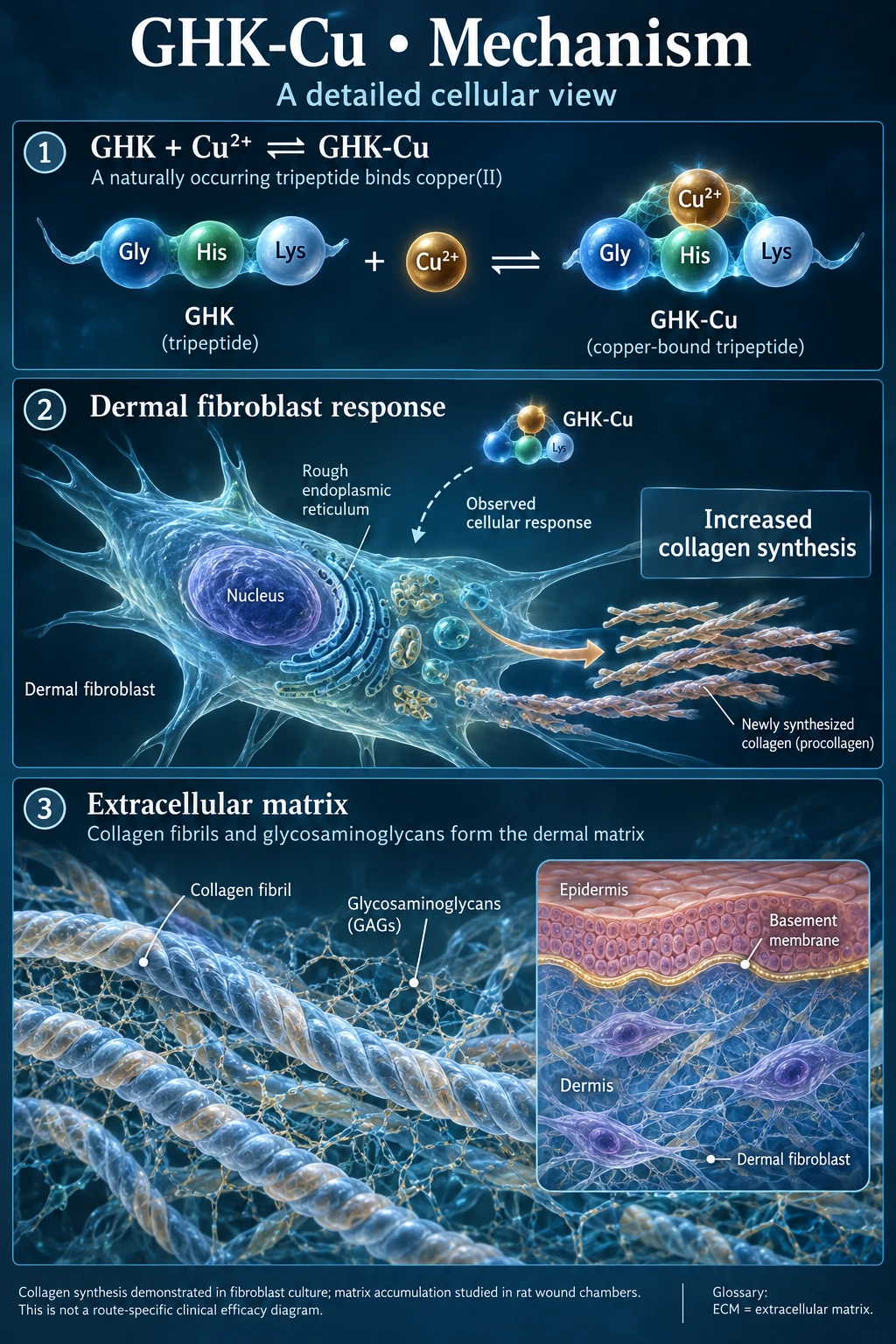
Skin contains cells called fibroblasts that help maintain the surrounding structural material, including collagen. GHK-Cu research has explored effects on this activity, tissue remodelling and inflammatory signals.
Remodelling means both making and breaking down material as tissue changes. More collagen signalling is not automatically better in every situation; useful repair involves organisation and balance, not simply maximising production.
Copper binding also matters. Free copper ions and a formulated copper-peptide complex do not behave identically. The finished product's acidity, other ingredients and delivery system influence how the complex is presented to skin.
Large claims about thousands of affected genes can sound impressive but are not a direct measure of visible benefit. A gene-expression experiment does not tell a user how much a wrinkle will change or whether an injection improves longevity.
Medical · Topical products versus injectable preparations
A topical product is usually intended for intact skin and includes a vehicle such as a cream, gel or serum. That vehicle affects spread, stability, irritation and delivery. The percentage may refer to pure GHK-Cu or to a solution containing it; these are not necessarily equivalent labels.
An injectable preparation must meet entirely different requirements. Cosmetic purity, a normal-looking solution or a familiar ingredient does not establish injection suitability. Do not inject a serum or a product intended for external use.
GHK without copper, AHK-Cu and multi-peptide blends are also different entries. Retain the exact ingredient rather than shortening them all to “copper peptide.”
Medical · Dosing and concentration
For topical use, follow the finished product's directions for amount, area and frequency. A concentration alone does not determine how much reaches the skin: the amount applied, area covered, vehicle and condition of the skin matter too.
Start a new cosmetic product on a small area as directed and avoid introducing several new actives at once. This makes irritation easier to identify. More frequent application or a higher percentage is not automatically better.
Topical percentages and the injectable 1–2 mg patterns encountered in wellness discussions should not be treated as interchangeable or as a validated injectable skin-rejuvenation regimen. Cosmetic trials do not establish an injection dose.
When reading a label, distinguish active peptide content from total complex solution. “One percent copper-peptide solution” may not mean one percent pure GHK-Cu. Ask for an unambiguous ingredient specification rather than calculating from a marketing headline.
Medical · Preparation and reconstitution
A finished skin-care product
A ready-made serum or cream does not need reconstitution. Do not add bacteriostatic water, extra copper, an acid or another peptide to it. Those changes alter the formula and may undermine its stability or preservation.
Keep the product in its intended container. Decanting it into an unlabelled jar makes it harder to retain ingredient, opening-date and storage information.
Lyophilised GHK-Cu
Lyophilised means freeze-dried. Dissolving the material creates a solution, but it does not automatically create a suitable cosmetic or injectable formulation. Concentration, acidity, compatible ingredients and microbial control still matter.
Bacteriostatic water contains a preservative; it is not a complete skin-care base and does not establish injectable compatibility. A blue colour is expected for many copper complexes, but colour cannot verify purity, sterility or potency.
For a prescribed preparation, use its specific formulation instructions. A laboratory vial should not be converted into a human-use product by following a generic water-volume chart. Retain the exact compound, amount, route and preparation details in any record.
Medical · Administration
For a topical product intended for intact skin, apply according to its directions and avoid eyes and mucous membranes unless specifically formulated for them. Use clean hands and keep applicators clean. Irritation is a reason to stop and reassess, not to “push through” presumed repair.
Avoid applying cosmetic GHK-Cu into open wounds or immediately after microneedling or resurfacing without procedural guidance. These situations alter the barrier and can expose deeper tissue to ingredients intended only for the surface.
There is no demonstrated need to inject beside a wrinkle, scar or painful joint to direct GHK-Cu there. Local cosmetic use and injection are different interventions. For any medically prescribed injection, site and technique belong to that specific clinical instruction rather than the topical profile.
Medical · Routes and bioavailability
Topical delivery is intended to act at or through skin, so a low blood concentration does not necessarily mean a skin-care product is ineffective. The relevant questions are local delivery, tolerability and the outcome measured in the skin.
Swallowed GHK-Cu encounters digestion and normal copper handling. Oral exposure does not reproduce a topical treatment, and taking copper supplements is not the same as delivering GHK-Cu to a target tissue.
Subcutaneous injection bypasses the gut and skin surface barrier, but that does not establish better cosmetic results. It changes exposure and introduces risks absent from routine use on intact skin. There is no useful universal oral-to-topical-to-injectable conversion.
Medical · Half-life
There is no reliable human subcutaneous half-life value to use for GHK-Cu scheduling in this profile. Numbers from cell experiments, related copper compounds or endogenous GHK should not be substituted.
For a topical product, wear time and application frequency depend on the formulation. A blood half-life would not by itself determine how often a serum should be applied.
Medical · Storage
Store the finished topical product under its own directions, with the cap closed and away from unsuitable heat or light. A bathroom shelf exposed to steam and direct sun may not match those conditions.
Respect its after-opening period. Changes in texture, smell or colour should be checked, but an unchanged appearance does not guarantee microbial quality.
A lyophilised vial and a mixed solution have different stability questions. Copper-related chemistry, acidity and other ingredients can matter, so a generic “30 days refrigerated” rule is not a substitute for formulation data. Do not try to restore an altered product by adding water or more peptide.
Medical · Contraindications and side effects
Topical products can cause irritation or contact allergy, including reactions to ingredients other than GHK-Cu. Stop using a product that produces persistent redness, burning or swelling and seek advice for a significant reaction.
People with Wilson disease or another copper-handling disorder should discuss copper-containing products and supplements with their treating clinician, particularly before any systemic exposure. Pregnancy and breastfeeding require review of the actual product rather than assumptions based on copper being a nutrient.
Injection adds concerns about infection, impurities and immune reactions that cannot be assessed from cosmetic tolerability. Active skin disease, unexplained lesions or a wound that is not healing deserves diagnosis rather than escalation to injections.
Medical · Nutrition and supplement support
Protein and vitamin C
Skin repair requires adequate protein and nutrients. Include varied protein sources and fruit or vegetables containing vitamin C. Vitamin C participates in collagen formation; this normal role does not mean high-dose supplementation multiplies a copper peptide's effect.
If dietary intake is limited, address the reason and consider an appropriate supplement. A cosmetic goal should not lead to an unnecessarily restrictive diet that reduces the nutrients needed for skin and hair.
Copper and zinc
GHK-Cu does not create an automatic need for oral copper. Copper is found in foods such as nuts, seeds, whole grains and shellfish. Excess supplemental copper can be harmful, and a copper-metabolism disorder changes the discussion substantially.
Long-term high-dose zinc can reduce copper absorption and cause deficiency. Do not respond to that possibility by adding an arbitrary copper dose to a large zinc dose. Review total intake, the reason for supplementation and any relevant laboratory findings.
Hair-loss supplements
Iron, vitamin D or other supplementation may be appropriate when a deficiency contributes to shedding. They are not universal hair-growth treatments. Biotin is often promoted for hair, but unnecessary high doses can interfere with some laboratory tests, including important hormone and cardiac tests. Tell the laboratory and clinician about its use.
Collagen and sun protection
Oral collagen products have their own evidence and limitations. They do not replace adequate total protein, and their use does not establish synergy with GHK-Cu.
For photoageing goals, consistent sun protection is an essential part of the plan. Continuing heavy ultraviolet exposure while adding more products can undermine the very outcome being tracked. Skin-care routines should be tolerable enough to use consistently.
Medical · Tracking progress and everyday questions
Use photographs in the same light, at the same distance and without changing filters. Record dryness, redness, stinging and new products as well as the desired appearance change. For hair, use consistent parting and images rather than judging one shower's shedding.
Can GHK-Cu be used with vitamin C or retinoids? Compatibility depends on the finished formulas and skin tolerance; there is no universal ban or guarantee for every combination. Introduce products separately and follow their directions.
Does a stronger blue colour mean better quality? No. Does a topical benefit prove an injection benefit? No. The route and formulation remain part of the treatment being assessed.
Medical · Medical
The evidence includes laboratory tissue-remodelling research and studies of specific topical preparations. A diabetic-ulcer study and a laser-resurfacing study concern very different skin conditions and should not be generalised to all cosmetic products or injections.
The laser-resurfacing trial did not demonstrate a broad objective healing advantage from adding the copper complex, illustrating why the profile should discuss mixed results rather than promise universal repair. No FDA-approved injectable GHK-Cu indication is established here.