Educational illustration · Read the evidence and limitations below.
What is GHK-Cu?
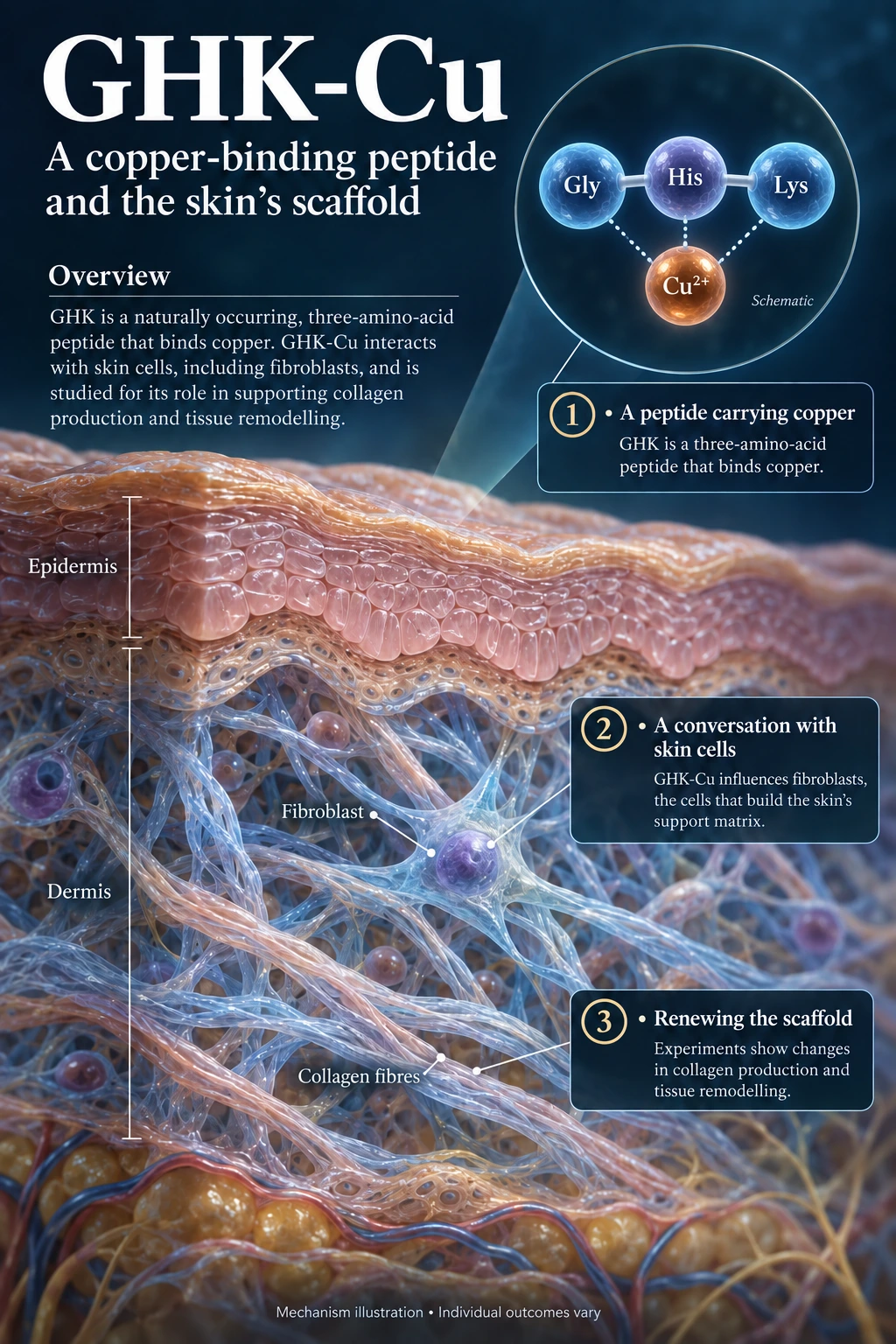
GHK-Cu is a copper-binding peptide associated with skin repair and tissue renewal. GHK stands for glycine, histidine and lysine, the three amino acids that form the peptide. Cu is the chemical symbol for copper. Together they form a small complex that can interact with processes involved in tissue maintenance.
Its best-known everyday use is in topical skincare, where the goals include smoother texture, improved appearance of fine lines and support for ageing or stressed skin. Experimental uses also include hair and wound-related applications, as well as injectable preparations. These are distinct uses: results from a topical formulation cannot be assumed to apply to an injected product.
Why copper is part of the molecule
Copper is needed by enzymes that perform several normal jobs, including helping form and maintain connective tissue. An enzyme is a protein that makes a chemical process happen. Binding copper to a peptide changes how that copper is carried and interacts with its surroundings; it is not the same as simply adding dietary copper.
Using GHK-Cu does not establish that someone has a copper deficiency. Nor does it create an automatic need for extra copper supplements. Copper and zinc intake can affect one another, so the nutrition discussion should distinguish normal nutritional needs from the separate use of a copper-containing preparation.
Skin is more than its surface
The outer skin layer provides a barrier. Beneath it, the dermis contains collagen and elastin, which contribute to strength and elasticity. Fibroblasts are cells that help maintain this supporting material. These are some of the tissues and processes that explain the interest in GHK-Cu.
A change in surface hydration can make skin look smoother quickly. Remodelling of deeper supporting tissue is a different process and should not be inferred from that immediate appearance. This is why a useful skincare assessment considers texture, irritation and longer-term appearance separately.
What it is used for
Skin texture and visible ageing
Topical GHK-Cu is used with the aim of improving skin texture and the appearance of fine lines. The proposed benefit involves support for repair and the balance between building and breaking down the skin's supporting material. The size of any visible change depends on the formulation and skin condition; the ingredient name alone does not guarantee a result.
A serum and a cream may contain different concentrations and deliver the ingredient differently. The rest of the formula also affects hydration and irritation. A change after starting a product may therefore reflect the complete formula rather than the peptide in isolation.
Wound and tissue repair
GHK-Cu has also been investigated in wound-related applications. A wound is a different environment from intact cosmetic skin: the barrier is disrupted, inflammation is active and repair cells are rebuilding tissue. A preparation intended for intact skin should not automatically be applied to an open wound.
The same distinction applies after procedures. Recently treated skin can absorb or react to products differently. Instructions for a cosmetic serum do not establish suitability immediately after laser treatment, needling or surgery. The type of wound or procedure and the actual product need to guide care.
Hair-related use
Hair-related interest centres on the scalp and follicle environment. A follicle is the structure in the skin from which a hair grows. Supporting skin conditions is not the same as reversing every cause of hair loss, and GHK-Cu should not be described as a dependable treatment for pattern hair loss or scarring disorders.
Shedding, breakage and thinning are also different problems. A photograph can help follow density over time, but lighting, hair length and styling can create large apparent changes. A consistent comparison is more informative than judging a few hairs in the shower after each application.
Injectable use is a separate category
Injectable GHK-Cu is used experimentally for broader repair or cosmetic goals. It bypasses the skin barrier and creates a different exposure from a topical product. That does not establish greater benefit, and topical experience does not provide an interchangeable injection amount or schedule.
A topical product is never made suitable for injection by diluting it. Its ingredients, manufacture and intended route are different. The Practical section keeps topical products and injectable preparations separate for this reason.
How it works
Building and remodelling connective tissue
Tissue maintenance involves both construction and controlled breakdown. Collagen provides strength, while other components influence elasticity and hydration. Proposed GHK-Cu actions include effects on repair-cell behaviour and the processes that regulate this surrounding material.
More collagen is not automatically better in every setting. Healthy tissue needs organisation and a balance between production and removal. A scar, for example, contains connective tissue but does not have exactly the structure or function of the original skin. “Supports repair” should therefore not be read as a promise of scar-free healing.
Delivery determines what tissue is exposed
The skin barrier limits the entry of many substances. A topical formula must be considered as a complete delivery system, not simply a concentration on a label. Injecting a compound bypasses that barrier but introduces a different set of questions about distribution and tolerability.
This is the practical reason to avoid ranking routes as simply weak and strong. The useful route depends on the intended tissue and the actual preparation. A topical goal does not automatically become better served by whole-body exposure.
Colour and skin response
Copper-peptide solutions can have a characteristic blue colour. Colour is not a test of identity, purity, sterility or the amount present. Those properties require appropriate product information and testing.
For topical use, persistent burning, redness or worsening irritation is not evidence of productive renewal. Keep the product, application area and skin response clear in the record. This makes it easier to separate tolerance from cosmetic benefit and to understand whether a change followed the peptide product or another part of the routine.