Educational illustration · Read the evidence and limitations below.
Medical · What is Epitalon?
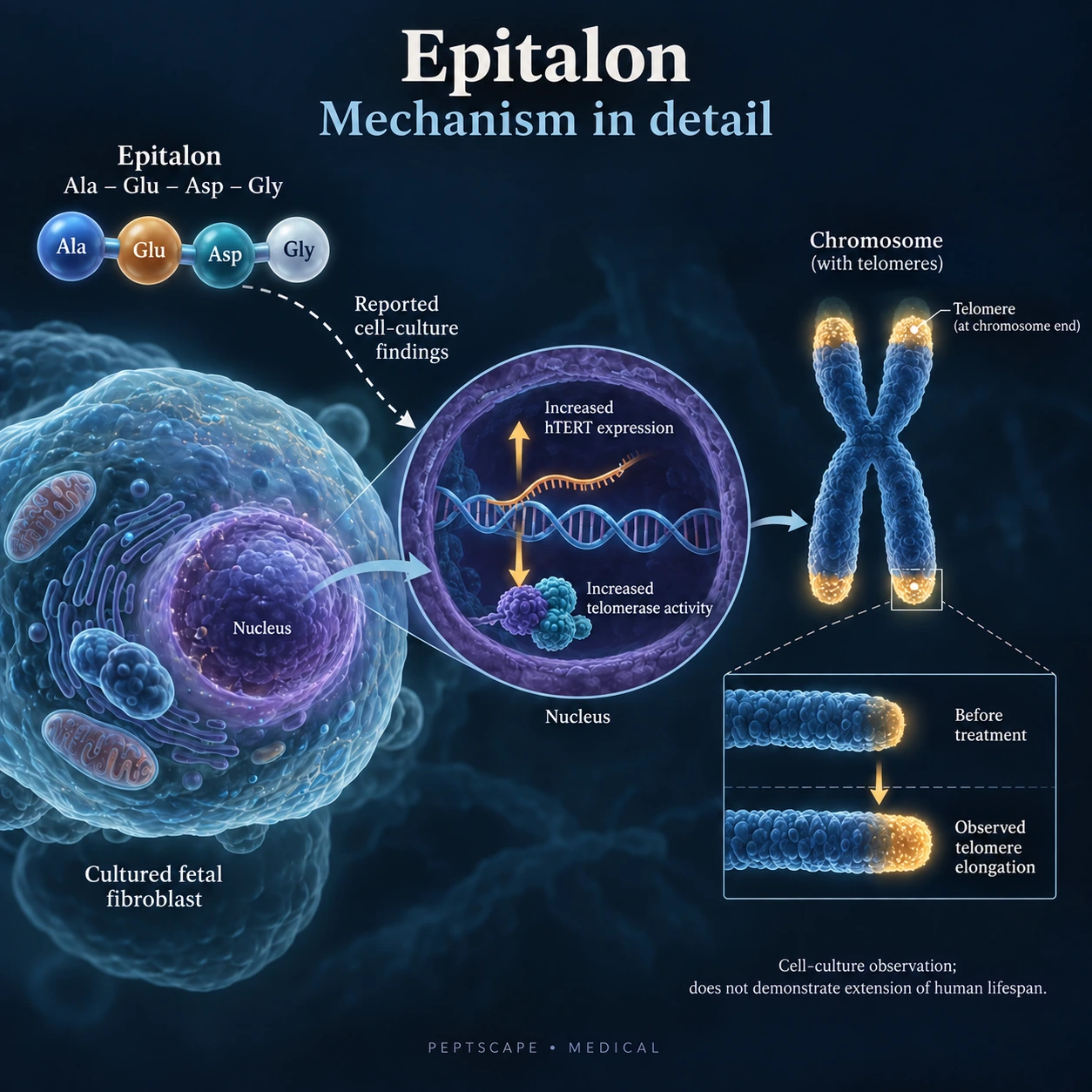
Epitalon, also spelled Epithalon, is a synthetic peptide made from four amino acids: alanine, glutamate, aspartate and glycine. It is discussed mainly in relation to ageing, cellular maintenance and sleep rhythms. The shorthand AEDG comes from the one-letter names of those amino acids.
Its best-known research concerns telomeres, protective structures at the ends of chromosomes. Some cell experiments found changes in telomerase, an enzyme involved in maintaining telomeres. That is the origin of many “longevity peptide” descriptions.
Epitalon is not a vitamin, a replacement for melatonin or a demonstrated way to reverse a person's biological age. The useful explanation is more specific: it is a research peptide with intriguing cellular findings, while the leap from those findings to healthier or longer human life remains substantial.
Medical · Benefits and common reasons for interest
Healthy ageing
People may be interested in preserving independence, energy, cognition and physical function. Epitalon's cellular research is relevant to questions about ageing, but it has not established that a course of injections extends human life or prevents age-related disease.
Sleep and circadian rhythm
The research history is linked to the pineal gland and biological rhythms. That connection does not make Epitalon a standard sleep treatment. Difficulty falling asleep, early waking and daytime exhaustion can have different causes and should be tracked separately.
Cellular maintenance
Laboratory changes in telomere biology provide a reason to investigate mechanisms. They are not the same outcome as fewer illnesses, better function or longer survival. A consumer biological-age test cannot close that gap by itself.
Medical · How does it work?
Telomeres help protect chromosome ends when cells divide. In many cell types they shorten over time, although their relationship to ageing is more complex than a simple countdown clock. Telomerase can add telomeric material in certain settings.
Epitalon experiments have explored changes in gene activity and telomerase. A peptide changing a signal in cultured cells does not tell us which tissues would receive a useful exposure after a particular human route, or whether that change would be beneficial over years.
Longer telomeres are not an unconditional goal. Cell growth and cancer biology also involve telomere-maintenance systems. This does not prove that Epitalon causes cancer, but it does mean that “more telomerase is always better” is an unsafe oversimplification.
Medical · Epitalon and Epithalamin
Epithalamin is a pineal-derived peptide preparation; Epitalon is a defined synthetic tetrapeptide. Older clinical reports about an extract cannot automatically be assigned to the four-amino-acid molecule.
Check the exact compound name when reading longevity claims. A decades-long observation involving a different preparation is not a decades-long Epitalon injection study. Similar spelling has contributed to considerable confusion in public summaries.
Medical · Dosing and concentration
Wellness discussions commonly describe short courses, including 5–10 mg daily for 10–20 days. These are reported practices, not a verified human longevity prescription. The evidence does not identify an optimal annual course, maintenance schedule or lifetime exposure.
Doses used in cell culture are concentrations in a laboratory environment. They cannot be converted into a human injection by body weight. Likewise, historical dosing of a pineal extract cannot supply the missing schedule for a different synthetic molecule.
Keep milligrams, vial totals and solution concentration distinct. An entry saying “one vial” or “20 units” cannot describe the amount without the vial strength or mg/mL. A concentration calculator can check arithmetic, but it cannot determine a beneficial dose or justify repeating a course.
Medical · Preparation and reconstitution
Lyophilised Epitalon is freeze-dried material. Reconstitution means dissolving it using a specified compatible liquid. Bacteriostatic water is often discussed, but preservative content, acidity, concentration and the preparation's intended route all matter.
Water containing a preservative does not remove contaminants or make research material suitable for human injection. Instructions must identify the actual compound, liquid volume, final concentration and storage limit. Do not interpret easy dissolution as proof of identity or quality.
Keep a dated label with the exact preparation. Do not mix Epitalon with another “longevity” peptide in the same vial or syringe based on a proposed stack. Different molecules can require different formulation conditions even when both are sold as lyophilised material.
Medical · Administration
Subcutaneous injection is commonly described in wellness use, while research reports may involve other routes or experimental settings. These should not be treated as interchangeable. There is no evidence that injecting close to the head improves a pineal-related effect or that a particular fat depot improves longevity outcomes.
For a documented injectable preparation, a clinician should demonstrate the actual syringe and suitable subcutaneous tissue. Clean handling, new sterile equipment, rotating sites and sharps disposal are essential handling practices. They do not resolve uncertainty about an experimental product's long-term effects.
Do not repeat an injection because there was no immediate sensation. Longevity claims cannot be checked by how someone feels in the first hour, and an absent sensation is not evidence of an inadequate amount.
Medical · Oral versus subcutaneous delivery
A small peptide still faces digestive enzymes and absorption barriers when swallowed. Having only four amino acids does not guarantee complete oral absorption. A tablet or capsule would need evidence for its own formulation and intended effect.
Subcutaneous delivery avoids initial gut processing, but that does not prove delivery to a particular brain region or a useful effect on telomeres throughout the body. Local action in gut tissue is a legitimate research question for some peptides; it is not an established explanation for oral Epitalon's longevity claims.
Medical · Half-life
A reliable human half-life for the commonly discussed subcutaneous preparation has not been measured well enough to give a confident number here. The peptide's breakdown time also cannot explain claims of benefits lasting months. Avoid using an online minutes-long estimate as a dosing timer.
Medical · Storage
Use the preparation's documented temperature and discard instructions. Freeze-dried material and a solution may have different storage requirements. Record the preparation date and final concentration rather than relying on memory of when a vial was opened.
Refrigeration does not establish that a solution remains suitable throughout a multi-week course. The preservative's own bottle expiry is not the prepared peptide's expiry. Do not use unexpected colour change, particles or container damage as a cue to alter the solution yourself.
Medical · Contraindications and side effects
Human long-term safety information is limited. Pregnancy, breastfeeding, childhood, active cancer or a history of cancer warrant specialist review; Epitalon should not be presented as a proven low-risk longevity routine in these settings.
Telomerase-related concerns are mechanistic uncertainties, not proof that the peptide either causes or prevents cancer. Do not stop surveillance or established treatment because of anti-ageing claims. New persistent symptoms deserve ordinary medical assessment rather than being labelled a “rejuvenation response.”
Allergic reactions, injection-site problems and contamination risks remain relevant. Breathing difficulty, facial swelling, fever or spreading redness requires prompt attention. Lack of an extensive side-effect list is not the same as evidence of no side effects.
Medical · Nutrition and supplement support
Support healthy ageing directly
A varied diet, adequate protein and resistance activity support function with age. Meals should provide enough energy to maintain muscle and everyday activity. Unintentional weight loss or declining strength deserves attention before buying a longevity stack.
Bone and nutrient health
Calcium intake, vitamin D status and B12 adequacy can matter, particularly with restricted diets or age-related absorption problems. Supplements should address a dietary or clinical need. High doses do not translate into longer telomeres or a stronger Epitalon effect.
Sleep support
Regular waking time, morning light and attention to caffeine and alcohol can improve a sleep routine. Melatonin is a timing signal with its own uses and limitations, not a required companion to Epitalon. Magnesium does not reliably solve every type of insomnia and can cause diarrhoea; kidney disease changes its safety considerations.
Avoid stacking longevity claims
NAD precursors, antioxidant blends and “telomerase activators” have not been shown to create a proven Epitalon longevity programme. Adding several at once makes it harder to judge tolerability, expense and benefit. Choose an identifiable purpose for each supplement and review interactions with existing medicines.
Medical · Tracking progress and common questions
Choose observable goals such as sleep timing, exercise capacity and daily function. Record other changes in routine. A telomere or biological-age test can vary with measurement method and sampling; a single improved result cannot establish that a peptide extended life.
“Is Epitalon the same as the pineal extract in older studies?” No. “Does a cell study prove rejuvenation?” No: it identifies a mechanism worth investigating. “Should I repeat a course every few months?” The available research does not establish that schedule as a useful long-term health intervention.
Medical · Medical
The classic telomerase paper studied cultured human cells, not human lifespan. The regulatory material helps separate the synthetic peptide from other preparations and describes the limitations of the sleep-related evidence.