Educational illustration · Read the evidence and limitations below.
What is Epitalon?
Epitalon, also written Epithalon, is a synthetic peptide made from four amino acids. Its sequence is alanine, glutamate, aspartate and glycine. It was developed in connection with research on the pineal gland and ageing, and its main areas of experimental interest are cellular ageing and daily biological rhythms.
It is not melatonin, growth hormone or a vitamin. It is also different from Epithalamin, a preparation derived from pineal tissue. Similar names and shared development history do not mean that findings from one preparation apply directly to the other.
Why telomeres appear in the discussion
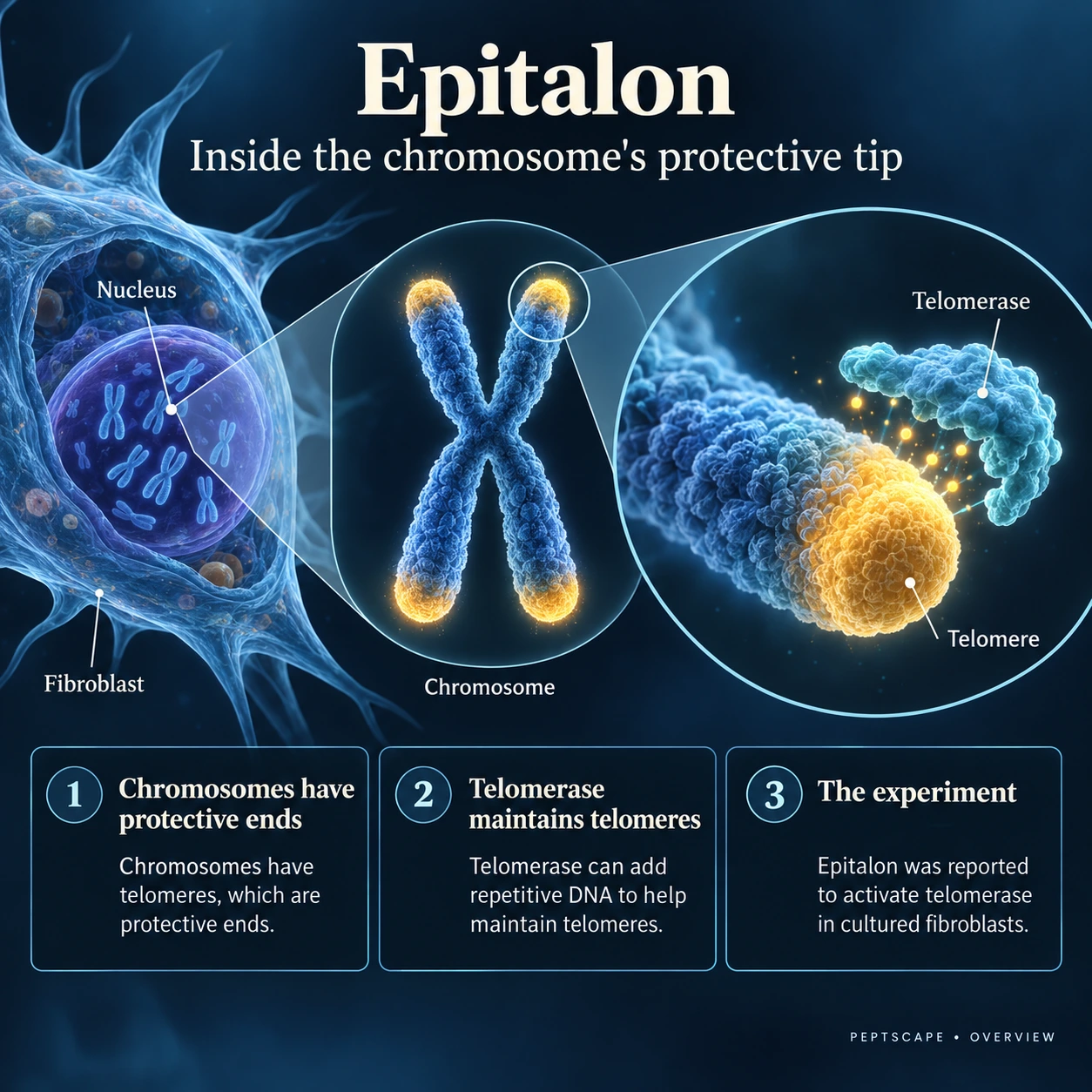
Telomeres are protective structures at the ends of chromosomes, which contain genetic material. They help protect chromosome ends during cell division. In many cells, telomeres shorten as divisions occur, although ageing involves far more than telomere length alone.
Epitalon has attracted interest because of laboratory work involving telomerase, an enzyme that helps maintain telomeres. This is a finding about cell behaviour, not proof that administering Epitalon makes a person younger or extends life. A longer-lived cell population and a longer, healthier human life are different outcomes.
Ageing is not one biological clock
Ageing involves changes in many systems: repair, metabolism, immune function, blood vessels and the handling of damaged cells, among others. Telomeres are one part of that picture. There is no single number that completely captures biological age or guarantees future health.
This helps explain why “anti-ageing peptide” is too broad on its own. The useful discussion identifies the proposed process—such as cellular maintenance or circadian signalling—rather than treating every age-related concern as the same target.
What it is used for
Experimental longevity use
Epitalon's main experimental use is with the aim of supporting healthier ageing or longevity. These are understandable goals, but a life-extension benefit from administering the peptide has not been established. It should not be described as resetting age, renewing all cells or adding a predictable number of years to life.
A short course also cannot be judged by how young someone feels immediately afterwards. Energy and wellbeing can change with sleep, activity, illness and expectation. Those experiences may be worth noting, but they do not measure telomere maintenance or lifespan.
Sleep and daily rhythms
The pineal gland is involved in melatonin secretion, which helps communicate biological night. That connection has contributed to interest in Epitalon for sleep and circadian rhythms. The circadian system helps coordinate when the body is prepared for sleep, activity and other daily functions.
Sleep timing is different from sedation. A treatment that makes someone drowsy is not necessarily correcting a delayed body clock, and a change in sleep timing does not prove improved deep sleep. Epitalon should not be presented as a direct substitute for melatonin or as a dependable insomnia treatment.
Recovery and general vitality
Broader experimental claims include improved recovery and vitality. Those terms need unpacking. Recovery from exercise, recovery after illness and persistent fatigue involve different processes. A general cellular-ageing rationale does not establish that the peptide treats all three.
The most useful account of a change describes the function involved: sleep timing, activity tolerance or another specific experience. This keeps the discussion concrete without converting every positive observation into evidence of slower ageing.
Interpreting biological-age tests
Commercial age estimates and telomere measurements may be influenced by the method, the cells sampled and normal variability. Two different tests may measure different aspects of biology rather than disagreeing about one definitive age.
A change in a test result does not establish that Epitalon caused it or that health outcomes improved. These measurements should not become a reason to pursue escalating exposure until a desired number appears. A biomarker is information about a biological feature, not an instruction by itself.
How it works
Proposed effects on cell maintenance
The central mechanistic interest concerns changes in cellular activity related to telomerase and telomere maintenance. Telomerase is not a universal rejuvenation switch. Different cells regulate it differently, and maintaining the capacity to divide is not beneficial in every biological setting.
Cancer cells are an important example of why unlimited cell persistence is not automatically desirable. This does not establish that Epitalon causes cancer; it explains why a telomerase-related finding cannot be converted into an uncomplicated safety or longevity claim.
Pineal origin does not make it melatonin
Melatonin is a different molecule with its own receptors and timing-dependent effects. Epitalon's developmental association with pineal biology does not mean it delivers melatonin or follows melatonin's instructions. Likewise, results associated with a pineal extract cannot be silently reassigned to the synthetic four-amino-acid peptide.
Keeping these identities clear is especially important when reading older material that uses related names. The Medical section preserves the distinction between the molecule, the preparation and the outcome examined.
Short exposure and long-term goals
A peptide may be cleared relatively quickly while the desired outcome concerns months or years. That mismatch does not prove that repeated courses create lasting rejuvenation. Duration of exposure, duration of a cellular response and duration of a meaningful benefit are separate questions.
An exact-sounding cycle can therefore be more certain than the underlying knowledge supports. This Overview explains why the peptide is of interest; the Practical material needs to remain specific about what is known for the preparation rather than filling gaps with precision.
The clearest way to understand Epitalon
Epitalon is a small research peptide associated with cellular ageing and pineal-related biology. Its appeal is the possibility of influencing maintenance processes, not supplying a missing everyday nutrient. That makes identity, realistic outcome definitions and careful interpretation more useful than a broad promise of rejuvenation.