Educational illustration · Read the evidence and limitations below.
Medical · What is DSIP?
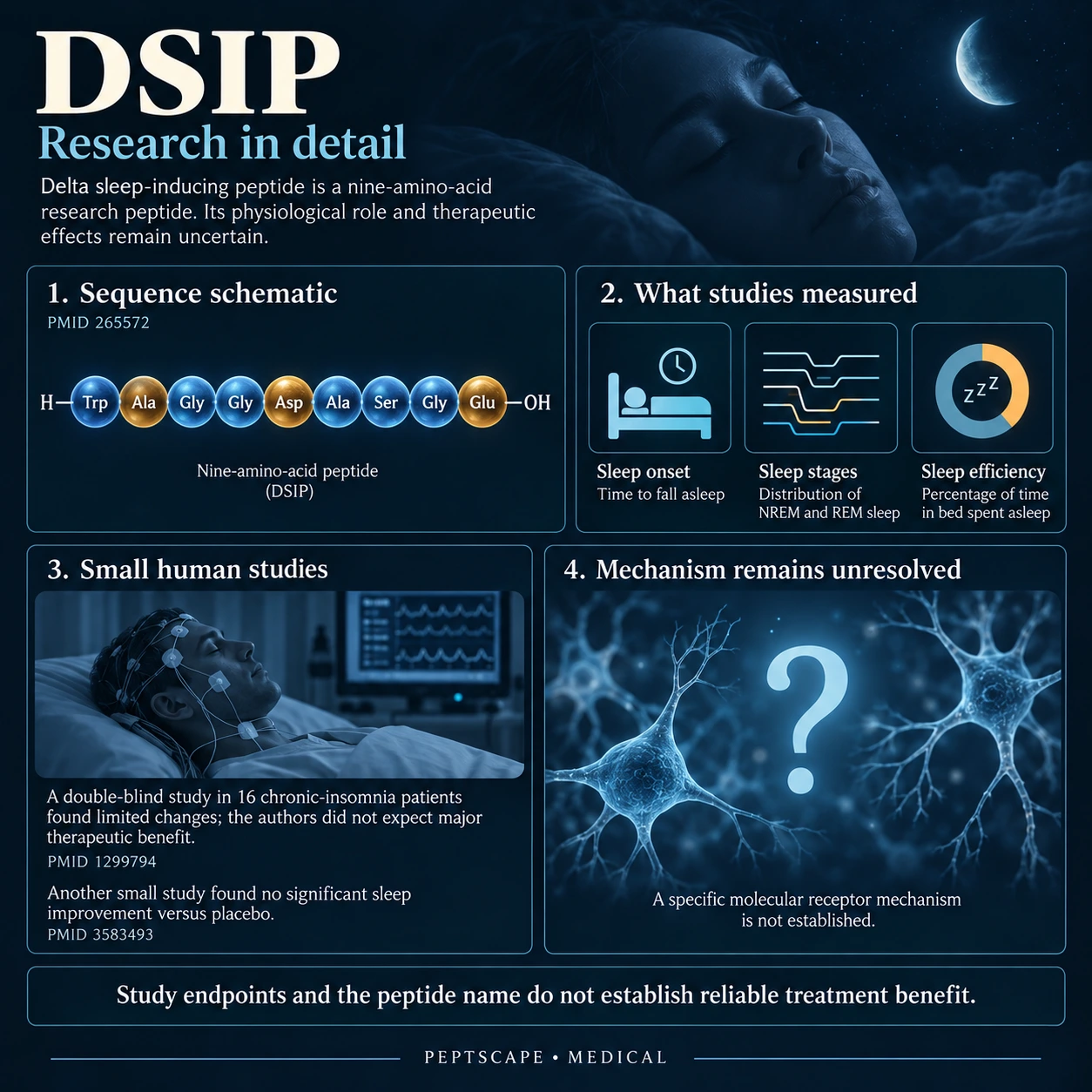
DSIP stands for delta sleep-inducing peptide. It is a nine-amino-acid peptide investigated in sleep research and sometimes called emideltide. Its name comes from early experiments involving sleep-related brain activity, which helped create its reputation as a “deep sleep peptide.”
The name sounds more conclusive than the human research. DSIP is not a guaranteed switch for deep sleep, and it is not the same as melatonin. Small human studies have produced mixed or limited findings rather than a dependable treatment for chronic insomnia.
People are usually interested in falling asleep more easily, waking less often or feeling restored the next morning. Those are separate goals. A useful sleep profile should explain each rather than assuming that every poor night is caused by too little deep sleep.
Medical · Benefits and common reasons for interest
Sleep continuity
Early research explored whether DSIP changed sleep duration or interruptions. Later controlled work did not provide convincing support for a reliable insomnia treatment. Individual reports of better sleep are worth recording, but they do not establish how often the peptide helps or which people benefit.
Recovery and daytime energy
Better sleep can support daytime function, but DSIP has not been shown to create a predictable recovery advantage for athletes or an alternative to adequate sleep time. Feeling sedated is also different from waking refreshed.
Stress and pain
These subjects appear in DSIP's broader research history. They should not be turned into a claim that one peptide treats anxiety, chronic pain, withdrawal and insomnia equally well. Each condition requires its own assessment and evidence.
Medical · How does it work?
Sleep is regulated by sleep pressure, the body clock and several interacting brain systems. DSIP has been investigated for effects on sleep-related signalling and stress responses, but its role in normal human physiology is not as settled as the name suggests.
Delta activity is a pattern measured by electrodes during sleep. More delta activity in an experiment is not automatically the same as better overall sleep quality. The timing of sleep, breathing, awakenings and next-day performance matter as well.
A watch estimates sleep stages from indirect measurements. It does not measure brain waves like a laboratory sleep study. A higher “deep sleep” score after a new product cannot by itself demonstrate that DSIP changed the intended brain mechanism.
Medical · DSIP, Melatonin and sleep treatment
Melatonin is a hormone involved in timing the sleep-wake cycle. DSIP is a different peptide with a different and less established clinical role. Taking one does not replace the other, and neither should be treated as an answer to every cause of poor sleep.
Chronic insomnia can respond to cognitive behavioural therapy for insomnia, which addresses patterns that keep the problem going. Loud snoring, gasping, restless legs, depression, pain and medication effects may need separate care. A peptide should not delay investigating these causes.
Medical · Dosing and concentration
Wellness discussions often describe 100–500 micrograms near bedtime. These amounts are reported practices, not a validated bedtime prescription. Older human experiments used specific intravenous protocols, which cannot be converted into a home subcutaneous schedule simply by matching micrograms.
More is not necessarily more sedating or more effective. Timing, route and the nature of the sleep problem are central uncertainties. Repeatedly adding an amount during the night because sleep has not arrived can increase exposure without solving the cause.
A microgram is one-thousandth of a milligram. Record the actual peptide amount and concentration, not only syringe markings. A concentration calculator can check a documented volume, but it cannot tell someone which amount will improve their sleep or when redosing is appropriate.
Medical · Preparation and reconstitution
DSIP may be supplied as lyophilised, meaning freeze-dried, material. Reconstitution needs instructions for the exact preparation: compatible diluent, liquid volume, resulting concentration and discard limit. Bacteriostatic water is not a universal recipe for making a sleep medicine.
Its preservative, usually benzyl alcohol, does not sterilise a research vial. Water that dissolves a peptide does not establish that the resulting solution is safe for injection or suitable for nasal use. Those routes require different formulation considerations.
Do not add sedatives or other peptides to the same vial, and do not prepare a nasal spray from injection instructions. Label any documented preparation clearly with compound, concentration, route and dates. Preparing or measuring a product while already drowsy increases the chance of a mistake.
Medical · Administration
The route in an older sleep experiment matters. Intravenous research cannot establish a preferred home injection site or a matching nasal amount. Subcutaneous use described online should not be presented as though it was the same intervention.
If a clinician is supervising a documented preparation, they should demonstrate its actual device and handling. Use clean hands and new sterile equipment, rotate suitable sites and dispose of sharps immediately. These steps address handling risks; they do not establish that the peptide will improve sleep.
Do not drive or perform hazardous tasks if a new product makes you drowsy or dizzy. Alcohol, sedatives and multiple sleep products make changes harder to interpret and can create additional risks. Lack of immediate sleep is not a reason to keep escalating overnight.
Medical · Oral versus subcutaneous delivery
Swallowed DSIP faces digestive breakdown and absorption barriers. A peptide in a capsule or under the tongue does not automatically deliver the exposure used in an injection study. Nasal delivery also requires its own evidence and formulation; a spray is not simply a needle-free equivalent.
For some compounds, an oral route is intended to act locally on gut tissue. DSIP's sleep claims instead concern effects on the nervous system. A local gut explanation does not establish that an oral DSIP product will improve sleep.
Medical · Half-life
DSIP is described as rapidly broken down, but a dependable human subcutaneous half-life cannot be assigned from the sleep studies used here. The often-quoted minutes-long estimates are not a redosing schedule. Peptide disappearance and changes in sleep are different measurements.
Medical · Storage
Follow the exact preparation's storage and discard instructions. Lyophilised material and a reconstituted solution need separate guidance. The opening date of bacteriostatic water does not establish the expiry of the peptide mixed with it.
Keep the container labelled and away from children. Do not leave a prepared solution at the bedside without temperature guidance, and do not keep an unlabelled syringe for later use. Unexpected particles, colour changes or damaged packaging need assessment rather than a home attempt to repair the preparation.
Medical · Contraindications and side effects
Long-term human safety, interactions and use in pregnancy or breastfeeding are poorly characterised. People with sleep apnoea, significant respiratory disease, unexplained daytime sleepiness or use of sedating medicines need medical review before experimenting with sleep-active products.
Headache, dizziness, unexpected alertness, poor sleep or next-day impairment should be recorded rather than dismissed. A very small literature cannot establish the absence of dependence or withdrawal risks. DSIP should not be promoted as a do-it-yourself treatment for alcohol or opioid withdrawal.
Seek urgent help for breathing difficulty, severe confusion, fainting or a serious allergic reaction. Fever or spreading redness after an injection needs assessment. Persistent insomnia deserves treatment even when a wearable appears to show normal sleep duration.
Medical · Nutrition and supplement support
Timing can matter more than adding products
Caffeine late in the day can interfere with sleep even when someone feels accustomed to it. Alcohol may make falling asleep easier while worsening sleep continuity. Heavy late meals can aggravate reflux. A stable meal pattern and attention to these triggers may be more useful than adding another supplement.
Magnesium and melatonin
Magnesium is not a universal insomnia treatment and can cause diarrhoea; kidney disease requires particular caution. Melatonin is used for specific timing problems, not as a mandatory DSIP companion. Combining products makes it harder to know what caused morning grogginess or a change in sleep.
Iron and B12
Restless legs and fatigue can have nutritional contributors, but iron should be guided by assessment and testing rather than taken indiscriminately. B12 matters when intake or absorption is inadequate. Neither is an established way to increase DSIP's effectiveness.
Recovery nutrition
Adequate food and protein support recovery, especially with regular training. Going to bed hungry after severe calorie restriction can undermine the routine someone is trying to improve. A simple food and sleep diary can identify patterns without turning every poor night into a supplement deficiency.
Medical · Tracking progress and common questions
Record bedtime, estimated time to fall asleep, awakenings, waking time and next-day function. Add caffeine, alcohol, illness and unusual stress. Look for a sustained pattern rather than one excellent or terrible night.
“Does the name guarantee deep sleep?” No. “Should I chase a wearable's sleep-stage number?” No: symptoms and function matter, and wearables estimate stages. “Can DSIP replace an assessment for snoring and gasping?” No: sleep-disordered breathing needs its own diagnosis and treatment.
Medical · Medical
The small human sleep studies differ in participants, timing and route. The later controlled trial should be considered alongside early positive reports. These studies do not establish routine home subcutaneous use.