Educational illustration · Read the evidence and limitations below.
What is DSIP?
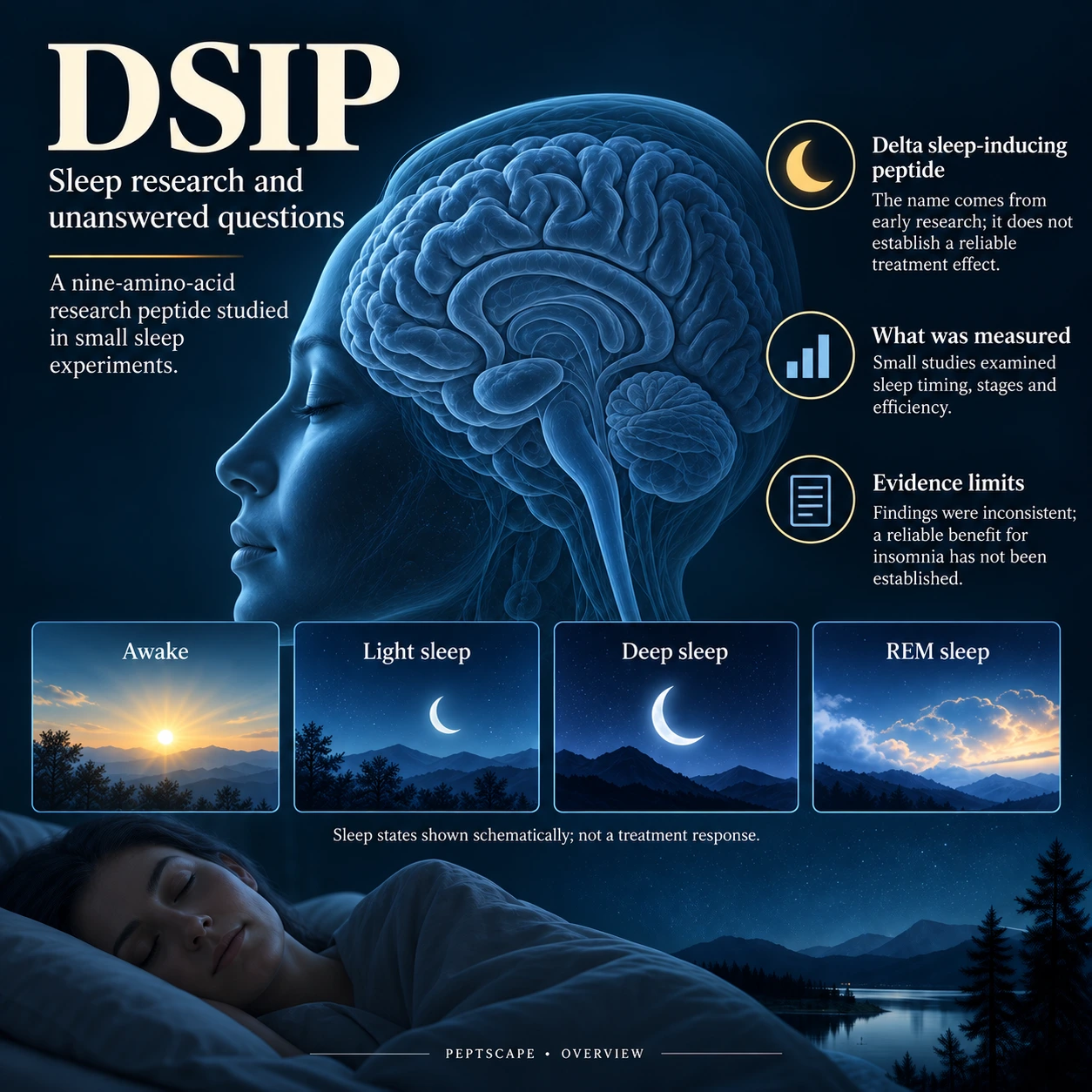
DSIP stands for delta sleep-inducing peptide. It is a nine-amino-acid peptide named after early work linking it to sleep-related brain activity. Its principal experimental use is to improve sleep, particularly when the goal is more restorative sleep rather than simply becoming drowsy.
The name sounds like a guarantee of deep sleep, but it is a historical name rather than a dependable description of what administration does. DSIP has not been established as a consistent treatment for insomnia or as a reliable way to increase restorative sleep.
What delta sleep means
During deep non-REM sleep, brain electrical activity includes slow waves often called delta waves. This stage is part of normal sleep architecture, the pattern of stages that repeats through the night. REM sleep and lighter non-REM stages also have important roles.
A healthy night is therefore not simply the largest possible amount of deep sleep. Timing, continuity and an appropriate sequence of stages matter. Spending longer in bed or feeling heavily sedated does not show that this pattern improved.
Sleep pressure and the body clock
Two useful concepts help explain sleep. Sleep pressure builds with time awake. The body clock helps coordinate when sleep and wakefulness are biologically favoured. They interact, but they are not the same system.
A person with a delayed sleep schedule may sleep well when allowed to follow it, yet struggle at an earlier bedtime. Another person may fall asleep readily but wake repeatedly. DSIP should not be described as correcting both problems simply because they are both called poor sleep.
What it is used for
Difficulty falling asleep
One experimental goal is shorter time to fall asleep. This is called sleep latency. It is different from total sleep duration and from feeling refreshed the next day. Reducing latency would not by itself establish improvement in the rest of the night.
Even the estimate of sleep latency can be imperfect, because people do not continuously observe themselves while falling asleep. A repeated pattern is more informative than one unusually good or bad night. Bedtime, wake time and caffeine use provide useful context without needing a complex record.
Fragmented or unrefreshing sleep
Another goal is fewer awakenings or a more restorative night. Fragmentation means sleep is repeatedly interrupted. Unrefreshing sleep means the person wakes without feeling adequately restored; the two can occur together but are not identical.
Snoring, breathing pauses, pain, restless legs, alcohol and medicines can all contribute to disturbed sleep. A peptide associated with sleep does not identify or resolve each of these causes. In particular, stronger sedation is not treatment for obstructed breathing during sleep.
Recovery after demanding periods
DSIP also attracts use around heavy training, stressful periods and fatigue. Sleep supports recovery, which provides the connection. However, a peptide's sleep-related name does not establish that it improves muscle repair, hormone balance or resilience after illness.
The intended outcome should be described directly: easier sleep onset, fewer awakenings or better daytime function. This avoids treating every change in recovery as the same thing and makes it easier to recognise when the main problem lies outside sleep.
Stress-related use
DSIP has also been investigated in stress-related biological systems. Here, a proposed effect on a signalling pathway is different from dependable relief of anxiety. A sleep intervention and an anxiety treatment are not interchangeable because stress can disturb sleep.
If worry is the main reason someone cannot settle, that deserves its own description and treatment plan. A better night may reduce next-day distress, but that does not show that the peptide directly treated the underlying anxiety.
How it works
A less clearly defined mechanism
Unlike a medicine with a well-characterised receptor target, DSIP does not have a simple, established mechanism that explains predictable sleep effects. Proposed actions involve sleep regulation and stress-related signalling, but the relationship between administered peptide and a useful night's sleep remains uncertain.
That uncertainty is best stated directly, rather than replaced with a story that DSIP switches deep sleep on. The peptide is of interest because of its history and biological observations, not because a reliable sleep-control mechanism has been fully mapped.
Sedation and sleep quality are different
Sedation reduces alertness. Sleep is an organised biological process. A person can be drowsy without gaining better sleep continuity or the normal sequence of stages. Conversely, an improved night does not always require a strong sensation immediately before sleep.
This distinction matters when evaluating DSIP. Feeling an effect shortly after administration is not a measurement of delta-wave sleep. Likewise, no immediate sensation does not provide a basis for automatically repeating an amount.
Wearables provide estimates
Watches and rings can be useful for following broad patterns, but their sleep-stage labels are estimates based on indirect measurements. A device's deep-sleep number is not the same as a full laboratory sleep assessment using brain-wave recordings.
Look at repeated trends alongside how the person sleeps and functions. A single higher deep-sleep score should not be treated as proof that a peptide changed brain physiology. Changes in device fit, algorithm estimates or the night's circumstances can affect the result.
Daytime function completes the picture
A useful sleep outcome includes how the next day goes: alertness, ability to work and whether unintended sleepiness occurs. More time asleep is not automatically an improvement if significant grogginess follows.
The Practical section addresses preparation and precautions separately. The central educational point is that DSIP is an experimental sleep-related peptide, while sleep itself has several components that need to be understood before any result can be judged meaningfully.