Educational illustration · Read the evidence and limitations below.
Medical · What is CJC-1295 without DAC?
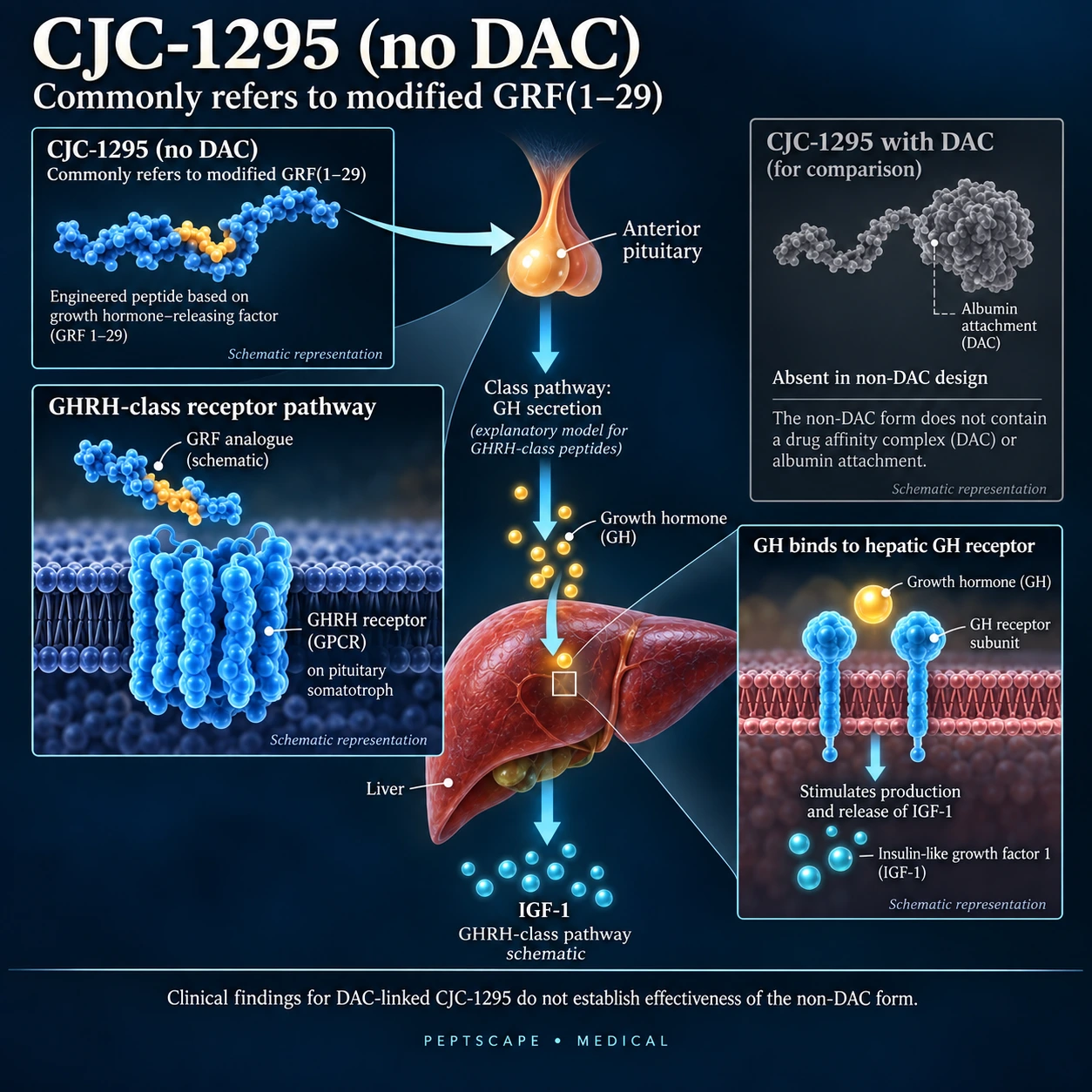
CJC-1295 without DAC is a name commonly used for a short-acting growth hormone-releasing peptide, often identified as modified GRF(1–29). It is designed to stimulate the pituitary gland's release of growth hormone through the GHRH receptor.
GHRH is one of the body's normal signals controlling growth hormone. Modified GRF keeps the active core of that signal but changes several amino acids to make it more resistant to breakdown. It does not include the albumin-binding DAC modification responsible for the much longer action of CJC-1295 with DAC.
People usually look into this peptide for sleep, training recovery and body composition, often together with ipamorelin. Its appeal is a shorter period of stimulation rather than sustained exposure over many days. That pharmacological idea should be distinguished from proof of a particular recovery or anti-ageing result.
The naming deserves attention. “No DAC” is used inconsistently, and analytical literature distinguishes related 29- and 30-residue structures. A label or blend should identify the actual compound, not rely on the shortened word “CJC.”
Medical · Benefits and common reasons for interest
Shorter growth-hormone stimulation
The aim is to prompt a relatively brief release signal. This is why it is usually discussed differently from the DAC compound. A shorter signal does not automatically mean a completely natural hormone pattern, a safer product or a superior clinical result.
Recovery and muscle
Growth hormone and IGF-1 participate in tissue activity and metabolism, so users often hope for improved recovery and changes in body composition. However, the biological connection does not establish that a short-acting CJC product heals an injury or adds meaningful muscle in a healthy adult.
Strength progression, adequate nutrition and appropriate rehabilitation remain the direct tools for those goals. A peptide's effect should not be inferred from tingling, flushing or a single night of unusually good sleep.
Sleep and vitality
Bedtime use is often discussed because natural growth-hormone pulses are associated with sleep. The association is real; the conclusion that every bedtime secretagogue improves sleep is not established. Persistent fatigue or disrupted sleep may need evaluation for causes unrelated to growth hormone.
Medical · How does it work?
Modified GRF stimulates GHRH receptors on cells in the pituitary. Those cells release growth hormone, which then influences other tissues and IGF-1 production.
Changes in the peptide's amino-acid sequence are intended to resist enzymes that rapidly break down the natural signal. The absence of DAC means it does not obtain the same prolonged albumin-linked exposure as long-acting CJC.
Ipamorelin acts at a different receptor, associated with ghrelin. Using both pathways can increase a hormone response in principle, which explains interest in pairing the compounds. That is not the same as demonstrating a safe, effective combination for a person's sleep, physique or injury.
The response also depends on the person's pituitary function and other hormone signals. A fixed amount does not guarantee a fixed GH or IGF-1 response across different people.
Medical · Understanding names and blends
Modified GRF(1–29), sermorelin and CJC-1295 with DAC are related but not interchangeable. Sermorelin corresponds to the unmodified active GHRH fragment; modified GRF includes substitutions; DAC compounds add a long-acting attachment.
A blend containing modified GRF and ipamorelin should state the amount of each. A “10 mg blend” alone does not reveal whether it contains equal amounts or another ratio. The ratio determines both exposures whenever a volume is drawn.
Two ingredients being used in the same plan does not establish that they remain stable when mixed in one vial. Mixing compatibility needs separate information about concentration, diluent and storage. Keep co-use and physical mixing separate in the explanation and record.
Medical · Dosing and concentration
Online protocols often describe 100 micrograms subcutaneously one to three times daily, alongside ipamorelin. This is a commonly circulated wellness pattern, not a clinically established prescription for every product called “no DAC.” It should not be automatically copied into a new plan.
The widely cited 2006 CJC-1295 human trial studied the long-acting compound. Its dose and duration cannot be borrowed to validate short-acting schedules. Similarly, a short plasma presence does not prove that frequent redosing improves outcomes.
A reliable record identifies exact compound, amount in micrograms, concentration, route and actual administration time. For blends, record each ingredient separately even if both are delivered in one volume.
As an arithmetic example, a documented 2 mg in 2 mL equals 1,000 micrograms/mL. If a blend also contains another 2 mg ingredient in that same volume, each ingredient has its own 1,000 micrograms/mL concentration. The total blend concentration is not the concentration of either peptide alone.
Medical · Preparation and reconstitution
Start with the full identity. “CJC” without a DAC designation or verified sequence is an inadequate basis for transferring preparation or dosing directions.
A lyophilised vial is freeze-dried. Reconstitution requires the specified diluent and volume for the actual preparation. Bacteriostatic water contains a preservative, commonly benzyl alcohol, but that does not make it suitable for every peptide or establish a usable period after mixing.
For a prescribed injectable preparation, use the supplied instructions, a clean preparation area and sterile single-use equipment. Keep the peptide vial, diluent and final concentration clearly labelled. Do not substitute a different solvent to improve appearance, and do not assume that adding more water makes an uncertain preparation safe.
Check whether instructions specify the volume added or the final volume. Calculations should use the documented final concentration, especially when a blend or different vial strength is involved. A clear solution demonstrates dissolution, not verified sterility or identity.
Medical · Administration
Subcutaneous administration refers to the fat beneath the skin. It is not an instruction to inject into a sore tendon, joint or muscle. These peptides act through hormone signalling; a location near a painful area does not establish a targeted repair effect.
A prescribed product should come with teaching on site selection and the particular needle or device. Rotate appropriate sites and avoid bruised, irritated or infected skin. Use new sterile equipment for every administration and place used sharps in an appropriate container.
Record actual times rather than only planned times. Do not compress several missed administrations into a short period to make a schedule look complete. If the preparation changes, recheck concentration before reusing any saved syringe-volume entry.
Medical · Routes and bioavailability
Oral delivery exposes the peptide to digestive enzymes and the gut barrier. Subcutaneous delivery bypasses that first stage, but a higher or more predictable bloodstream exposure still has to be demonstrated for the actual product.
Sublingual and nasal products are separate formulations, not alternative names for an injection. Their absorption cannot be assumed from a subcutaneous amount.
Some peptides are used orally to act locally in the gut. Modified GRF's intended target is the pituitary GHRH receptor, so poor oral absorption is not itself a therapeutic advantage. There is no demonstrated local-gut rationale that makes an oral “CJC” preparation equivalent to the injectable research concept.
Medical · Half-life
A figure of roughly 30 minutes is commonly quoted for modified GRF(1–29). It is a short-acting estimate, not a well-validated human subcutaneous measurement for every “CJC no DAC” product.
Do not use the 5.8–8.1-day estimate from CJC with DAC here. The shorter duration also does not determine a safe or effective redosing interval on its own.
Medical · Storage
Use the actual preparation's labelled storage and discard instructions. Keep separate dates for vial expiry, preparation and first opening. A generic “refrigerate for 30 days” statement is insufficient for an unknown concentration or blend.
Protect the vial from inappropriate heat and light, and do not freeze unless specifically directed. A long trip in a warm bag is a storage event worth recording, even if the liquid still looks normal.
Do not pool leftovers, top up an older vial or transfer material to an unlabelled container. Retain the batch and concentration so a future symptom or dosing question can be traced to the correct preparation.
Medical · Contraindications and side effects
Growth-hormone stimulation can be relevant to glucose control, fluid retention and conditions affected by growth signalling. Active cancer, pituitary disease, diabetes, significant swelling or unexplained headaches warrant medical review before considering use.
Potential problems include local injection reactions, flushing, headache, tingling, joint discomfort and metabolic changes. Short acting does not mean free of these concerns. A blend can make it difficult to tell which ingredient caused a reaction.
Pregnancy, breastfeeding and paediatric treatment are not settings for self-directed wellness cycles. Review existing hormone treatments and glucose-related medicines together. Breathing difficulty, severe allergic symptoms or severe headache with visual changes needs urgent assessment.
Medical · Nutrition and supplement support
Food timing without unnecessary rules
Online protocols often insist on rigid fasting windows to maximise a growth-hormone pulse. Meals can influence hormone physiology, but there is not good evidence that a universal fasting rule around this peptide produces better health or recovery outcomes.
Avoid skipping necessary food after training or creating a schedule that worsens sleep. A clinician's product-specific instructions take precedence, and the overall nutritional goal should remain clear.
Protein and recovery
Regular protein-containing meals help support training recovery. A shake is useful if it fills a practical gap, not because modified GRF requires a specific supplement. Include sufficient energy and carbohydrate for the amount of activity being performed.
Collagen products are sometimes added for connective-tissue goals. They are not a complete substitute for varied dietary protein, and evidence about a collagen intervention does not establish that it enhances a peptide combination.
Magnesium, vitamin D and zinc
These nutrients have normal physiological roles. Correcting low intake or deficiency can matter for health, but high-dose use is not a proven way to improve a GH-peptide response. Too much supplemental zinc can cause copper deficiency; magnesium can cause diarrhoea and needs extra care with kidney disease.
Creatine and combination products
Creatine may support resistance-training performance independently. Record its start date because it can change weight and training results. Proprietary “hormone support” blends are harder to assess: doses may be unclear, stimulants may disturb sleep, and multiple ingredients can obscure adverse effects.
Keep a short list of supplements with a reason for each. The goal is to support diet and training, not to build an untested second stack around the first one.
Medical · Tracking progress and everyday questions
Keep exact identity visible in the plan. Record sleep, recovery, training and unwanted effects separately. A change in IGF-1, if measured by a clinician, should be interpreted with age, laboratory range and the timing of exposure.
Is no DAC the same as sermorelin? No; the commonly intended modified GRF has sequence changes. Can a with-DAC schedule be used? No. Does pairing with ipamorelin prove better results? It explains a biological rationale, but it does not establish the clinical benefit of a particular blend.
Medical · Medical
The original albumin-conjugate work distinguishes structural variants within this family. Analytical literature also shows why “CJC without DAC” and modified GRF naming cannot always be treated as precise chemical identity. The profile should retain that distinction without allowing it to overwhelm the basic explanation.
The long-acting CJC human trial is included for comparison only. It is not direct validation of short-acting wellness schedules, storage periods or claimed physique outcomes.