Educational illustration · Read the evidence and limitations below.
What is CJC-1295 without DAC?
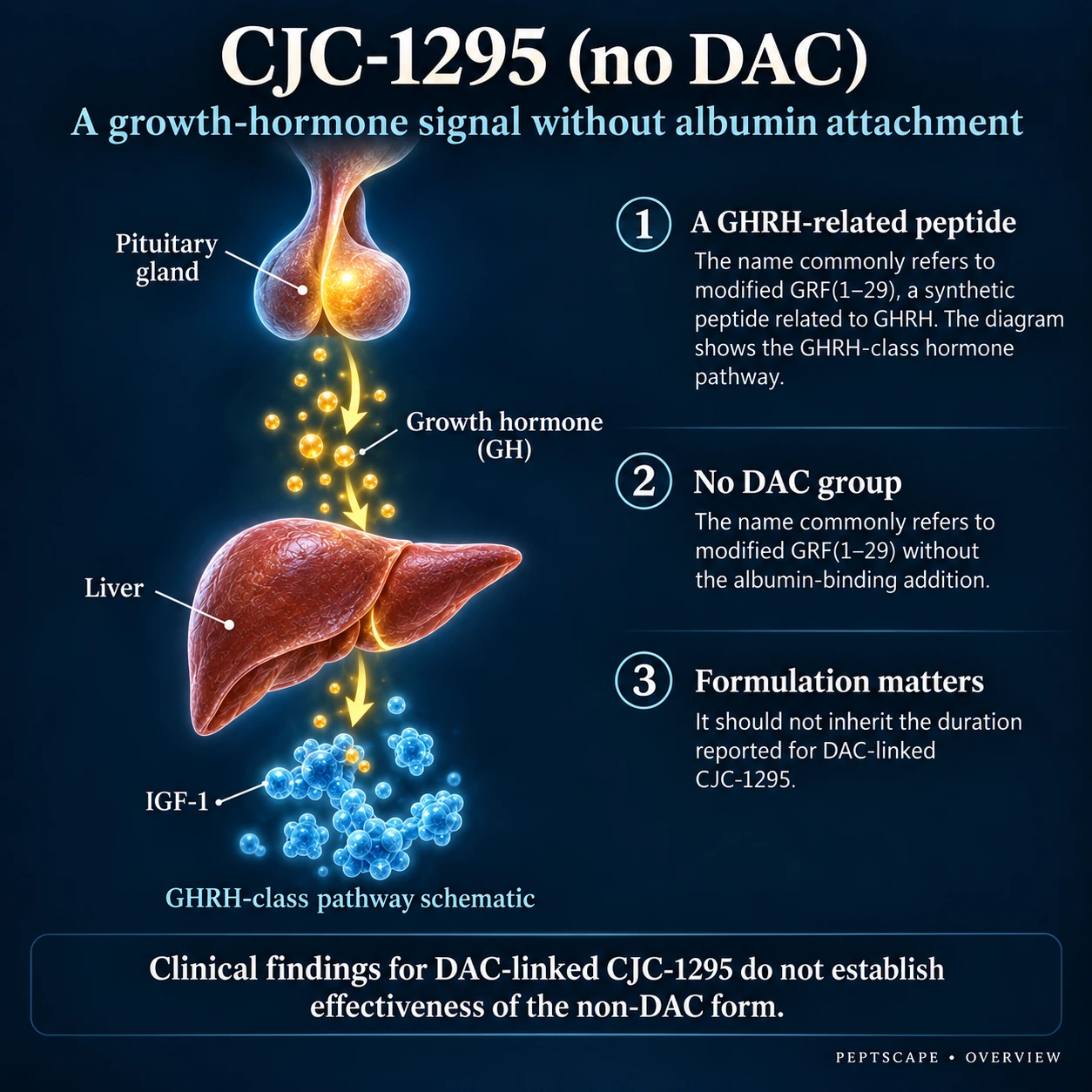
“CJC-1295 without DAC” is a name commonly used for modified GRF(1–29), a short-acting growth hormone-releasing peptide. It is designed around the active first 29 amino acids of growth hormone-releasing hormone, or GHRH. This natural signal tells the pituitary gland to release growth hormone.
The name needs careful attention because it is not simply the long-acting CJC-1295 product at a lower strength. Modified GRF(1–29) has changes in its amino-acid sequence intended to resist rapid breakdown, but it does not have the albumin-binding DAC modification that gives the DAC preparation its prolonged exposure.
What GRF and GHRH mean
GRF means growth hormone-releasing factor. GHRH means growth hormone-releasing hormone. Both names refer to the releasing signal rather than growth hormone itself. The numbers 1–29 identify the portion of the peptide sequence, not a dose or a treatment duration.
This makes the names easier to compare. Sermorelin represents the active 1–29 fragment of GHRH. Modified GRF(1–29) contains alterations to that fragment. CJC-1295 with DAC adds a long-acting albumin-binding feature. These distinctions matter more than similar packaging or a shared “growth hormone peptide” description.
Releasing hormone is not growth hormone
A GHRH-related peptide gives the pituitary a signal. Growth hormone replacement supplies growth hormone directly. A releasing peptide therefore depends on the gland's ability to respond and remains subject to the body's wider hormonal regulation.
That does not mean the response is always gentle or automatically suitable for someone with fatigue. It means the mechanism is different. A tired person does not necessarily have low growth hormone, and a noticeable effect after administration cannot identify a hormone deficiency.
What it is used for
Short-acting growth hormone stimulation
Experimental uses include body-composition goals, exercise recovery and sleep-related concerns. The appeal is a relatively brief releasing signal rather than the prolonged background exposure of a DAC preparation. These hoped-for benefits should not be confused with a proven improvement in healthy users simply because the peptide can act on a hormone pathway.
Short-acting does not mean that a universal administration frequency follows directly from the name. The duration of the releasing peptide, the growth hormone response and downstream IGF-1 changes are different things. A schedule cannot be calculated from a half-life number alone.
Body composition rather than appetite control
Growth hormone influences the release of stored fat and the maintenance of tissue. It does not act like an appetite-reducing peptide whose main effect is helping someone eat less. This is why hunger, body weight, waist size and physical performance are different outcomes to follow.
Likewise, a change in lean mass does not necessarily represent new muscle. Water is included in lean-tissue measurements, and fluid retention can make weight or fullness rise. Gradual improvements in strength and function provide different information from a quick change in appearance.
Why it appears alongside Ipamorelin
Modified GRF(1–29) acts through the GHRH receptor. Ipamorelin acts through the ghrelin receptor. Both receiving systems can influence growth hormone release, which is the biological rationale behind their appearance in experimental combinations.
That rationale does not establish that a blend is more effective, safer or correctly proportioned. A premixed vial also makes it harder to change one ingredient independently. The actual identity and amount of each component remain important, even if a product is described using one combined name.
Recovery and sleep expectations
Recovery includes muscle repair, replenishment of energy stores and adaptation to exercise. Sleep supports those processes and also influences growth hormone secretion. These connections explain the interest in a releasing peptide, but they do not mean it replaces sleep or directly repairs an injured tendon.
A useful recovery goal names the activity involved: returning to a normal training load, tolerating a rehabilitation exercise or feeling less exhausted after comparable sessions. New swelling, persistent weakness or a worsening injury are separate findings, not evidence that the peptide needs more time or a higher amount.
How it works
A brief signal with downstream effects
The peptide activates the GHRH receptor at the pituitary. The gland can then release growth hormone, which acts on tissues and promotes production of IGF-1. IGF-1 helps carry some of the growth and tissue-maintenance effects of this system.
A short-lived initial signal can therefore have effects that are not limited to the moment the peptide is circulating. This is why “short half-life” and “no effect later” are not equivalent statements. It is also why the half-life of the DAC preparation must not be copied into the profile for a no-DAC product.
Normal pulses and laboratory readings
Growth hormone is normally released in bursts. A random measurement may be low between bursts or higher during one. IGF-1 changes less abruptly, but it still needs interpretation in context. Neither test should be read as an independent measure of how well a person is recovering from exercise.
The meaningful distinction is between demonstrating hormonal activity and demonstrating a useful outcome. More activity is not automatically better: fluid retention, tingling and changes in glucose control may accompany increased growth hormone exposure.
Start with the correct identity
For this peptide, an accurate name is a practical safety issue. Record whether the preparation is modified GRF(1–29), whether DAC is present and whether another peptide is included. The same vial weight does not make different molecules equivalent. Keeping these details clear makes the dosing, preparation and timing sections understandable rather than interchangeable instructions for a broad peptide category.