Educational illustration · Read the evidence and limitations below.
Medical · What is CJC-1295 with DAC?
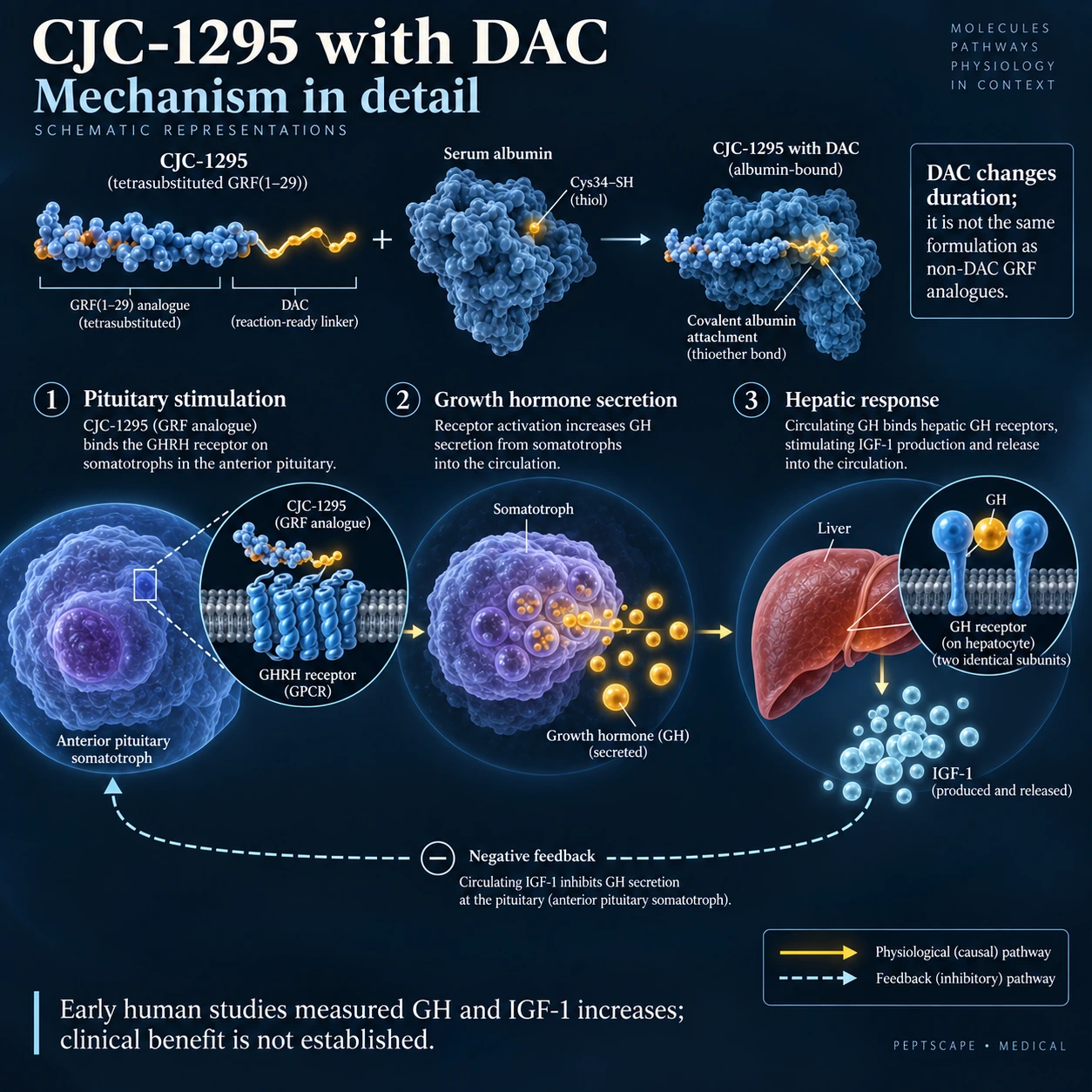
CJC-1295 with DAC is a long-acting peptide designed to stimulate growth hormone release. It imitates growth hormone-releasing hormone, or GHRH, one of the signals the brain normally uses to tell the pituitary gland to release growth hormone.
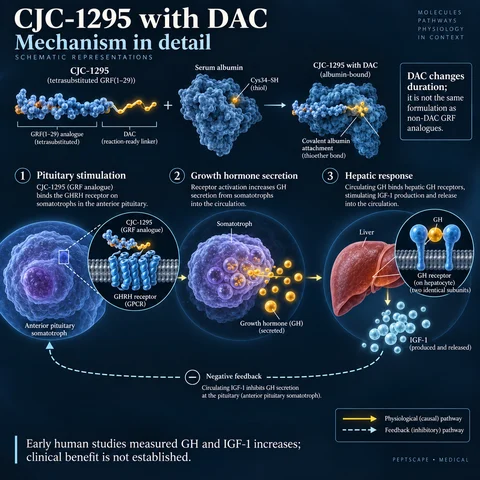
The distinguishing feature is DAC, short for Drug Affinity Complex. This modification allows the peptide to attach to albumin, a protein circulating in blood. Attachment slows its removal from the body, so its influence on growth hormone and IGF-1 can last for days rather than minutes.
People are usually interested in it for body composition, recovery or the convenience of a longer-acting compound. The best human evidence concerns hormone levels and duration of action. Improvements in muscle, sleep, injury recovery or longevity cannot simply be read off those hormone changes.
CJC-1295 with DAC and products described as “CJC without DAC” need separate profiles. Removing the long-acting component changes the practical question completely. They are not two concentrations of the same preparation, and their schedules should not be exchanged.
Medical · Benefits and common reasons for interest
A sustained growth-hormone signal
The main distinguishing effect is prolonged stimulation of the growth-hormone system. In healthy adults, a study found increases in growth hormone and IGF-1 lasting several days after administration. Repeated administration could produce accumulation.
For someone comparing growth-hormone peptides, this means the DAC compound is not tied to a brief window around one meal or workout. It also means an unwanted effect may not disappear quickly after stopping.
Body composition and recovery
Growth hormone influences fat metabolism and tissue activity, while IGF-1 participates in growth-related signalling. These effects explain interest in fat loss, muscle and recovery. However, an elevated IGF-1 result is not the same as demonstrated improvement in strength or a healed tendon.
Changes in fluid balance can alter appearance and body weight. Tracking swelling and waist measurement alongside weight helps avoid labelling every increase in “lean mass” as new muscle.
Sleep and healthy ageing
Natural growth-hormone release changes with age and sleep. That does not establish that raising the signal reverses ageing or corrects every sleep problem. The relevant question is whether a meaningful outcome improves without unacceptable effects, not whether a hormone value can be pushed higher.
Medical · How does it work?
GHRH binds to receptors on pituitary cells that release growth hormone. CJC-1295 is a modified GHRH analogue designed to remain active longer than the natural signal.
The DAC attachment links it to albumin. Albumin acts as a circulating carrier rather than an injection-site depot. This is why a small change in injection location is not expected to target one muscle group or one area of body fat.
Growth hormone then affects tissues directly and stimulates IGF-1 production. Feedback systems still exist, but their presence does not guarantee that hormone levels remain appropriate or that glucose metabolism is unaffected.
You may read that DAC causes continuous “GH bleed” and completely abolishes natural pulses. That is too simplistic. A human study found that pulsatile secretion persisted during sustained stimulation. The important difference is prolonged exposure, not a claim that the body switches from pulses to a perfectly flat hormone line.
Medical · With DAC versus without DAC
With DAC means albumin binding and a long duration. “Without DAC” commonly refers to modified GRF(1–29), a shorter-acting GHRH analogue. The published long-acting CJC-1295 trial does not establish the dosing or half-life of every short-acting product using a similar name.
Check the exact identity on any record, including whether the product is a single ingredient or a blend. A total vial amount such as 5 mg does not reveal whether DAC is present.
Combining long-acting CJC with ipamorelin adds a second growth-hormone-releasing signal. It does not simply make the original peptide last longer. Keep the rationale, amount and adverse-effect review separate for each ingredient.
Medical · Dosing and concentration
The human dose-ranging research used body-weight-based subcutaneous amounts, including 30 and 60 micrograms/kg, in a monitored study. Those are research exposures, not a conversion table for an unsupervised wellness plan.
A commonly circulated online pattern is 1–2 mg weekly. That should be understood as a reported practice, not a proven fat-loss or recovery prescription. Weekly use also does not mean the previous amount has left the body before the next administration.
For this compound, accumulation is especially important. Increasing an amount or shortening an interval can increase exposure across several weeks. A missed calendar entry should not be “caught up” with an extra amount without the prescriber's direction.
Concentration is total peptide amount divided by final volume. For example, 2 mg in a documented final volume of 2 mL equals 1 mg/mL. That calculation describes the liquid; it does not select a dose or establish that 2 mL is the correct preparation volume.
Keep mg, micrograms and syringe volume distinct. One milligram equals 1,000 micrograms. An insulin syringe's numbered volume markings are not units of biological CJC activity.
Medical · Preparation and reconstitution
A lyophilised vial contains freeze-dried material. Before preparation, confirm that its documentation identifies the DAC compound, peptide amount, intended route and suitable diluent. A short label reading only “CJC” is not enough to resolve the long-acting versus short-acting distinction.
Bacteriostatic water is commonly discussed as a peptide diluent, but the benzyl alcohol preservative does not establish compatibility with every formulation. Use a preparation's specified diluent and volume. A laboratory-use vial does not become an injectable medicine because the arithmetic is correct.
For an appropriately prescribed preparation, follow the supplied mixing instructions with clean hands, a clean work area and sterile single-use equipment. Do not improvise acid, heat or vigorous shaking if the material does not dissolve as described. Unexpected particles or a damaged seal need assessment.
Record the final concentration, preparation date, storage conditions and discard date. A long half-life inside the body says nothing about how long the solution remains stable inside a vial.
Medical · Administration
The human long-acting study used subcutaneous administration: delivery into the fatty tissue beneath the skin. This is different from injecting into muscle, a joint or near a damaged tendon.
If prescribed an injectable preparation, have the device, site selection and technique demonstrated. Rotate suitable sites and avoid inflamed, bruised, scarred or infected areas. Needle length and angle should match the device and person rather than a generic internet diagram.
A local lump or redness should be recorded. Do not interpret an injection reaction as stronger hormone release. Use a fresh needle and syringe each time, keep used equipment out of all vials and dispose of sharps promptly.
Because this is long acting, daily sensations are a poor guide for deciding on additional administrations. Review symptoms over time alongside the actual schedule and any clinician-directed laboratory monitoring.
Medical · Routes and bioavailability
Subcutaneous administration avoids the initial digestion encountered by a swallowed peptide. Absorption from tissue and binding to albumin then influence exposure. Neither fact makes a nasal spray or oral capsule equivalent.
An oral peptide must survive digestion and cross the gut barrier to produce a systemic hormone effect. A label claiming enhanced absorption needs evidence for that formulation, not just a claim that it contains the same amino-acid sequence.
Local gut action can be a reason to use some oral peptides, but the main target here is the pituitary growth-hormone system. Reduced absorption is not an established gut-health benefit of CJC-1295.
Medical · Half-life
Approximately 5.8–8.1 days after subcutaneous administration in the healthy-adult study. This estimate applies to the long-acting DAC compound.
IGF-1 effects can outlast a single dosing day, and repeated amounts can accumulate. Half-life is a description of elimination, not a recommendation for weekly or twice-weekly use.
Medical · Storage
Follow the preparation's own storage instructions. Keep the lyophilised expiry separate from the after-reconstitution limit, and record any significant heat exposure during travel.
Bacteriostatic water's preservative does not prove a mixed CJC solution remains potent or sterile for 30 days. Refrigeration can slow some degradation processes but cannot reverse contamination or guarantee an unsupported shelf life.
Keep vials labelled and protected as directed. Do not combine leftover material from different batches, top up an old vial or reuse a prior concentration entry for a new preparation. The actual batch and final volume belong in the inventory record.
Medical · Contraindications and side effects
A sustained growth-hormone signal deserves particular caution in people with active cancer, diabetes or impaired glucose control, pituitary disease, significant fluid retention or unexplained neurological symptoms. These are reasons for clinician assessment, not a checklist that makes use safe once every box is blank.
Flushing, headache and injection-site reactions have been reported in research. Growth-hormone-related concerns can include swelling, joint discomfort, tingling and worsening glucose control. A long duration can make an unwanted effect more persistent.
Pregnancy, breastfeeding and children require a different medical context from adult wellness use. Review all other growth-hormone agents and relevant medicines together. Severe headache with visual change, breathing difficulty, chest pain or a severe allergic reaction needs prompt medical attention.
Medical · Nutrition and supplement support
Support the actual body-composition goal
A sustainable eating pattern matters more than trying to time every meal around a hormone pulse. Include adequate protein, vegetables or fruit, fibre-rich carbohydrate and appropriate energy for the goal. For fat loss, an excessively restrictive diet can reduce training quality and lean-tissue retention.
There is no demonstrated nutritional trick that selectively turns a prolonged CJC signal into fat loss while preventing its metabolic effects. Record changes in eating and exercise so they are not confused with the peptide's contribution.
Protein and creatine
Protein supplements are a convenience when ordinary food does not meet intake needs. Creatine may support strength-training performance in appropriate users, but its evidence is independent of CJC. Neither should be described as a required activator of the peptide.
Both food intake and creatine can influence body weight. Use performance, waist measures and symptom records alongside the scale rather than assuming every weight change represents muscle or fat.
Vitamin D and minerals
Vitamin D, calcium and magnesium support normal bone and muscle function. Correct a demonstrated deficiency or a clear dietary shortfall; routine megadoses do not have a proven CJC-specific benefit. Kidney disease and existing medicines can change supplement suitability.
Glucose-related supplements
Berberine, chromium and concentrated herbal products are sometimes proposed to offset glucose changes. They should not be used to conceal or self-treat a worsening laboratory result. Review the growth-hormone exposure and the underlying metabolic problem instead. Supplements can also interact with prescribed glucose-lowering treatment.
Sleep and recovery
Regular sleep, sensible training progression and recovery days make outcomes easier to interpret. Alcohol and late stimulants can undermine sleep even when a person is using a peptide specifically for recovery. A useful plan addresses these basics without pretending they validate the peptide itself.
Medical · Tracking progress and everyday questions
Track the exact DAC identity, each administration date, swelling, weight, waist and the original goal. Laboratory results should include date and reference range. An IGF-1 number taken at one point cannot be compared casually with a result collected under different circumstances.
Does DAC mean more effective? It means longer acting. Does a longer half-life reduce all risks? No; it may prolong exposure to an unwanted effect. Is bedtime essential? A multi-day compound is not confined to a short bedtime window, and the available study does not establish an ideal wellness timing strategy.
Medical · Medical
The 2006 healthy-adult trial demonstrated prolonged changes in GH and IGF-1 with an estimated half-life of 5.8–8.1 days. It was not a long-term clinical-outcome trial for healthy ageing, injury recovery or bodybuilding. A separate study found that GH pulsatility persisted during stimulation, correcting the claim that DAC necessarily removes all pulses.
There is no FDA-approved CJC-1295 product. Medical interpretation should retain the exact compound and study design rather than applying these results to an ambiguously named blend.