Educational illustration · Read the evidence and limitations below.
What is CJC-1295 with DAC?
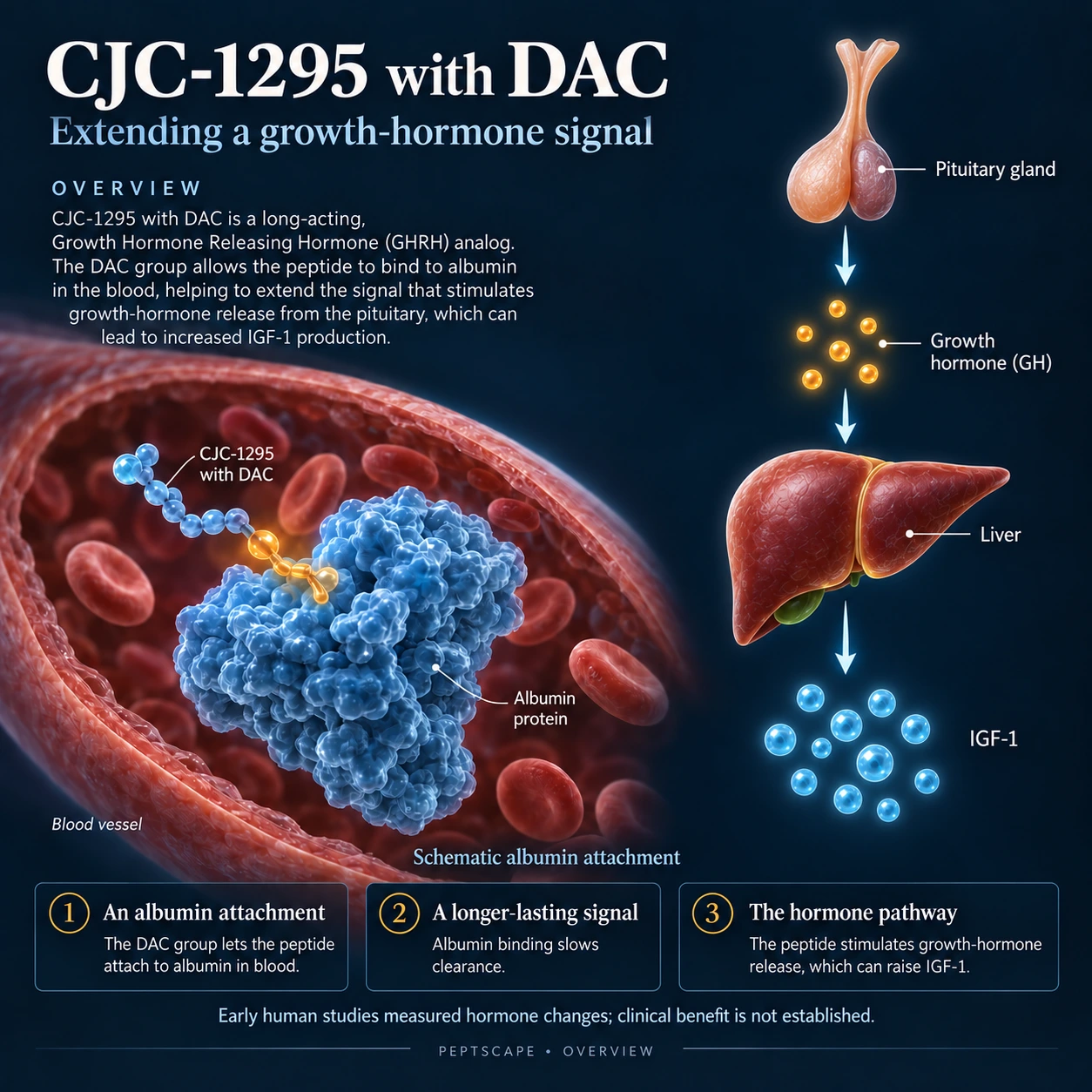
CJC-1295 with DAC is a long-acting peptide that stimulates growth hormone release. It is based on growth hormone-releasing hormone, usually shortened to GHRH, which is one of the signals the brain uses to communicate with the pituitary gland. The pituitary responds by releasing growth hormone.
The important part of the name is DAC, which stands for “drug affinity complex.” This modification allows the peptide to attach to albumin, a protein that circulates in the blood. Attachment slows its clearance and extends the time during which it can influence the growth hormone system.
Why the DAC distinction matters
A vial labelled CJC-1295 with DAC should not be treated as interchangeable with a product labelled “CJC-1295 no DAC.” The latter name is commonly applied to modified GRF(1–29), a different, shorter-acting preparation. Removing those three letters from a label is not a minor naming choice: it changes the expected duration of exposure.
DAC is not a concentration or an amount. A label can state the same number of milligrams for two peptides that behave very differently. Confirming which molecule is present therefore comes before comparing vial sizes, reconstitution volumes or schedules.
Sustained exposure does not mean growth hormone becomes flat
A long-acting releasing signal is different from a continuous infusion of growth hormone. The body's growth hormone output can still occur in pulses while the background influence of CJC-1295 with DAC persists. This helps explain why the peptide may raise overall hormonal exposure without turning normal secretion into a completely constant level.
It also explains why a single blood sample does not describe the whole response. Growth hormone changes through the day, while IGF-1 provides a different, less rapidly changing measure of the system. Neither measurement is a direct score for fat loss, sleep quality or recovery.
What it is used for
Body composition and recovery goals
Experimental use of CJC-1295 with DAC centres on body composition, exercise recovery and age-related concerns about reduced physical performance. These uses aim to make use of growth hormone's effects on fat metabolism and tissue maintenance. Raising growth hormone and IGF-1 has been demonstrated, but that does not establish a predictable improvement in these outcomes for a healthy user.
Fat metabolism means how the body stores and releases fat for energy. It is different from suppressing appetite. This peptide should therefore not be described as another version of an appetite-reducing treatment. A person may experience a hormonal response without becoming less hungry or seeing a substantial reduction on the scale.
Lean tissue is not all muscle
Body-composition measurements divide body mass into categories, but “lean” includes water and other tissue as well as muscle. Growth hormone-related fluid retention can affect weight and the appearance of fullness. A quick increase in lean mass is therefore not automatically new contractile muscle.
Strength, activity tolerance and measurements taken under similar conditions add useful context. For recovery, the relevant question is whether a comparable workload becomes easier to tolerate, not simply whether a laboratory value increased. Persistent pain or weakness still needs to be understood as its own problem.
Sleep and longer-term use
Growth hormone secretion is linked to deep sleep, which has encouraged experimental use of releasing peptides for sleep-related goals. That link does not make CJC-1295 with DAC a sleep aid or prove that prolonged stimulation improves sleep architecture. The long action is a feature of drug exposure, not evidence that its benefits last longer than those of another peptide.
Terms such as “anti-ageing” also cover several different goals. Better endurance, less visceral fat, fewer wrinkles and improved memory are not a single outcome. The peptide should be assessed against a specific purpose rather than an assumption that higher hormone levels broadly reverse ageing.
How it works
A longer-lasting message to the pituitary
The peptide activates the GHRH receptor, a receiving point involved in growth hormone release. Its albumin attachment allows that message to remain available longer than a short-lived GHRH fragment. This is why its pharmacology cannot be inferred from sermorelin or a no-DAC preparation.
Growth hormone then influences other tissues and promotes production of IGF-1. The response remains part of a system involving sleep, nutritional state, other hormones and feedback signals. The same labelled amount is not a guarantee of the same biological response in different people.
Repeated administration can overlap
With a long-acting peptide, a previous administration may still be contributing to exposure when the next one occurs. This overlap is sometimes called accumulation. It matters because changing a schedule can change total exposure over time, even if the amount in each injection stays the same.
The reverse is also important: stopping administration does not instantly remove a long-acting peptide's effect. This is a reason to keep accurate dates and avoid treating a long-acting preparation as if it were a short, isolated pulse. The Practical section addresses timing separately from the explanation of mechanism.
What the peptide does not target
A subcutaneous injection does not direct growth hormone release toward the tissue nearest the injection site. The pituitary signal and downstream hormonal effects are systemic. Choosing an abdominal injection site does not make the peptide specifically remove abdominal fat.
Fluid retention, tingling and changes in glucose control can accompany increased growth hormone activity. They should not be reinterpreted as evidence that a higher exposure is working better. The defining advantage of DAC is a longer duration of exposure; whether that is useful depends on the purpose, response and tolerability, not duration alone.