Identity
Cerebrolysin is a peptide preparation evaluated as an adjunct in neurological treatment studies.
Selected study only; not a complete clinical review.
Peptide library
Your guide to this compound.
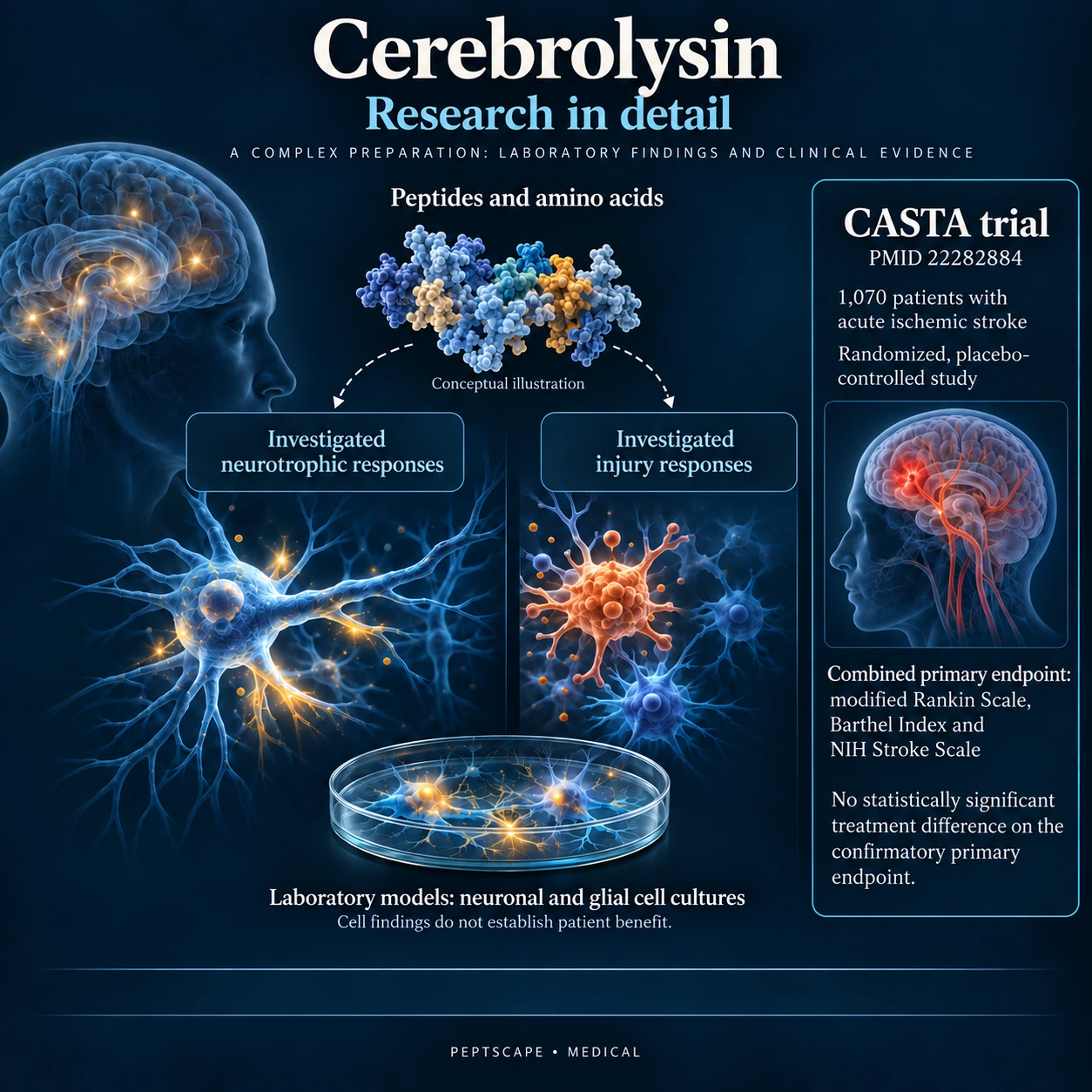
The large CASTA trial did not meet its primary combined functional endpoint. Post hoc severe-stroke findings are hypothesis-generating. A complex peptide mixture also requires a matched manufactured preparation.
Existing source snapshot critically reassessed.
Based on the selected source scope described in this profile, often an indexed abstract. Full methods and clinician sign-off remain pending; no systematic-review claim.
Editorial assessment · 2026-09-07
1,070 acute ischemic-stroke patients in the randomized CASTA trial.
The primary combined functional endpoint was not significantly improved. Favorable severe-stroke subgroup findings were post hoc and require confirmation.
Current authorization for the exact product and jurisdiction was not independently checked in this snapshot. A clinical trial is not marketing authorization.
Selected indexed primary-study abstract reviewed. Full methods, bias, all safety outcomes, product stability, current jurisdictional authorization and a comprehensive literature search remain outstanding. This is not a complete clinical review.
Cerebrolysin is a peptide preparation evaluated as an adjunct in neurological treatment studies.
The study-specific findings below distinguish biological activity from demonstrated treatment benefit.
This catalog identifies human research. A trial can be early, small or negative; its existence does not establish approval or benefit for every proposed use. Check the study population and outcomes.
Selected study only; not a complete clinical review.
This catalog identifies human research. A trial can be early, small or negative; its existence does not establish approval or benefit for every proposed use. Check the study population and outcomes.
Cerebrolysin is a peptide preparation evaluated as an adjunct in neurological treatment studies.
Selected study only; not a complete clinical review.
The primary combined functional endpoint was not significantly improved. Favorable severe-stroke subgroup findings were post hoc and require confirmation.
Selected study only; not a complete clinical review.
A neutral efficacy result does not establish safety; comprehensive adverse-event assessment remains necessary.
Selected study only; not a complete clinical review.
Cerebrolysin in patients with acute ischemic stroke in Asia: results of a double-blind, placebo-controlled randomized trial. 2012.
PMID: 22282884
Catalog review date: Sep 7, 2026. This date alone does not establish independent clinical review.