Educational illustration · Read the evidence and limitations below.
What is Cerebrolysin?
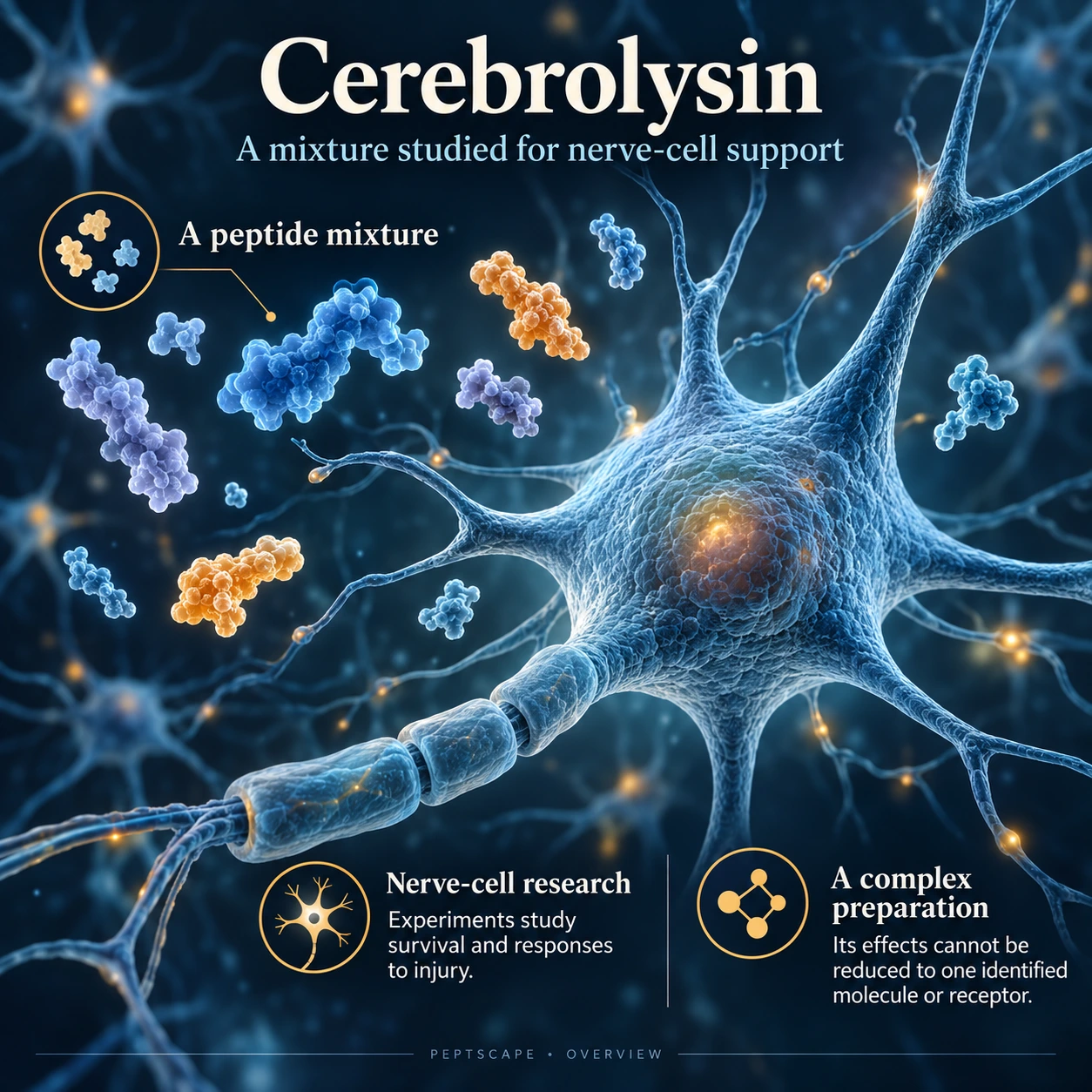
Cerebrolysin is a mixture of small peptides and amino acids produced from a biological protein source. It is not a single peptide with one sequence. It has been used in neurological treatment settings, particularly around recovery after brain injury or stroke and in discussions of cognitive impairment.
The wider picture
Cognition includes attention, learning, memory, language and planning. These abilities overlap, but a change in one does not necessarily improve the others. Alertness is also different from memory: feeling more awake can make work easier without changing the ability to retain information. Clear descriptions of the intended effect are more useful than treating every brain-related compound as a general intelligence enhancer.
Memory has stages. Information has to be noticed, learned, stored and later retrieved. Poor attention during the first stage can feel like a memory problem even when storage is intact. Explaining which stage a proposed compound might influence is more informative than promising a broad increase in brain power.
What it is used for
The intended purpose is to support neurological recovery rather than provide an immediate stimulant effect. Recovery after stroke involves speech, movement, swallowing, attention and many other functions, each with a different course. A peptide mixture cannot replace rehabilitation or time-sensitive stroke treatment. A sudden neurological symptom requires urgent assessment.
Understanding the intended benefit
A useful cognitive goal is specific: following a conversation, sustaining attention during a task or recalling information after a delay. Sleep, stress, alcohol, medicines and mood can influence each of these. A notebook or journal helps identify the surrounding circumstances, although it cannot by itself establish that a peptide caused a change. Sudden confusion, new weakness, a severe unusual headache or a rapid change in function needs medical assessment rather than a nootropic adjustment.
Stress can affect concentration, sleep and the perception of cognitive effort. Relief from anxiety may make tasks easier without directly increasing memory capacity. Conversely, a stimulant-like feeling may increase confidence without improving accuracy. A useful personal record includes errors, task completion and sleep as well as the subjective feeling of mental sharpness.
How it works
The proposed actions involve support of nerve-cell survival and responses to injury. Because this is a mixture, its biological behaviour cannot be reduced to the half-life of one named peptide. Product composition and manufacture are part of its identity. It should not be treated as interchangeable with a synthetic single-molecule nootropic or with a vial containing a collection of unrelated peptides.
The biology in plain language
Nerve cells communicate through electrical activity and chemical signals. Some molecules act at receiving points on the cell surface; others influence how cells respond to injury or maintain their connections. A proposed effect on nerve-cell survival is different from restoring a lost skill in daily life. Likewise, changing a peptide's chemical ends or attaching another group can change its behaviour. It does not automatically make a derivative more effective, longer lasting or equivalent to the original molecule.
The brain is protected by a selective barrier between the blood and nervous tissue. Reaching the bloodstream is not the same as reaching a particular brain target. Nasal, oral and injected preparations therefore raise different delivery questions. A label claiming brain penetration or a chemical modification cannot establish the absorbed amount or expected effect on its own.