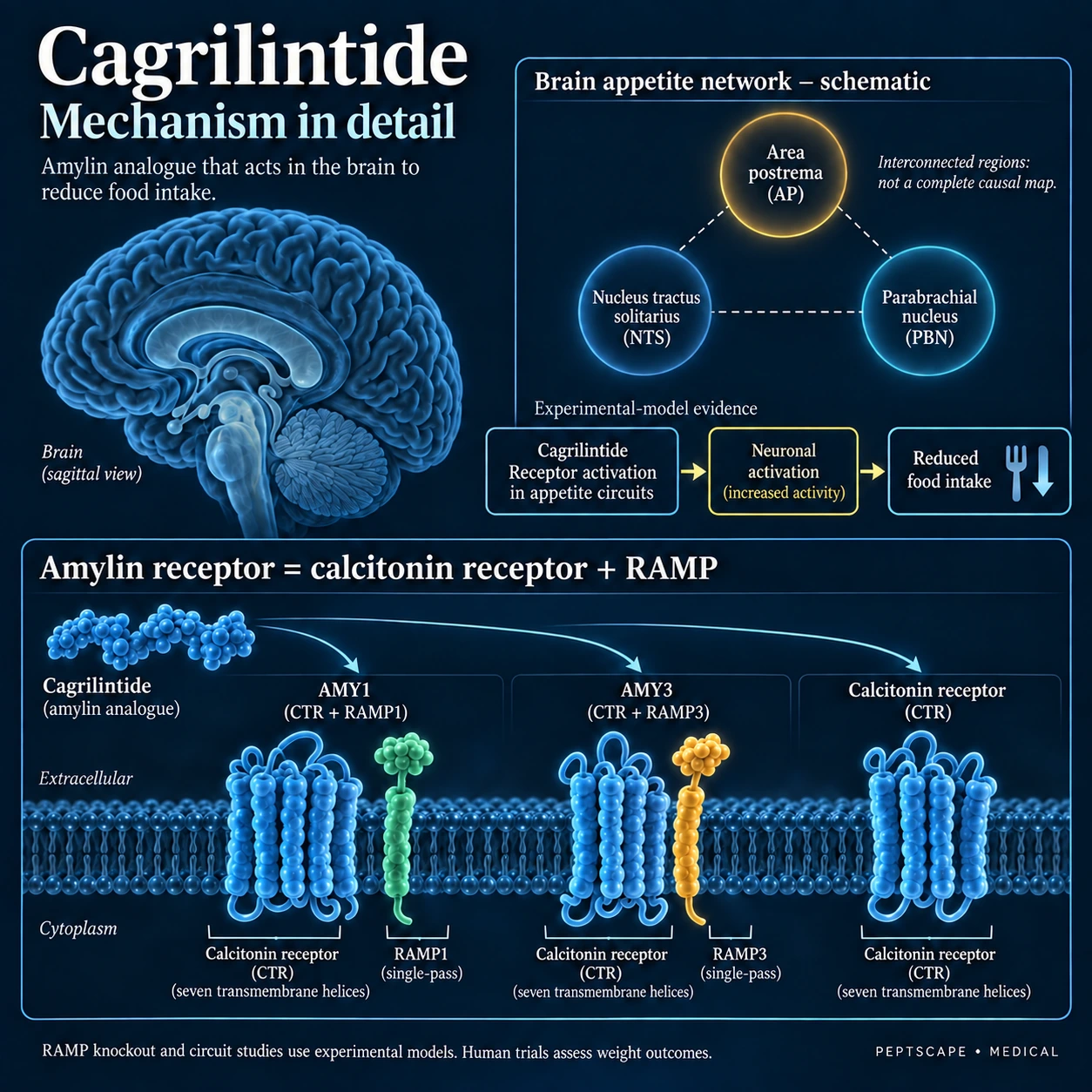
Educational illustration · Read the evidence and limitations below.
Medical · What is Cagrilintide?
Cagrilintide is a long-acting peptide modelled on amylin, a hormone released by the pancreas alongside insulin. Amylin helps signal that a meal has been eaten and that enough food has arrived. Cagrilintide is being developed to extend that appetite-related signal over a much longer period.
People usually encounter it in discussions of fullness, weight management and combinations with GLP-1 peptides. It is not itself a GLP-1 agonist, and it is not insulin. Its value in research comes from working through a different appetite pathway.
The everyday idea is simple: a person may feel satisfied with less food. The harder question is whether that response can be achieved while maintaining nutrition and avoiding troublesome nausea or other side effects. A stronger loss of appetite is not automatically a better result.
Medical · Benefits and common reasons for interest
Fullness and weight management
A phase 2 trial studied weekly cagrilintide in adults with overweight or obesity without diabetes. Across the tested doses, mean weight reductions after 26 weeks were about 6.0–10.8%, versus 3.0% with placebo under the trial's adherent-treatment analysis. Results vary with dose, analysis and population.
A different appetite pathway
Interest in cagrilintide is partly about adding an amylin-related signal rather than simply increasing a GLP-1 dose. That is a research rationale, not proof that every combination is helpful or tolerable.
Meal satisfaction
Feeling full sooner can change portion size and eating patterns. It should still be possible to meet nutritional needs. Persistent food aversion, vomiting or difficulty drinking is a problem to address, not a desired measure of success.
Medical · How does it work?
Amylin communicates with brain regions involved in meal size and satiety, the feeling of having had enough to eat. Cagrilintide activates amylin-related receptor systems and is modified to remain active longer than natural amylin.
The amylin pathway also relates to digestive and glucose regulation. Its role is different from the insulin signal that moves glucose into tissues. Calling cagrilintide an insulin substitute would therefore be misleading.
Appetite involves several overlapping systems. Activating more than one can produce a useful combined effect, but can also make symptoms harder to manage. The aim of combination research is to test that balance under defined conditions.
Medical · Cagrilintide, CagriSema and Pramlintide
CagriSema refers to cagrilintide combined with semaglutide. Findings for the combination do not all belong to cagrilintide alone. Keep both component names and amounts separate when reading a study or documenting a plan.
Pramlintide is another amylin analogue, with different duration, dosing and clinical use. It is not a dose-conversion reference for cagrilintide. Neither a shared receptor family nor a similar name establishes the same preparation or schedule.
Medical · Dosing and concentration
The standalone phase 2 study tested once-weekly subcutaneous targets of 0.3, 0.6, 1.2, 2.4 and 4.5 mg, with a dose-escalation period. These were separate study groups, not a universal sequence that every person should follow. Combination studies used their own schedules.
A statement such as “2.4 mg CagriSema” is incomplete unless it identifies both component amounts. It can be unclear whether someone means cagrilintide, semaglutide or a combined total. The same ambiguity applies to a vial labelled only with a blend name.
For measurement only, 0.1 mL of a documented 3 mg/mL solution contains 0.3 mg. The concentration, not the word “units,” determines the delivered amount. A U-100 syringe measures 0.1 mL at 10 marked units. This example does not select a personal dose or reconstitution recipe.
Medical · Preparation and reconstitution
Cagrilintide is a peptide whose formulation matters. Solubility, acidity, excipients and the container affect a solution's behaviour. Dissolving a lyophilised vial is not the same as reproducing a clinical-trial formulation.
Bacteriostatic water is commonly discussed for peptide reconstitution, but it is not automatically compatible with every peptide or mixture. Its preservative does not validate stability or make contaminated material sterile. A documented preparation needs a specified diluent, final concentration and discard limit.
Do not combine cagrilintide and semaglutide in one vial or syringe merely because both appear in a combination trial. The tested formulation and handling conditions matter. Research participants should use the supplied preparation and instructions rather than recreating it from separate materials.
Medical · Administration
The cited trials used subcutaneous injections. Participants were taught how to use the particular study product. Subcutaneous means delivery into the fatty layer beneath the skin; it does not mean injecting into the gut or directly into an area where fat loss is desired.
A clean work surface, handwashing, new sterile equipment and a sharps container belong to injection handling. Site rotation helps avoid repeatedly irritating one patch of skin. Avoid bruised, red, hardened or damaged areas and follow the device-specific instructions demonstrated by the clinical team.
A visible droplet or uncertain delivery should be recorded, not automatically corrected with another full injection. Do not share pens, needles or syringes, and do not use oral or topical preparations for injection.
Medical · Oral versus subcutaneous delivery
A swallowed peptide encounters digestive enzymes and must cross the gut lining before reaching the bloodstream. Subcutaneous administration avoids that initial digestive route. An ordinary cagrilintide capsule cannot be assumed to provide the exposure measured in injection studies.
Some oral peptides are investigated for local gut effects. Cagrilintide's weight-management research instead concerns systemic appetite signalling. Low oral absorption is not a reason to assume a useful local anti-inflammatory action in the bowel. Route choices need a reason specific to the peptide and formulation.
Medical · Half-life
In an early combination study, cagrilintide's measured half-life was approximately 159–195 hours, or about 6.6–8.1 days. That explains the weekly research schedules. It also means that effects can accumulate and do not disappear immediately after stopping.
Medical · Storage
Follow the handling instructions for the supplied study product or documented formulation. A room-temperature allowance for semaglutide does not automatically apply to cagrilintide, even when the two are used in the same research programme.
For any prepared vial, record the preparation date, concentration and assigned discard date. Keep temperature excursions in the record. Refrigeration cannot establish a missing stability period, and visual clarity cannot rule out contamination or chemical change. Avoid repeated transfer between containers and do not freeze unless the exact instructions require it.
Medical · Contraindications and side effects
Nausea, constipation, diarrhoea and injection-site reactions occurred in clinical studies. Reduced food intake can become a concern if it causes weakness, dehydration or inability to meet nutritional needs. Severe abdominal pain or persistent vomiting warrants medical assessment.
Pregnancy, breastfeeding, significant stomach-emptying problems, diabetes medicines and other appetite treatments require individual review. Amylin-family pharmacology should prompt careful attention to food intake and glucose management rather than an assumption that every related drug has identical contraindications.
Study entry criteria and adverse-event reports are not a complete long-term safety label. Tell the treating or study team about new medicines, planned procedures and significant symptoms. Do not treat an undocumented interaction as a confirmed safe combination.
Medical · Nutrition and supplement support
Plan for earlier fullness
Start with manageable meals containing a protein source and other nutritious foods. If large meals are uncomfortable, smaller regular portions can be easier to finish. Protein foods, fruit, vegetables and carbohydrate sources still matter even when appetite is quiet.
Avoid turning low appetite into malnutrition
Track energy, strength and food variety alongside weight. An inability to eat much is not a reason to rely entirely on vitamin tablets. A dietitian can help adapt texture, portion size and meal timing when intake remains low.
Fibre and fluids
Constipation may respond to adequate fluids and a gradual increase in tolerated fibre, but sudden large fibre doses can worsen bloating. Persistent symptoms need review. Repeated vomiting requires assessment; an electrolyte drink alone does not solve ongoing fluid loss.
Supplements
Protein supplements can fill a practical dietary gap. Vitamin D, B12, calcium or iron should be considered according to food intake and deficiency risk, not as mandatory cagrilintide companions. Iron can worsen constipation; magnesium can cause diarrhoea. There is no demonstrated supplement that makes an unverified preparation safer or guarantees better appetite control.
Medical · Tracking progress and common questions
Record fullness before and after meals, nausea, bowel changes, hydration and the exact peptide or combination. Separate the names and amounts of both components if reviewing a combination plan. Note functional changes and a consistent weight trend.
“Is CagriSema a different name for cagrilintide?” No: it includes semaglutide. “Can I judge the effect after one day?” A long-acting peptide may have a changing response over several weeks. “Should I keep reducing meals because I can?” No: meeting nutritional needs is part of a useful outcome.
Medical · Medical
Standalone and combination results are separated here because they answer different questions. The early pharmacokinetic study measured a particular subcutaneous preparation under its protocol.