Educational illustration · Read the evidence and limitations below.
What is Cagrilintide?
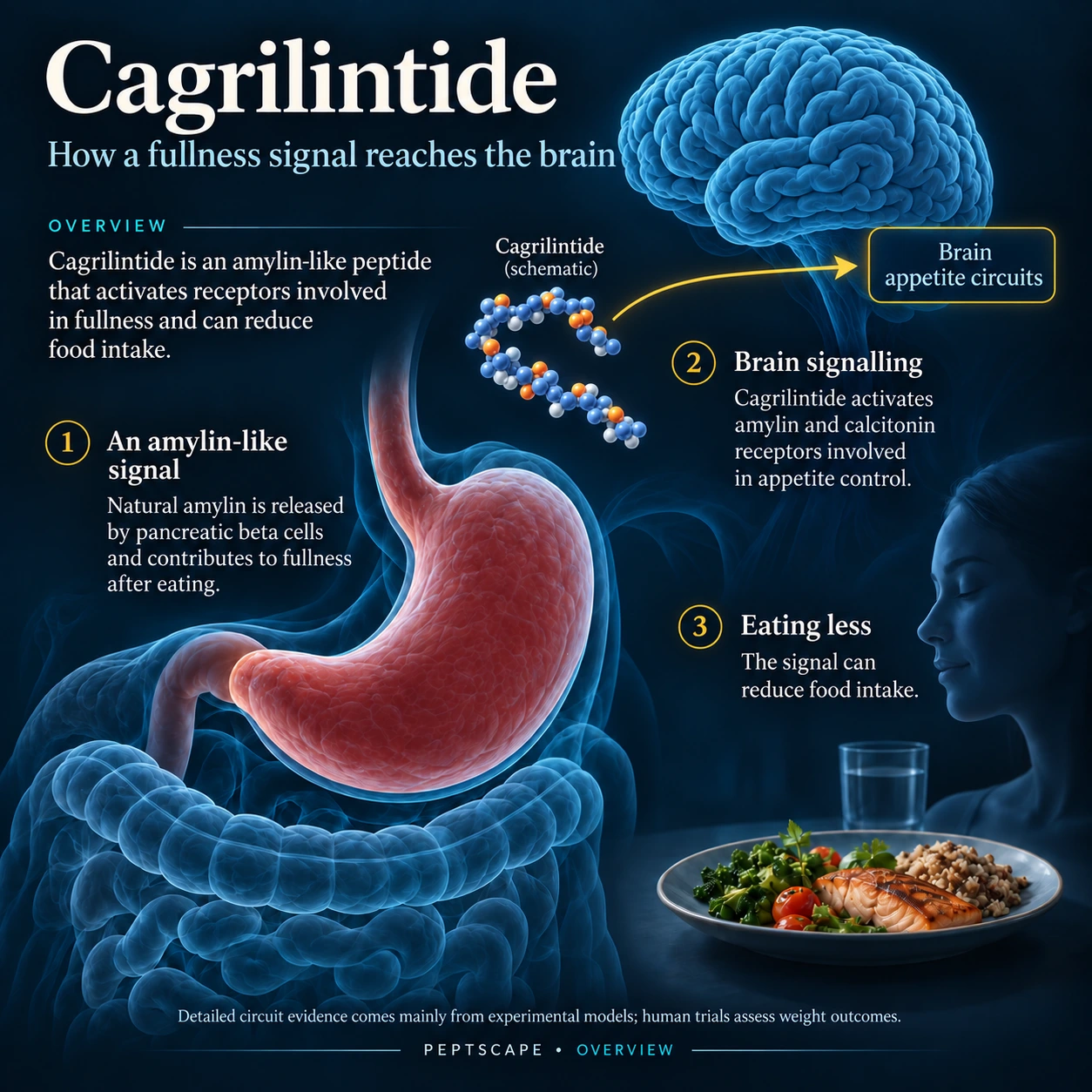
Cagrilintide is a long-acting analogue of amylin, a hormone released alongside insulin after eating. Its development focuses on appetite and weight management. The main idea is to strengthen meal-related signals that help the body recognise when enough food has been eaten.
It belongs to a different peptide family from semaglutide and tirzepatide. Although all can be associated with reduced food intake, cagrilintide does not work by being another GLP-1 agonist. Understanding that difference explains both its interest as a separate treatment and its development in combinations.
What amylin normally does
Amylin contributes to communication between a meal, the digestive system and the brain. Its actions include promoting meal satisfaction, influencing stomach emptying and helping coordinate glucose responses after food. Insulin and amylin are released together, but they do not have identical jobs.
Insulin helps direct nutrient use and storage. Amylin contributes to the message that food has arrived and to the way the body handles that meal. Cagrilintide is designed to provide a longer-lasting version of amylin-related signalling rather than supplying extra insulin.
Feeling satisfied versus feeling unwell
Satiation is reaching a comfortable stopping point during a meal. Satiety is the reduced desire to eat for a period afterwards. These are the useful appetite concepts for understanding cagrilintide.
Nausea can also reduce eating, but it is an adverse effect rather than the intended measure of success. A person should be able to distinguish “a smaller meal felt sufficient” from “I could not eat because I felt sick.” That distinction matters when evaluating any appetite-directed treatment.
What it is used for
Weight management through reduced intake
Cagrilintide is being developed to help reduce body weight by influencing appetite and meal size. It is not a peptide that directly dissolves local fat or builds muscle. The clinical development results support interest in weight management, but they do not establish equivalence for every preparation carrying its name.
Reduced intake needs to remain nutritionally useful. With smaller meals, protein-containing foods, fluids and tolerable sources of fibre may require more deliberate attention. The goal is not simply to make eating as infrequent as possible.
Why it is combined with Semaglutide
Amylin-related and GLP-1 pathways provide different but interacting signals about appetite and food intake. This is the rationale for developing cagrilintide with semaglutide. CagriSema names that combination; it is not a synonym for cagrilintide alone.
A combination result cannot be attributed entirely to one component. It also does not establish that adding cagrilintide to another weight-management peptide independently will reproduce the same result. The formulation, amounts, schedule and tolerability of the combination all matter.
Persistent hunger and meal size are not identical goals
Some eating difficulty comes from feeling hungry again soon after a meal. Some involves finding it hard to stop once eating begins. Cravings, habit and emotional context can add other influences. These patterns overlap, but a single phrase such as “appetite control” can obscure the differences.
Cagrilintide's amylin-related action makes meal satisfaction a particularly useful way to explain its intended role. That does not mean it selectively treats every form of craving or removes all the non-biological influences on eating.
Maintaining weight and function
A weight-management discussion should include what happens after weight reduction. Continued appetite regulation may remain relevant, while nutritional adequacy and physical function become important ongoing measures. A falling number on the scale is not the only useful outcome.
Strength, hydration and bowel comfort provide information that weight alone does not. If eating becomes too difficult, the result needs reassessment rather than being labelled stronger appetite control. The Practical and Nutrition sections address those day-to-day considerations separately.
How it works
Amylin-related receptors
Cagrilintide is designed to activate receptor systems involved in amylin signalling. These systems contribute to communication about food intake and fullness, including signals involving the brainstem. It is therefore a hormonal appetite approach rather than a mechanical way of filling the stomach.
The long-acting design extends exposure compared with the natural hormone. This is why its action is not limited to the short period immediately after a meal. It also means that the feeling of hunger on a particular day is not a direct reading of how much peptide remains in the body.
Stomach emptying and meal response
Amylin signalling can influence how quickly the stomach passes food onward. That affects meal processing, but slowing digestion is not automatically beneficial in every person. Existing digestive problems and other medicines that affect gut movement need to be considered.
A larger meal after appetite has decreased may feel unusually uncomfortable. Persistent vomiting or inability to maintain fluids is different from ordinary meal satisfaction and deserves assessment. Digestive discomfort should not be used as a target to pursue.
Glucose is part of the system, not the whole purpose
Amylin-related signalling can also influence glucagon responses after meals. Glucagon helps regulate the liver's release of glucose. These effects help explain why appetite hormones and glucose control are connected, but they do not make cagrilintide an interchangeable replacement for diabetes medicines.
If another treatment can cause low glucose, reduced food intake may alter its requirements. The complete regimen matters more than the isolated label “weight-loss peptide.”
Understanding the difference from other peptides
Cagrilintide's defining feature is its amylin-based approach to meal satisfaction. Semaglutide and tirzepatide use different receptor systems, and a combined product is another distinct exposure. Keeping those identities clear makes the dosing, preparation and combination information much easier to follow.