Educational illustration · Read the evidence and limitations below.
Medical · What is BPC-157?
BPC-157 is a laboratory-made peptide best known for its connection to injury recovery and digestive health. A peptide is a short chain of amino acids—the same building blocks that make up proteins. BPC-157 contains 15 amino acids and takes its name from “Body Protection Compound.”
People usually discover BPC-157 while looking for help with a stubborn tendon injury, joint discomfort, slow recovery or ongoing gut problems. Researchers are interested in whether it can influence the processes the body uses to protect and repair damaged tissue.
BPC-157 is different from a painkiller. A painkiller mainly reduces pain; BPC-157 is being investigated for effects on the repair process itself. That distinction explains much of the interest surrounding it. However, most of the encouraging findings come from animal and laboratory studies, and its benefits and long-term safety in people remain uncertain.
Medical · Benefits and uses
Tendon and ligament recovery
Tendons connect muscles to bones. Ligaments connect bones to other bones and help stabilize joints. Both can take a long time to recover after injury.
Animal studies have found improvements in tendon and ligament healing with BPC-157. Researchers have also observed effects on the cells involved in rebuilding connective tissue. These findings explain why people discuss BPC-157 for problems such as Achilles tendon injuries and ligament damage.
For someone recovering from an injury, progress means more than less pain. It also means gradually tolerating movement, strength exercises and everyday activity. Feeling better does not necessarily mean the tissue is ready for heavy loading.
Muscle recovery
BPC-157 has been studied in animal models of muscle damage. This has led to interest in its possible role after strains and other soft-tissue injuries.
Recovery still depends on the injury, rehabilitation, sleep and adequate food intake. BPC-157 should not be expected to compensate for repeatedly aggravating an injury or returning to training too quickly.
Digestive health
BPC-157’s connection to digestive health comes from research involving protection of the stomach and intestinal lining.
That lining has several jobs: absorbing nutrients, producing protective mucus and controlling what passes from the digestive tract into the body. Researchers have investigated BPC-157 in models involving damage to this protective barrier.
This is why oral BPC-157 is often discussed for gut-related goals. However, reflux, irritable bowel syndrome and inflammatory bowel disease are different conditions. Evidence involving one type of intestinal injury does not establish a treatment for all digestive symptoms.
Medical · How does it work?
When tissue is injured, the body needs to bring repair cells into the area, maintain a blood supply and rebuild damaged structures.
BPC-157 has been studied for its effects on several parts of that process:
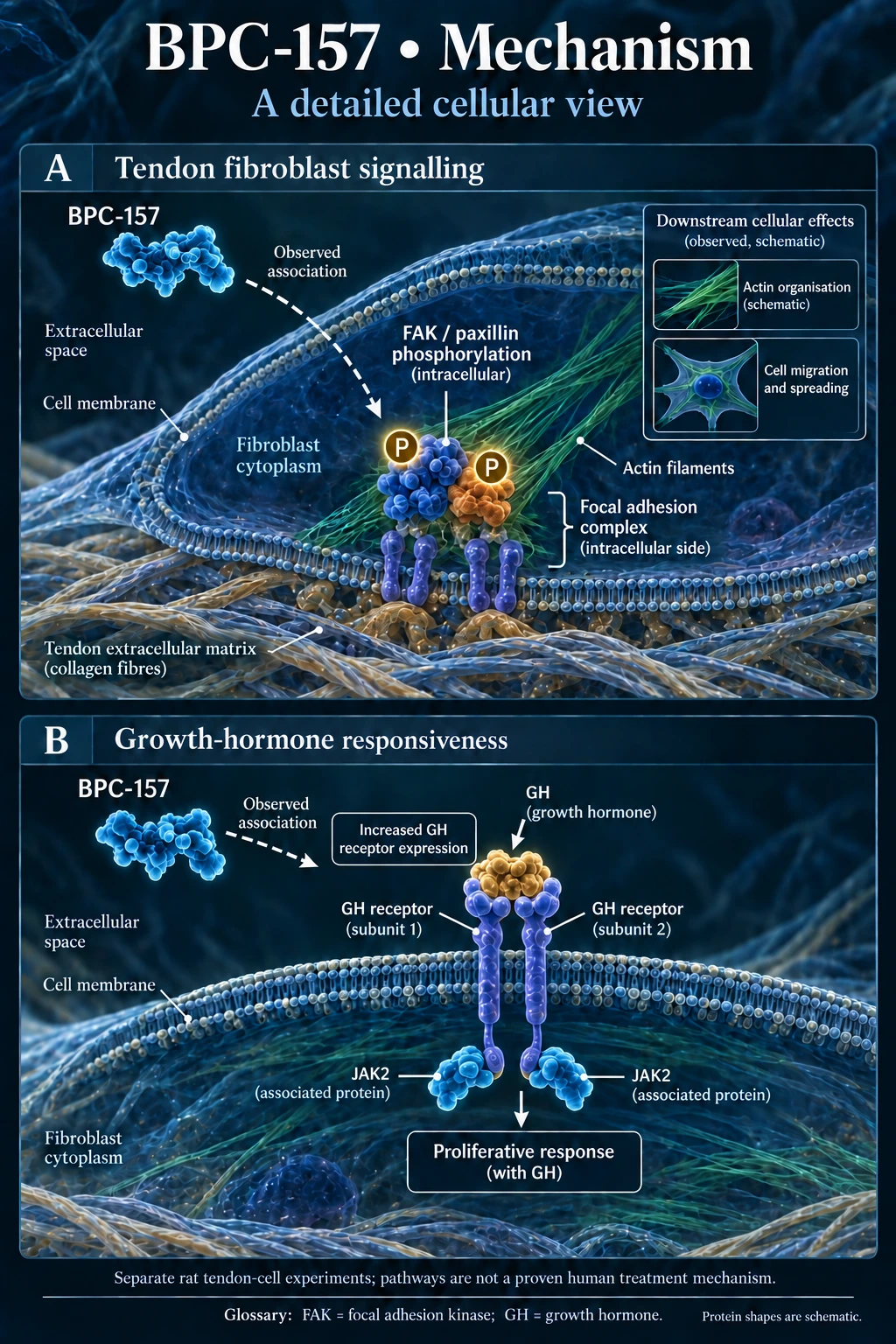
• Repair-cell movement. Laboratory work suggests it can help tendon cells move and spread. These are steps involved in filling and rebuilding an injured area.
• Cell survival. Experiments have examined whether it helps repair cells withstand stressful conditions.
• Blood-vessel signaling. Researchers have investigated pathways involved in circulation and the formation of small blood vessels.
• Connective-tissue signaling. Studies have also examined changes in how tendon cells respond to growth-related signals.
These findings help explain the healing claims. They do not yet tell us how much benefit a particular person will experience.
Medical · Oral versus SubQ
What happens when a peptide is swallowed?
The digestive system breaks proteins and many peptides into smaller pieces. Acidity, digestive enzymes and the intestinal lining all affect how much of a swallowed peptide reaches the bloodstream intact.
Bioavailability means the proportion of an administered amount that reaches the circulation unchanged.
BPC-157 has attracted oral interest partly because researchers have reported stability in gastric juice. But surviving the stomach and passing into the bloodstream are separate steps. Stomach stability alone does not establish high oral absorption.
Why use an oral preparation if less reaches the blood?
Because the bloodstream is not always the intended destination.
For a treatment aimed at the gut lining, contact with the intestinal surface may matter more than a high blood concentration. Some established oral peptide medicines work this way.
That provides a reasonable explanation for interest in oral BPC-157 for digestive problems. It does not prove that an oral BPC-157 product heals the human gut or works better than an injection.
Oral preparations also avoid needles and may be easier to use consistently.
What changes with SubQ?
SubQ means subcutaneous: beneath the skin, in the fatty tissue.
This route bypasses the stomach and digestive enzymes. The peptide still needs to be absorbed from that tissue, so injection does not automatically mean 100% bioavailability.
An oral amount cannot be converted into a SubQ amount using a reliable BPC-157 conversion factor. Taking more orally to “make up for poor absorption” is not a sound dosing calculation.
Medical · Dosing
Amounts of 250–500 micrograms per day appear in community-use guides, sometimes divided into separate administrations. These are reported-use figures, not a medically established starting dose or a guarantee of safety.
A useful dosing record includes:
• The amount per administration.
• The number of administrations per day.
• The route: oral, SubQ or another specified route.
• The concentration of any liquid preparation.
• Where the instructions came from.
Daily total and individual dose are different. For example, 250 micrograms twice a day adds up to 500 micrograms per day. This is an arithmetic example, not a suggested schedule.
A vial labelled 5 mg contains 5,000 micrograms in total. That label describes the amount in the vial; it does not mean the whole vial is one dose.
Choosing an amount requires more than copying a number from another person’s plan. A clinician needs to consider the diagnosis, other treatments and the actual preparation. Online use reports do not resolve those questions.
Medical · Preparation and reconstitution
Reconstitution means adding a suitable liquid to a lyophilised (freeze-dried) peptide to make a solution.
An oral capsule does not normally require this step. A ready-made liquid already has a concentration. A lyophilised vial needs preparation instructions identifying the correct diluent, volume and handling conditions.
Understanding the concentration
Consider this calculation example, not a mixing or dosing recommendation:
• Peptide in the vial: 5 mg, equivalent to 5,000 micrograms.
• Documented final solution volume: 2 mL.
• Concentration: 5,000 micrograms ÷ 2 mL = 2,500 micrograms/mL.
• At this concentration, 0.1 mL contains 250 micrograms.
Adding more liquid makes a solution more dilute. It does not add more peptide.
Which diluent?
A diluent is the liquid used to prepare the solution.
Bacteriostatic water contains a preservative. Sterile water does not. Neither can be assumed suitable for every BPC-157 preparation, and adding a preservative does not sterilize contaminated powder.
The preparation instructions need to specify which liquid is compatible with the actual product. A research-use label or a purity percentage does not establish suitability for human injection.
What needs to be checked before preparation?
Confirm the vial identity and strength, the specified diluent, the mixing volume and the resulting concentration. Follow the preparation’s own mixing and inspection instructions.
For a documented injectable preparation, handling includes clean hands, a clean preparation area, new sterile supplies and disinfecting the vial stopper before access, allowing it to air-dry. Record the mixing date and the instructed discard date.
If a product has no reliable preparation instructions, a concentration calculator cannot supply the missing information about compatibility, sterility or stability.
Medical · Administration
Oral preparations
Use the directions for the exact capsule or liquid preparation. Different formulations can release their contents differently; do not assume that every capsule should be opened or every preparation taken on an empty stomach.
Subcutaneous injections
A subcutaneous injection places medicine into fatty tissue beneath the skin using a short needle. Common sites for prescribed subcutaneous medicines include the abdomen and outer thigh. The appropriate site and equipment depend on the medicine and the person; these general sites are not proof of a preferred BPC-157 injection site.
Rotate sites and avoid skin that is infected, bruised, scarred or irritated. Needles and syringes are single-use supplies and belong in a sharps container after use.
Does injecting beside an injury work better?
There is no demonstrated advantage to placing a BPC-157 subcutaneous injection beside an injury. A published knee report involved injection into the joint by a clinician. That is a different procedure from injecting into the fatty tissue near a painful knee.
Understanding syringe markings
On a U-100 insulin syringe, 100 marked units represent 1 mL; 10 marked units represent 0.1 mL. When that syringe is used to measure another liquid, these markings describe volume. They do not specify micrograms of peptide or biological international units.
The peptide amount depends on the liquid’s concentration. Changing the dilution changes how much peptide is present at the same syringe marking.
Medical · Half-life
Less than 30 minutes was reported in a published rat and dog study using intravenous and intramuscular administration.
That is not a measured human half-life for oral or SubQ BPC-157. Blood clearance and the duration of a biological effect are different, so this number cannot determine a human dosing interval.
Medical · Storage
Before mixing
Keep dry powder sealed in its original packaging and follow the documented temperature and light-protection instructions. “Freeze-dried” describes how a powder was prepared; it does not provide an expiry date or prove that room-temperature storage is suitable.
After mixing
Record the preparation date, diluent and instructed discard date. If the preparation’s instructions specify refrigeration at 2–8°C, use a stable refrigerator location and avoid freezing. Do not assume freezing extends the usable life of a mixed solution.
A clear-looking solution is not proof that it is sterile or that the peptide remains intact. A generic 28- or 30-day rule cannot establish BPC-157 stability; use the documented interval for the actual preparation.
Oral capsules and liquids
Follow their own storage instructions. The handling requirements of an injectable vial should not be transferred to an oral capsule or liquid.
Medical · Contraindications and precautions
BPC-157 has limited human safety information. This means the list of people who should avoid it is incomplete, rather than that it has no contraindications.
• Pregnancy and breastfeeding: avoid self-directed use; effects on pregnancy, development and breastfed infants have not been adequately studied.
• Children and adolescents: adult reports do not establish pediatric safety or dosing.
• Previous serious reaction: a suspected allergic reaction to the peptide or an ingredient needs medical assessment before further exposure.
• Active cancer: discuss use with the oncology team. Interest in growth and blood-vessel signaling raises questions; it is not proof that BPC-157 causes cancer or is safe during cancer treatment.
• Upcoming surgery or complex treatment: tell the treating team about all peptides, medicines and supplements being used.
Absence from this list does not establish that use is safe for a particular person.
Medical · Side effects
Community reports describe nausea, dizziness and injection-site discomfort. These reports do not reliably establish how often reactions occur or whether BPC-157 caused them. Other ingredients, contamination, another medicine or injection technique can also contribute.
Record the symptom, when it started, the amount and route used, and other changes that day. This helps a clinician assess what happened without assuming that every symptom has the same cause.
Increasing redness, warmth, swelling, pus or fever after an injection needs prompt medical assessment. Trouble breathing, throat swelling or fainting can indicate a severe allergic reaction and requires emergency care.
Medical · Nutritional support
Protein: provide the building blocks
The body needs amino acids to maintain muscle and rebuild tissue.
Include protein-containing foods across meals: eggs, dairy, fish, meat, tofu, beans and lentils are examples. A protein powder can help when appetite, convenience or dietary restrictions make adequate intake difficult.
It supplements food intake; it does not activate BPC-157.
Vitamin C: support normal collagen production
Collagen helps give tendons, ligaments and skin their structure. Vitamin C is required to make it.
Peppers, citrus fruit, berries and broccoli are useful sources. Adult daily intake references are 75 mg for women and 90 mg for men, with an additional 35 mg for smokers.
These are total dietary requirements, not BPC-157 supplement doses. Large supplemental amounts can cause diarrhea and abdominal discomfort. The adult upper limit is 2,000 mg per day.
Zinc: correct inadequate intake
Zinc supports normal wound healing and immune function. Sources include meat, shellfish, beans, nuts and seeds.
Adult intake references are 8 mg per day for women and 11 mg per day for men. Long-term high-dose supplementation can reduce copper absorption. The adult upper limit is 40 mg per day from food and supplements unless medically supervised. Count zinc in multivitamins as well as individual supplements.
Collagen or gelatin: an optional addition
Small studies have examined vitamin-C-enriched gelatin alongside exercise and measured collagen-related outcomes. These studies did not test the combination with BPC-157 or demonstrate that it speeds recovery from a particular injury.
Collagen or gelatin should not replace a varied protein intake or a rehabilitation plan.
Put the overall recovery plan first
Adequate food intake, sleep and rehabilitation remain central to recovery. Choose a supplement for a defined nutritional purpose, such as filling an intake gap, rather than assuming that a larger supplement stack makes a peptide more effective.
No nutritional combination discussed here has been shown to make BPC-157 reliably effective or safe.
Medical · Medical
The clinical literature is dominated by laboratory and animal research. Small human reports do not establish broad effectiveness, an optimal regimen or long-term safety.
The pharmacokinetic measurements cited above are from animals and specific administration routes. The retrospective knee report involved intra-articular treatment and cannot be treated as evidence for a subcutaneous injection technique.
The nutritional references describe normal nutrient requirements and the studies they report; they do not establish a BPC-157 supplement protocol.
Direct medical references are collected here for professional review.