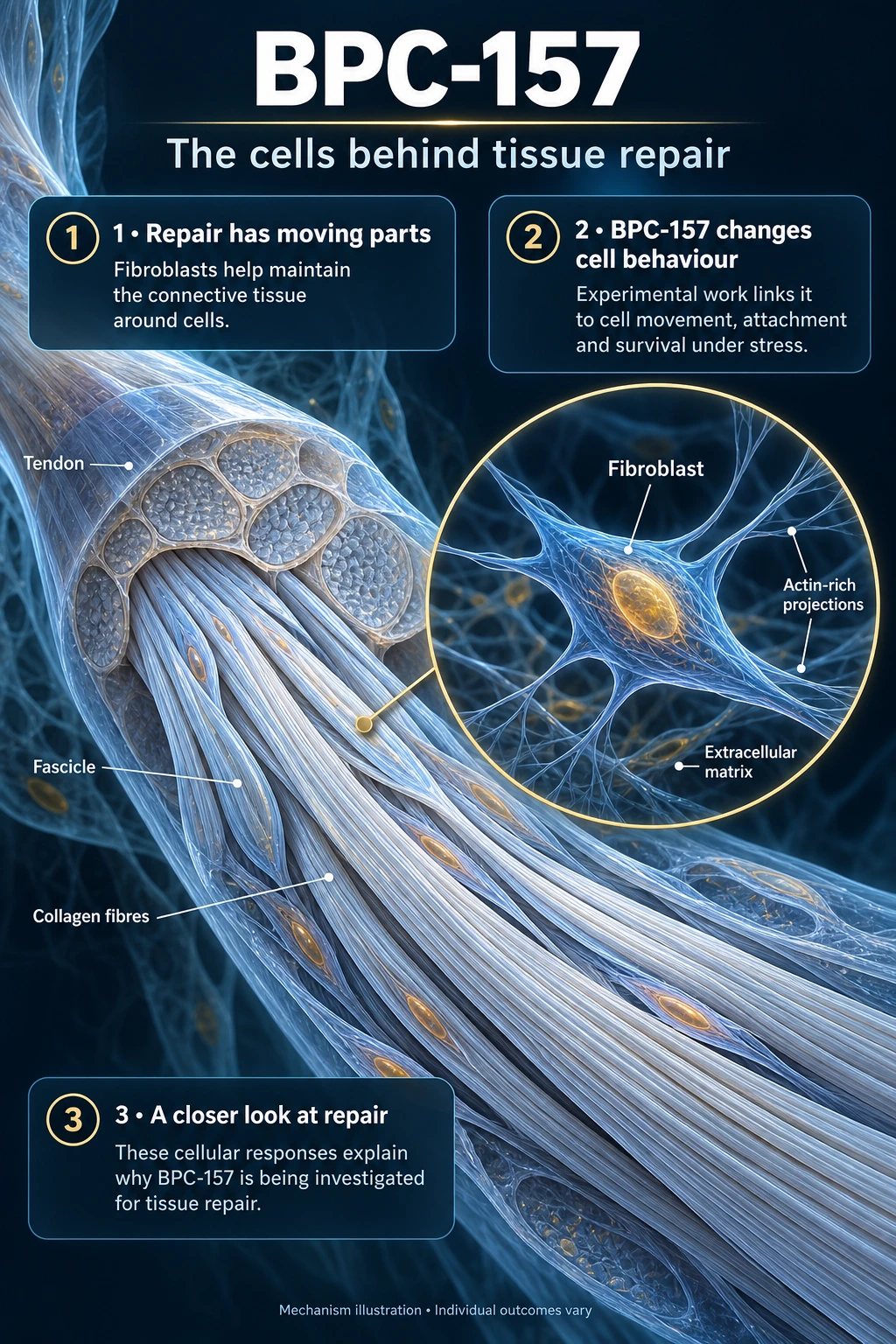
Educational illustration · Read the evidence and limitations below.
What is BPC-157?
BPC-157 is an experimental peptide developed for tissue repair and digestive health. Its name stands for “body protection compound,” and it contains 15 amino acids—the building blocks that join together to make proteins. Its main areas of interest are tendons, ligaments, muscles and the lining of the digestive tract.
The central idea behind BPC-157 is to influence the repair process after tissue has been irritated or injured. That process involves much more than closing a wound. Cells must remove damaged material, bring in nutrients, build replacement tissue and gradually organise that tissue so it can tolerate everyday movement again. BPC-157 is being investigated for effects on several parts of this process; a dependable improvement in recovery for an individual user has not been established.
Tendons, ligaments and muscles are different tissues
A tendon connects a muscle to a bone and transfers the force that moves a joint. A ligament connects bones to one another and helps keep a joint stable. Muscle contracts to produce movement. All three can be injured, but they have different structures, blood supplies and recovery needs. A strained muscle and a chronically painful tendon therefore should not be treated as the same problem simply because both hurt during exercise.
This distinction explains why a useful BPC-157 discussion needs to identify the problem being addressed. “Recovery” could mean less soreness after training, recovery from an operation, or rehabilitation of a partially torn tendon. Those are separate goals with different treatment requirements. A peptide cannot identify which injury is present or whether a structure needs protection, rehabilitation or surgical assessment.
What makes it different from a painkiller?
A painkiller primarily changes pain or inflammation. The interest in BPC-157 centres on tissue repair itself. These are different aims: pain can improve before injured tissue has regained its strength, and some conditions remain painful even as healing progresses. Feeling better is useful information, but it is not proof that a tendon or ligament is ready for its previous training load.
What it is used for
Soft-tissue injuries and rehabilitation
Experimental use of BPC-157 includes persistent tendon discomfort, ligament injuries, muscle strains and recovery after soft-tissue procedures. These uses are intended to support healing rather than build muscle directly. It is not a growth hormone-releasing peptide, and its proposed repair effects do not depend on deliberately increasing growth hormone or IGF-1.
For a tendon problem, the meaningful outcome is usually the return of a specific activity: climbing stairs, gripping a weight, running a set distance or moving through a previously painful range. Record that activity alongside discomfort and the following day's response. This gives a clearer picture than an isolated pain score taken at rest. Increased activity can also explain a temporary change in symptoms, so training and rehabilitation belong in the same record.
Digestive symptoms and the gut lining
BPC-157 also attracts interest for irritation and injury of the digestive lining. The lining forms a working barrier: it absorbs nutrients while controlling what passes from the gut into the rest of the body. Damage, inflammation and altered barrier function are related concepts, but they are not interchangeable diagnoses. Bloating alone, for example, does not identify a damaged barrier.
An oral preparation brings the peptide into contact with the digestive tract. That creates a different potential purpose from delivering it through an injection. A local effect on gut tissue would not necessarily require a large amount to reach the bloodstream. However, local contact alone does not establish that an oral product treats ulcers, inflammatory bowel disease or unexplained abdominal symptoms. The formulation and the condition being treated both matter.
Why the route matters
Swallowed peptides encounter acid and digestive enzymes that can break them into smaller pieces. Subcutaneous administration bypasses that digestive step. It does not follow that the two routes produce equivalent effects, or that an oral amount can be converted into an injection amount using a simple multiplier. The separate route section explains these practical differences in more detail.
How it works
Repair requires coordination
The proposed actions of BPC-157 involve signals associated with repair-cell movement, small blood vessels and tissue organisation. Repair cells need to reach an affected area and attach to the surrounding tissue. Blood vessels supply oxygen and nutrients. Collagen then forms part of the supporting structure that is rebuilt. These are possible points of influence, not a guarantee of stronger or faster healing.
Collagen is particularly important in tendons and ligaments, but more collagen is not automatically better tissue. Its arrangement and its ability to handle force matter. Rehabilitation provides progressively controlled loading that helps tissue adapt to the task it needs to perform. This is why a recovery plan should track function and loading, not only the passage of time.
Injection location does not select the injured structure
A subcutaneous injection enters the fatty layer under the skin. It does not place the peptide inside a tendon, ligament or joint. Injecting near a painful area has not been shown to reliably direct BPC-157 to that structure. An injection into or around a joint is a separate medical procedure, not an extension of routine subcutaneous administration.
The most useful way to follow progress is to keep the injury, activity and treatment timeline together. Note what improved, what still causes difficulty and whether swelling or weakness persists. That makes the record useful for rehabilitation decisions and helps distinguish genuine functional recovery from a temporary reduction in discomfort.