Educational illustration · Read the evidence and limitations below.
Medical · What is AOD-9604?
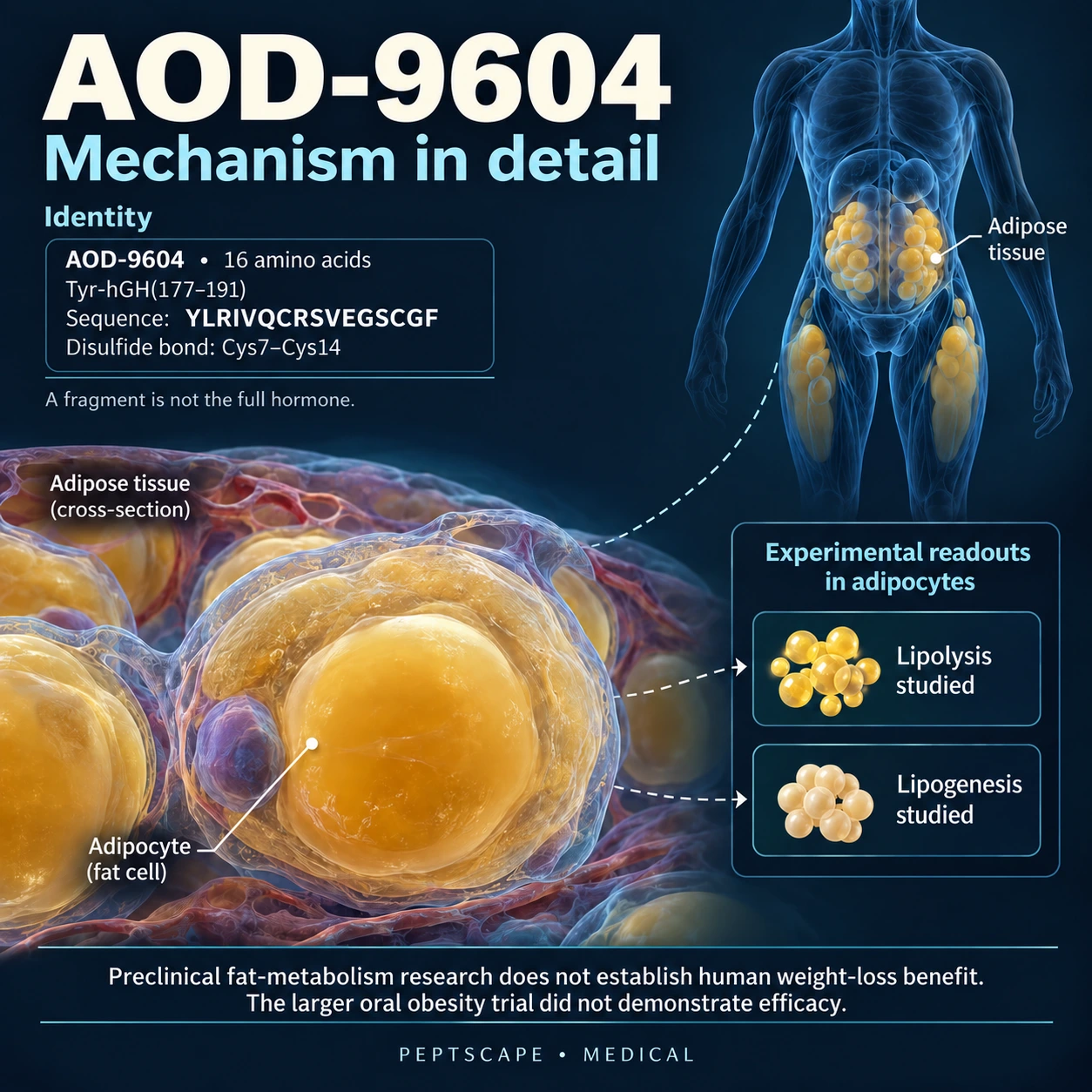
AOD-9604 is a short, modified fragment related to the tail end of human growth hormone. It was developed to investigate fat metabolism without reproducing all the growth-related actions of the full hormone. The name is often associated with fat loss, body composition and “stubborn fat” in wellness discussions.
A fragment is not simply a weaker dose of the original hormone. Changing a molecule changes which biological activities it retains. AOD-9604 should therefore be understood as its own compound, not as growth hormone replacement or as a way to obtain every benefit attributed to growth hormone.
Its scientific story is also more complicated than many online descriptions suggest. Animal experiments encouraged development, but the larger human weight-management programme did not establish a convincing weight-loss benefit over placebo. That distinction helps someone understand both why it became popular and why expectations should remain modest.
Medical · Benefits and common reasons for interest
Fat metabolism
AOD-9604 was investigated for effects on fat breakdown and fat storage. These processes occur inside a broader energy balance. Increasing a laboratory signal for fat breakdown does not guarantee that a person will lose measurable body fat.
Body composition
People interested in avoiding stimulant-type products may be attracted to a peptide described as non-stimulant. That description is not evidence of effectiveness or freedom from adverse effects. Weight, waist measurements, food intake and training still need to be considered together.
Joint and cartilage claims
Cartilage-related research is also discussed online. Experimental tissue findings do not establish that AOD-9604 repairs an injured joint, reverses arthritis or should be injected into a joint. Persistent joint pain needs a diagnosis and a rehabilitation plan.
Medical · How does it work?
Full growth hormone affects growth, metabolism and many tissues. AOD-9604 was designed around a smaller region associated with metabolic activity. Researchers explored whether it could influence lipid handling while avoiding some of the broader hormonal effects.
Lipolysis means releasing fatty acids from stored fat. Lipogenesis means making or storing fat. Both happen continuously and respond to food, exercise and hormones. A change in either process in cells or animals does not specify the net effect on a person's body weight.
The often-repeated claim that AOD-9604 has “all the fat loss with none of the hormonal effects” is too strong. A development goal is not a guarantee, and limited changes in selected study measurements do not prove that every preparation is harmless.
Medical · AOD-9604 and HGH Fragment 176–191
These names are often used together, but exact sequence and modification matter. AOD-9604 is a modified fragment; a label saying only “HGH fragment” may not identify the same substance. Keep the exact name and preparation in your record.
Neither name makes the product growth hormone replacement. Someone with confirmed growth hormone deficiency needs specialist assessment, and an experimental metabolic fragment cannot be assumed to correct that deficiency.
Medical · Dosing and concentration
Human development included oral doses, whereas wellness discussions often describe subcutaneous amounts of 250–500 micrograms per day. That online range is a reported practice, not a dose established to produce useful fat loss. It should not be presented as the proven answer to the negative oral trial results.
A clinician reviewing a proposed preparation needs its actual identity, route and concentration. Fasting rules and short “fat-loss cycles” repeated online have not been shown to solve the central uncertainty about effectiveness.
Be particularly careful with units: 500 micrograms equals 0.5 mg, not 500 mg. To check any documented liquid amount, divide the prescribed milligrams by the concentration in mg/mL. The result is a volume. Syringe markings cannot tell you the amount of peptide until that concentration is known.
Medical · Preparation and reconstitution
Lyophilised AOD-9604 is freeze-dried material. Reconstitution requires a documented compatible diluent and final concentration. Bacteriostatic water is frequently mentioned, but the word “bacteriostatic” does not mean that it sterilises the peptide or establishes its chemical stability.
Solubility complaints sometimes lead people to improvise with acids, heat or vigorous shaking. Do not make those adjustments from an online recipe. A peptide's appearance can change with formulation conditions, and forcing material into solution does not establish suitability for injection.
A prepared vial needs the exact compound, concentration, route, preparation date and discard limit recorded. If the preparation instructions do not identify these, ask for them rather than selecting a convenient water volume. Never use drinking water or a topical product to make an injectable preparation.
Medical · Administration
Oral administration was part of AOD-9604's development history. Subcutaneous use discussed in wellness settings involves a different route and cannot inherit the oral studies' conclusions automatically.
For any prescribed injectable preparation, a clinician should demonstrate the actual device and identify suitable subcutaneous tissue. Injecting near a fat deposit does not establish targeted fat reduction. Do not inject into a joint or painful tendon based on cartilage claims.
Clean hands, new sterile equipment, site rotation and immediate sharps disposal reduce handling risks but do not establish the identity or quality of a research vial. Do not repeat an amount because there was no sensation, appetite change or immediate visible effect.
Medical · Oral versus subcutaneous delivery
Swallowed peptides can be broken down in the digestive tract before reaching the circulation. AOD-9604's oral trials are therefore relevant to the formulations that were tested, not proof that every oral capsule works or that injection must succeed where oral treatment did not.
Subcutaneous delivery bypasses digestive breakdown, but greater exposure alone does not prove a useful treatment effect. A direct comparison would need the actual formulations, doses and clinical outcomes. AOD-9604 is not established as a local gut-lining treatment, so that rationale should not be used to explain an unstudied oral product.
Medical · Half-life
A dependable human subcutaneous half-life cannot be assigned from the studies cited here. Online estimates vary and often mix animal, intravenous and other measurements. Do not use a minutes-long estimate to justify repeated injections or assume that a short half-life means no lasting risk.
Medical · Storage
Storage requires the exact formulation's instructions. A lyophilised vial, a reconstituted solution and an oral preparation do not share one universal expiry rule. Record the preparation or opening date and the assigned discard date.
Protect the product from the conditions its instructions prohibit, including heat or freezing where applicable. Refrigerator storage cannot repair contamination or establish a missing stability study. Do not keep using a solution simply because it remains clear, and do not “rescue” unexpected particles by warming or filtering it at home.
Medical · Contraindications and side effects
The human safety reports do not establish the safety of every route or long-term wellness use. Pregnancy, breastfeeding, childhood, active cancer and significant endocrine or metabolic disease require specialist review rather than an assumption that a fragment is harmless.
Potential problems include reactions to the peptide or excipients, injection-site irritation and risks from a contaminated preparation. Breathing difficulty, facial swelling or rapidly spreading redness needs prompt assessment. Persistent pain at an injection site should not be treated by continuing into the same area.
Someone with diabetes should not rely on a claim of “no effect on glucose” to abandon monitoring. Similarly, AOD-9604 should not displace effective obesity treatment, nutritional care or investigation of unexplained weight change.
Medical · Nutrition and supplement support
Build the result around food and activity
A sustainable energy intake and regular activity are more dependable foundations for fat loss than expecting a peptide fragment to overcome the overall diet. Protein foods and resistance exercise support strength during weight reduction. Severe restriction can make fatigue and muscle loss more likely.
Fibre and meal quality
Vegetables, fruit, whole grains and legumes can help build satisfying meals. Adjust fibre gradually if it causes bloating. There is no requirement to fast around AOD-9604 based on a proven clinical benefit, and prolonged fasting is particularly unsuitable as an improvised strategy for someone using glucose-lowering treatment.
Supplements
Protein powder can fill a dietary gap; it is not required for the peptide to work. Vitamin D, iron or B12 should address a nutritional need. L-carnitine, chromium and stimulant “fat burners” have not been shown to make AOD-9604 reliably effective. Combining several products also makes side effects harder to attribute.
Joint-related goals
For someone reading about cartilage, adequate protein and general nutritional sufficiency support health, but supplements do not replace diagnosis and rehabilitation. A collagen supplement is not proof of cartilage regrowth, and it does not establish a beneficial interaction with AOD-9604.
Medical · Tracking progress and common questions
Use consistent weight and waist measurements, activity records and notes on food intake. Keep new supplements and other treatments visible in the same timeline so that an apparent change is not automatically assigned to AOD-9604.
“Can it remove fat where I inject?” There is no sound basis for promising spot reduction. “Does lack of a stimulant feeling mean it is inactive?” Sensation is not a potency test. “Can more compensate for a poor result?” A disappointing result is a reason to reassess the approach, not evidence that increasing an experimental amount will help.
Medical · Medical
The regulatory review describes the disappointing larger oral weight-loss programme. The published safety report does not establish effective subcutaneous fat-loss treatment. Neither source certifies research-labelled preparations.