Educational illustration · Read the evidence and limitations below.
What is AOD-9604?
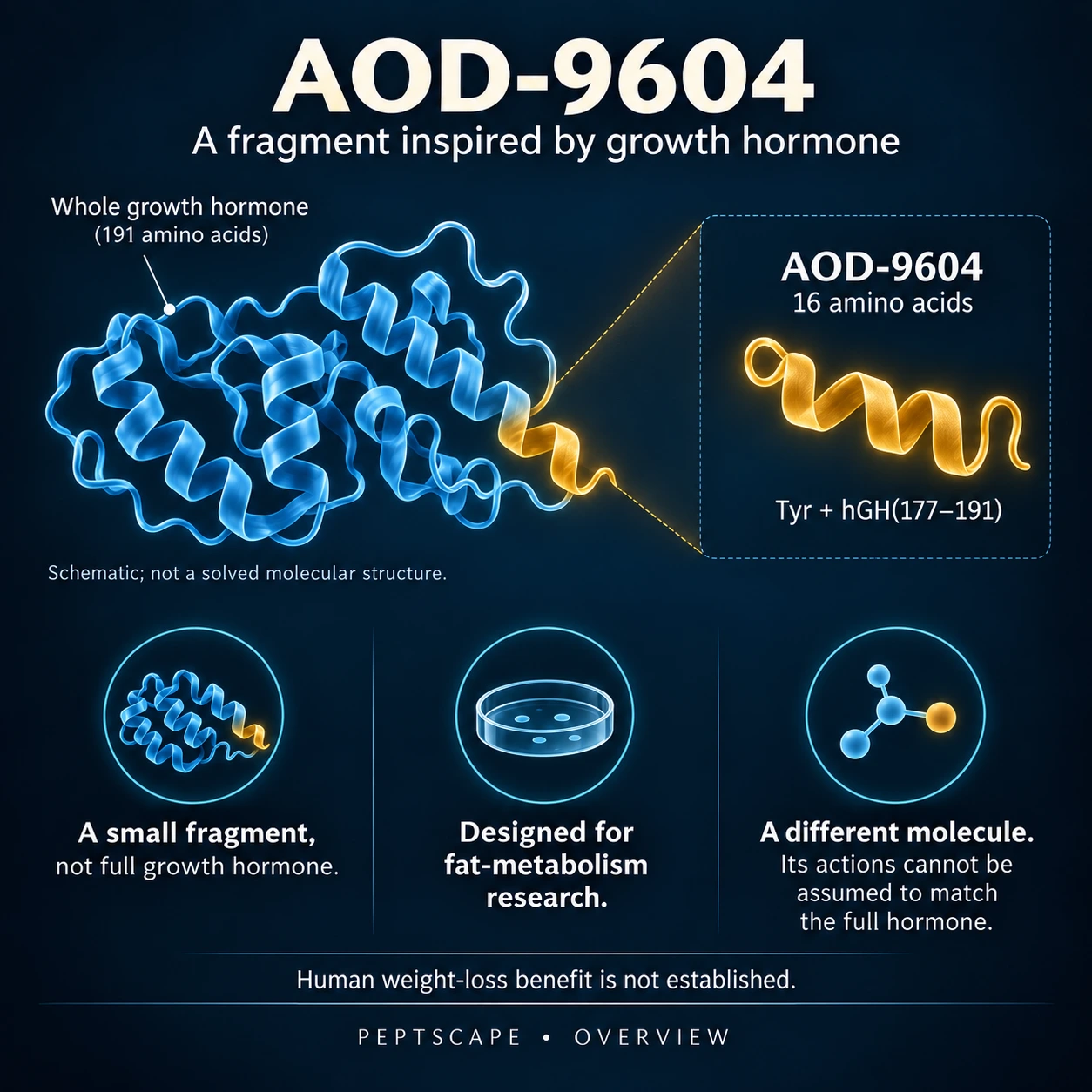
AOD-9604 is a modified fragment derived from the end of the growth hormone molecule. It was developed to investigate fat-metabolism effects separately from the broader growth-related actions of full-length growth hormone. Its main area of interest is body fat, rather than appetite suppression or stimulation of the pituitary.
A fragment contains only part of a larger molecule. That can change its action substantially. AOD-9604 is therefore not simply a small dose of growth hormone, and it is not a releasing peptide such as sermorelin or ipamorelin. Those peptides signal the body to release growth hormone; AOD-9604 was designed around a different idea.
What fat metabolism means
Fat tissue stores energy, largely in molecules called triglycerides. Lipolysis is the release of fatty acids from those stores. Fat oxidation is the use of fat as fuel. These are related but separate processes: making fuel available does not prove that the body uses more of it overall.
Lipogenesis refers to the formation of fat. AOD-9604's development rationale involved influencing the balance of fat storage and release. That rationale is not equivalent to demonstrated weight loss. Its development for obesity did not establish consistent, clinically useful weight reduction, and injectable use should not be presented as a proven solution to that limitation.
Why it differs from appetite peptides
Semaglutide and related treatments can make it easier to eat less by changing hunger and meal satisfaction. AOD-9604 was not designed around that same appetite mechanism. Lack of appetite suppression therefore does not tell someone whether AOD-9604 had a biological effect—but neither does it provide a reason to assume an unseen fat-loss benefit.
A clear description focuses on the actual proposal: affecting aspects of fat metabolism without reproducing all of growth hormone's actions. It should not turn that proposal into a promise of effortless or localised fat loss.
What it is used for
Experimental body-fat reduction
The main experimental use is reduction of body fat. That includes interest in areas that are difficult to change through weight loss alone. However, injecting near an area of fat does not establish selective loss from that area. Subcutaneous delivery is a route into the body, not a method of sculpting a particular fat depot.
Pinchable fat beneath the skin and visceral fat inside the abdomen are different compartments. A smaller waist can reflect changes in more than one factor, including bloating and total body weight. AOD-9604 should not be assigned the same visceral-fat effects as another peptide merely because both are discussed in relation to growth hormone.
Weight versus body composition
Weight includes fat, muscle, fluid and other tissues. A small short-term change does not identify which component changed. Body-composition estimates also have limitations and can vary with hydration and measurement conditions.
For this peptide, a claim of “fat loss without weight loss” still needs actual support; it cannot be assumed whenever the scale stays stable. The useful question is whether a meaningful change has been demonstrated, not whether a change could theoretically be hidden from one measurement.
Cartilage and joint-related interest
AOD-9604 also appears in experimental discussions of cartilage and joint repair. Cartilage is the specialised tissue that helps joint surfaces move smoothly and distribute load. Its structure and repair needs differ from fat tissue.
Interest in this area does not establish that AOD-9604 regrows worn cartilage or treats arthritis. Reduced discomfort and restored cartilage are different outcomes. A symptom change cannot substitute for an explanation of the underlying joint problem.
What it is not intended to replace
AOD-9604 is not growth hormone replacement, a muscle-building steroid or a nutritional substitute. Being derived from a hormone fragment does not make it a general treatment for fatigue, low strength or age-related concerns.
Its proposed narrower action is part of why it was developed, but narrower intended action does not mean that every safety question is settled. The actual preparation, route and exposure remain relevant, and they should be recorded separately from the desired fat-related outcome.
How it works
Selecting one part of a larger molecule
Full-length growth hormone has a complex structure and many downstream actions. Developing a fragment is an attempt to retain selected biological properties while changing others. Whether that succeeds must be assessed for the fragment itself; the parent hormone's reputation cannot answer the question.
Similarly named growth hormone fragments should not be assumed identical without confirming their sequence and modifications. A shared origin does not make two preparations interchangeable in activity or duration.
A metabolic signal is not a guaranteed result
A change in fatty-acid availability is a biochemical observation. Sustained fat reduction is a whole-body outcome influenced by intake, expenditure and other processes. A mechanism can provide a sensible reason to investigate a compound while still failing to produce a useful treatment effect.
This distinction is particularly important for AOD-9604. It allows the profile to explain the fat-metabolism idea clearly without treating the phrase “fat-burning fragment” as evidence of effectiveness.
Route does not rescue an unproven claim
Swallowed peptides encounter digestive barriers, while an injection bypasses those barriers. That difference does not establish that an injected version produces the desired clinical outcome. Better delivery and useful benefit are separate questions.
For the same reason, oral amounts cannot be converted into injectable instructions simply by assuming a percentage of absorption. The Practical section preserves route-specific context rather than treating different preparations as equivalent. The key educational point is straightforward: AOD-9604 is a fat-metabolism research peptide, not an established alternative to effective weight-management care.